
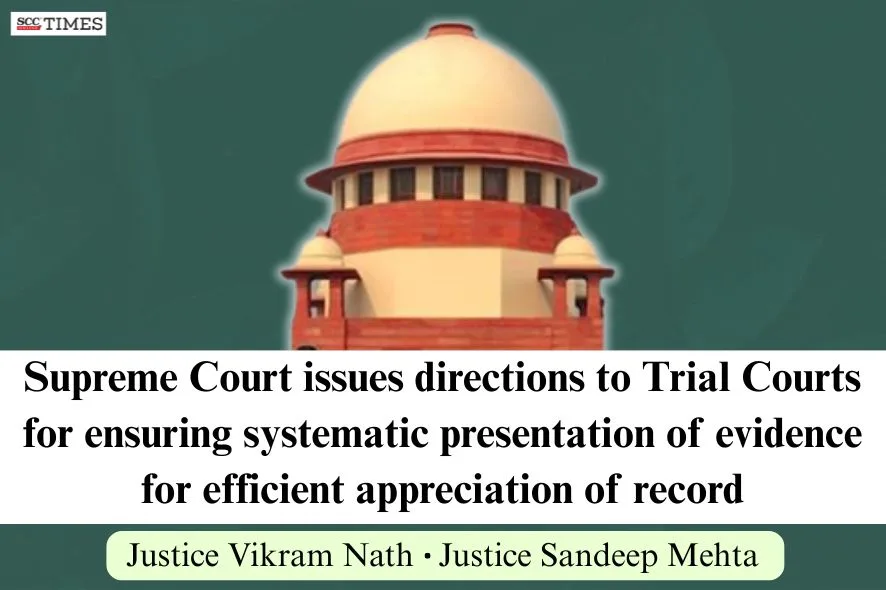
Supreme Court: While considering this matter revolving around sexual assault of a 4-year-old-girl (child victim) which was found to be “enveloped in layers of investigative apathy and procedural infirmities”, the Division Bench of Vikram Nath and Sandeep Mehta*, JJ., opined that a more structured and uniform practice must be adopted to enhance the legibility of criminal judgments. Accordingly, to ensure a systematic presentation of evidence that enables efficient appreciation of the record, the Court issued the following directions to all Trial Courts with the aim to institutionalize a standardized format for cataloguing witnesses, documentary evidence, and material objects, in order to facilitate better comprehension and immediate reference for all stakeholders, including the Appellate Courts:
Preparation of Tabulated Charts in all the judgments:
-
All trial Courts dealing with criminal matters shall, at the conclusion of the judgment, incorporate tabulated charts summarizing- a. Witnesses examined; b. Documents exhibited, and c. Material objects (muddamal) produced and exhibited.
-
These charts shall form an appendix or concluding segment of the judgment and shall be prepared in a clear, structured and easily comprehensible format
Standardized Chart of Witnesses
-
Each criminal judgment shall contain a witness chart with at least these columns- a. Serial Number; b. Name of the Witness c. Brief Description/Role of the Witness, such as: Informant, Eyewitness, Medical Jurist/Doctor, Investigating Officer (I.O.), Panch Witness, etc.
-
The description should be succinct but sufficient to indicate the evidentiary character of the witness. This structured presentation will allow quick reference to the nature of testimony, assist in locating the witness in the record and minimize ambiguity.
-
The judgment featured a Specimen Chart for Witnesses Examined for reference.
Standardized Chart of Exhibited Documents
-
A separate chart shall be prepared for all documents exhibited during trial. This chart shall include- a. Exhibit Number; b. Description of document; c. The Witness who proved or attested the document.
-
Illustratively, the description may include: FIR, complaint, panchnamas, medical certificates, FSL reports, seizure memos, site plans, dying declarations, etc.
-
The requirement of specifying the witness who proved the document ensures traceability of proof and assist the Court in appreciating compliance with the Evidence Act, 1872/Bharatiya Sakshya Adhiniyam, 2023.
-
The Judgment also attached a Specimen Chart for Exhibited Documents for reference.
Standardized Chart of Material Objects/Muddamals
-
Whenever material objects are produced and marked as exhibits, the trial Court shall prepare a third chart with- a. Material Object (M.O.) Number; b. Description of the Object; c. Witness who proved the Object’s Relevance (e.g., weapon, clothing, tool, article seized under panchnama, etc.)
-
This enables clarity regarding the physical evidence relied upon.
-
The judgment attached a Specimen Chart for Material Objects/Muddamals
Special Provisions for Cases Involving Voluminous Evidence
-
In complex cases, such as conspiracies, economic offences or trials involving voluminous oral or documentary evidence, the list of witnesses and exhibits may be substantially long. Where the number of witnesses or documents is unusually large, the trial Court may prepare charts only for the material, relevant, and relied-upon witnesses and documents, clearly indicating that the chart is confined to such items. This ensures that the charts remain functional reference tools rather than unwieldy compilations.
Application to Defence Witnesses and Evidence
-
The aforesaid directions shall apply, mutatis mutandis, to all witnesses examined and all evidence adduced by the defence.
Adoption of Specimen Format and Permissible Deviations
-
The specimen charts provided in the judgment shall ordinarily serve as the standard format to be followed by trial Courts across the country.
Observations Regarding Applicability to Civil Proceedings
-
While these directions are primarily intended to streamline criminal trials, we leave it open to the High Courts to consider, wherever appropriate, the adoption of similar tabulated formats in civil matters as well, particularly in cases involving voluminous documentary or oral evidence, so as to promote clarity, uniformity, and ease of reference.
The Court further stated that the High Courts may consider incorporating the above directions in their respective rules governing the procedure of trial Courts.
Background:
The appellant was arraigned as an accused in connection with FIR registered at Kalol Police Station for the offences punishable under Sections 363, 376(2)(i) and 201 of the Penal Code, 1860 and Sections 3 and 4 of the Protection of Children from Sexual Offences Act, 2012 for alleged sexual assault of the child victim.
The appellant was subjected to trial before the learned Additional Sessions and Special Judge, Panchmahal, Godhra and he was convicted and sentenced thusly. The appellant’s challenge to the Trial Court’s verdict was rejected by Gujarat High Court. Hence, the present appeal was preferred before the Supreme Court.
Court’s Assessment:
Perusing the appeal, the Court firstly pointed out that there was no direct evidence in the present case, and the case of the prosecution rested entirely on circumstantial evidence, to be specific, in form of last seen together circumstance, incriminating recoveries and medical evidence.
Elucidating the principles on evaluating circumstantial evidence, the Court pointed out that evidence of the witnesses in the present case was absolutely unconvincing and that they seem to have cooked up the last seen together theory so as to somehow implicate the appellant in the case for oblique motives. The Court opined that entire story felt dubitable and there existed grave doubts regarding the identity of the witnesses and the credibility of their evidence. The Court further pointed out that omission of material facts in the FIR brought the entire case of the prosecution under a grave cloud of doubt. The Court also highlighted the flawed approach towards appreciating the evidence as adopted by the Trial Court and High Court. It was pointed out that neither the Trial Court nor the High Court, adverted to the glaring shortcomings in the case and mechanically accepted the case of prosecution even though the conduct of the material witnesses was sufficient to raise a strong suspicion that they might have been the actual perpetrators of the crime.
The Court found that the conduct of the police officers who conducted the investigation of the case was highly pedantic and gravely negligent. The Court noted that the investigation was casually proceeded with. The so-called witnesses of last seen together circumstance, namely, somehow popped up and presented themselves before the Investigating Officer on the next day of the incident. The police officers casually proceeded to the house of the appellant. The incriminating material viz. blood stain clothes, bedsheet, curtain, etc. were lying scattered in the house as if to serve the incriminating evidence to the Investigating Officer on a platter.
The Court sternly stated that the Investigating Officer had ample opportunity to secure and preserve crucial forensic material, particularly by securing samples necessary for conducting DNA profiling of the child victim and the appellant. “Such scientific examination, now an integral component of modern criminal investigation, would have provided objective corroboration and materially assisted in ascertaining the truth”. However, no effort was made to obtain or preserve such forensic material and other incriminating materials.
Therefore, the Court opined that the prosecution case was clearly missing the key component of an unbroken chain of incriminating circumstances to convict the appellant on the basis of last seen together circumstance.
Therefore, with the afore-stated assessment, the Court allowed the appeal and acquitted the appellant of the charges with directions to be released and the afore-stated directions for systematic presentation of evidence.
[Manojbhai Jethabhai Parmar v. State of Gujarat, 2025 SCC OnLine SC 2803, decided on 15-12-2025]
*Judgment by Justice Sandeep Mehta
Advocates who appeared in this case:
For Appellant(s): Mr. Vijay Kumar, AOR Ms. Vidushi Garg, Adv.
For Respondent(s): Ms. Swati Ghildiyal, AOR Mr. Rishi Yadav, Adv
Buy Penal Code, 1860 HERE

Buy Protection of Children from Sexual Offences Act, 2012 HERE