
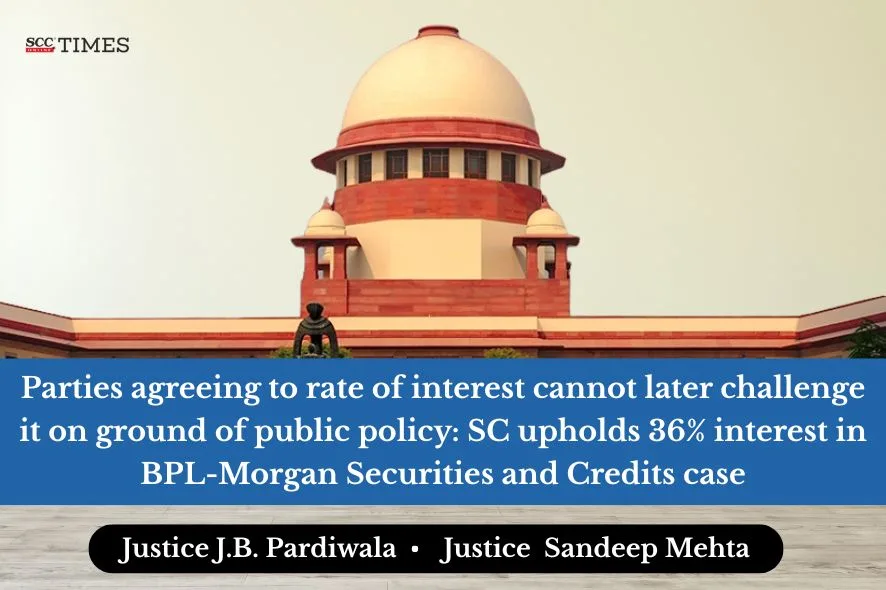
Supreme Court: The appeal arose from the Delhi High Court’s judgment dated 18-11-2024, which dismissed BPL Ltd.’s challenge to an arbitral award. The award had directed BPL Ltd. to pay Rs. 7,27,05,579 and Rs. 20,62,28,681 with 36% interest until the award date and 10% thereafter until realization. The Division Bench of J.B. Pardiwala* and Sandeep Mehta, JJ., stated that once the parties by mutual consent, agreed to a particular rate of interest and the same is included in the terms of the contract, there is no escape thereafter. The party concerned would be bound by the rate of interest as prescribed in the agreement. Thus, the borrower after availing the finance cannot turn around and question the rate on the ground of being unconscionable or opposed to public policy.
The Court in BPL-Morgan Securities case, Court stated that the Arbitral Tribunal and the High Court rightly returned a finding that the transaction between the parties was neither a loan nor a debt, rather it was simply in the nature of a commercial transaction. It was rightly held that since the compounding of interest was provided in the mutually agreed terms of the contract, Morgan Securities and Credits Private Ltd. (‘Morgan Securities’) was entitled to claim interest as per the terms of the contract, i.e., at the rate of 36% p.a. with monthly rest.
Background
BPL Display Device Ltd. (‘BDDL’) had sold certain goods to BPL Ltd. over a period of time. As there arose some issues of timely payments, the buyer and seller companies, together approached Morgan Securities for extending a Bill Discounting facility to BDDL, to which Morgan Securities agreed. Accordingly, the Bill Discounting facility was sanctioned by Morgan Securities vide letters dated 27-12-2002 (to the extent of Rs. 6 crores) and 11-6-2003 (to the extent of Rs. 6.5 crores).
However, dispute between the parties arose, when a sum of Rs.25,79,91,096 against particular Bills of Exchange became due and payable to Morgan Securities by BPL and BDDL in 2004, which amount they defaulted in repaying despite several reminders on behalf of Morgan Securities. Despite the assurances, BPL Ltd. and BDDL failed to repay the amounts due with interest. Thus, Morgan Securities invoked arbitration, against BPL Ltd. and BDDL.
The Arbitrator vide impugned award, directed BPL Ltd. to pay a sum of Rs. 7,27,05,579 as well as Rs. 20,62,28,681 with interest @ 36% per annum from the date these amounts were due till the date of the Award, and @10% per annum from the date of the Award till realization. Subsequently, the parties approached the High Court, whereby the High Court dismissed the appeal.
Analysis, Law, and Decision in BPL-Morgan Securities and Credits Case
The present case revolved around clause 4 of the agreement, which provides for bill discounting facility, and more particularly, the rate of interest specified therein. Thus, it is required to understand the basic difference between a business loan and bill discounting.
a. Difference between bill discounting and business loan
The Court stated a bill discounting facility is a short-term financing option where a business sells its unpaid invoices to a financial institution for immediate cash, while a business loan is a traditional debt obligation where the business receives a lump sum and is responsible for repaying it with interest. The Court stated that considering the distinction between the two, the High Court did well to stated that the provisions of Usurious Loans Act, 1918 would not be applicable in the present case. Since, the present litigation was one relating to the bill discounting facility and not a loan.
b. Section 31(7)(a) and Section 31(7)(b) of the Arbitration and Conciliation Act, 1996 (‘Arbitration Act’)
The Court stated that the discretion to grant interest would be available to the arbitral tribunal under Section 31(7)(a) of the Arbitration Act, only when there is no agreement to the contrary between the parties. When the parties agree with regard to any of the aspects covered Section 31(7)(a) of the Arbitration Act, the arbitral tribunal would cease to have any discretion with regard to the aspects mentioned in the said provision. Only in the absence of such an agreement, the arbitral tribunal would have the discretion to exercise its powers under clause (a) of sub-section (7) of Section 31 of the Act, 1996.
c. Is Penal Interest on Penal Interest Opposed to Public Policy?
The Court stated that the language of Section 31(7)(a) of the Arbitration Act is plain and simple. Once the parties by mutual consent, agreed to a particular rate of interest and the same is included in the terms of the contract, there is no escape thereafter. The party concerned would be bound by the rate of interest as prescribed in the agreement. Thus, the rate of interest once agreed and forms part of a written contract, the borrower after availing the finance cannot turn around and question the rate on the ground of being unconscionable or opposed to public policy.
The Court stated that in the present case, the agreement was entered between the parties who were well versed with the law and had the advantage of legal assistance before drafting and entering into the agreement. Thus, the clause 4 of the agreement, ought to be interpreted in such a way so as to save the clause rather than to render it invalid on the ground of being opposed to public policy.
It is well settled that a contract is a commercial document between the parties, and it must be interpreted in a manner so as to give efficacy to the contract rather than to invalidate it in the name of public policy, unconscionability etc. The Court stated that it is also well settled that the terms of the contract executed between parties, are not open to judicial scrutiny unless the same is arbitrary, discriminatory, mala fide or actuated by bias.
The Court stated that in the present case, BPL Ltd. needed finance and knowingly entered into the bill discounting facility agreement. If BPL Ltd. abided by the terms and conditions of repayment, it could have availed facility of concessional rate, but, BPL Ltd. declined to make the payment for years. In such circumstances, the conditions stipulated in the agreement of compound interest at the rate of 36% monthly rest cannot be termed as burdensome or oppressive in any manner.
d. Maxim ‘Verba Chartarum Fortius Accipiuntur Contra Proferentem’ — whether applicable?
The principle of contra proferentem is etymologically traceable to the maxim “verba chartarum fortius accipiuntur contra proferentem”, which means the words of deeds are to be taken most strongly against who uses them. Thus, the rule of contra proferentem protects the insured from the vagaries of an unfavourable interpretation of an ambiguous term to which it did not agree. The Court stated that the contra proferentem principle does not merit applicability in case of commercial contracts, because a clause in a commercial contract is bilateral and has mutually been agreed upon as held in a number of judgments, including Rashtriya Ispat Nigam Ltd. v. Dewan Chand Ram Saran, (2012) 5 SCC 306.
The Court stated that the true construction of a commercial contract must depend upon the import of the words used and not upon what the parties choose to say afterwards. The intention of the parties must be ascertained from the language they have used, considered in the light of the surrounding circumstances and the object of the contract. The nature and purpose of the contract is an important guide in ascertaining the intention of the parties.
The Court stated that once there is an agreement between the parties which provides that interest shall be at a particular rate, the arbitral tribunal is left with no discretion. The maxim “verba chartarum fortius accipiuntur contra proferentem’’ has no application to the present case. This principle would not apply in case of commercial contracts for the simple reason that a clause in a commercial contract is bilateral and has mutually been agreed upon.
e. Application of Section 74 of Contract Act, 1872 vis-a-vis Section 31(7)(A) of the Arbitration Act, 1996
The Court stated that where in a contract under which interest is payable, it is agreed between the parties that if such interest be not paid punctually the defaulter shall be liable to pay interest at an enhanced rate, such agreement does not come within Section 74 of the Contract Act, and is to be construed according to the intentions of the parties as expressed therein and not as a stipulation for a penalty. Such agreement is to be enforced according to its terms, unless it be found to have been when made unconscionable or fraudulent.
Conclusion
The Court stated that the Arbitral Tribunal and the High Court rightly returned a finding that the transaction between the parties was neither a loan nor a debt, rather it was simply in the nature of a commercial transaction. It was rightly held that since the compounding of interest on monthly rest was provided in the mutually agreed terms of the contract entered between the parties, Morgan Securities was entitled to claim interest as per the terms of the contract, i.e., at the rate of 36% p.a. with monthly rest.
The Court stated that the express use of “unless otherwise agreed by the Parties……” as the opening words of Section 31(7)(a) of the Arbitration Act, is a clear instance of ‘Party Autonomy’ which forms the bedrock of the arbitral process and will prevail in all cases, except where the legal provision is strictly non-derogable in nature e.g. the bar of limitation. The principle of unconscionability is inapplicable to voluntary commercial agreements between parties of equal bargaining strength.
[BPL Ltd. v. Morgan Securities and Credits (P) Ltd., 2025 SCC OnLine SC 2640, decided on 4-12-2025]
*Judgment authored by- Justice J.B. Pardiwala
Advocates who appeared in this case:
For Appellant: Gopal Subramanium, Sr. Adv. ; Pinaki Mishra, Sr. Adv. ; Ashok Panigrahi, Sr. Adv. ; Manu Nair, Adv. ; Arjun Perikal, Adv. ; Neelabh Shreesh, Adv. ; Pavan Bhushan, Adv. ; Jayavardhan Singh, Adv. ; R. Chandrachud, Adv. ; Gauri Subramanium, Adv. ; Shashank Jwalakumar, Adv. ; Aishwarya Prasad, Adv. ; Aryan Roy, Adv. ; Samridhi Shukla, Adv. ; Siddhant Juyal, Adv. ; Ankit Malhotra, Adv. ; Surajit Bhaduri, Adv. ; J.s. George, Adv. ; Pranav Diesh, Adv. ; Dharmendar Singh, Adv. ; Anmol Tayal, Adv. ; S. S. Shroff, AOR
For Respondent: Aruna Gupta, AOR; Simran Mehta, Adv.; Ramesh Allanki, Adv.
Buy Arbitration and Conciliation Act, 1996 HERE