The fundamental rights to privacy and dignity, guaranteed under Article 21 of the Constitution, have been linked to “personality” or “publicity” rights by the judiciary.
The word “Jhakaas” immediately makes you recall Anil Kapoor. Outstretched hands in a mustard field with multiple hues of sunlight in the background evoke the king of bollywood, Shah Rukh Khan. This takes us to an important legal concept — the persona of a celebrity and the immense value attached to it. The persona is an amalgamation of multiple characteristics and has huge commercial value. With the advent of multiple social media platforms like YouTube and Instagram and rapid digitalisation, it is becoming increasingly difficult to protect these personas and their inherent attributes as intellectual property or personality. The newly emerging menace of deepfakes and voice cloning due to proliferation of artificial intelligence (AI) has made protection of personality rights a necessity. There is a vital requirement to address this evolving concept to safeguard individual dignity, protect against commercial fraud, and remedy the legal gaps in current legislation.
The legislative vacuum and the constitutional bridge
Indian intellectual property statutes do not have a specific description for “celebrity” or “personality rights”. The Copyright Act, 1957, includes the term “performer”1 and grants “special rights” under Section 38. However, the definition of “performer” (which includes actors, singers, and musicians)2 is not comprehensive and does not completely cover the concept of a celebrity, a person under massive public limelight. A celebrity is not necessarily is a “performer”, and vice versa.
Indian judiciary has had to intervene to fill this legislative void. The “personality” of an individual, a composite package of characteristics including name, voice, image, likeness, mannerisms, and gestures,3 has been given judicial protection. The fundamental rights to privacy and dignity, guaranteed under Article 21 of the Constitution, have been linked to “personality” or “publicity” rights by the judiciary.4 This safeguard provided by courts whereby celebrities could safely commercialise and control use of identity is under threat today. Recently, celebrities like Jackie Shroff and Ravi Shankar v. John Doe(s)/Ashok Kumar(s)5 had to take action in order to protect their identities from AI-driven exploitation. This is a testament to the critical nature of this judicial armour.
The evolution of Indian jurisprudence
Personality rights and protection attached with it are a result of judicial innovation over the last 30 years and are not statutory in nature. There are several landmark judgments in this judicial journey. Foremost is the Supreme Court’s ruling in R. Rajagopal v. State of T.N.6 (the Auto Shankar case) which established the groundwork for personality rights. An individual’s right to control the commercial use of their identity was declared as part of the fundamental right to privacy under Article 21, upholding the “right to be let alone” against unlicensed misuse. In ICC Development (International) Ltd. v. Arvee Enterprises7, the Delhi High Court explained that the right of publicity derives from the right to privacy and inheres only in individuals, not in corporations or events. It proscribed the commercial monopolisation of a person’s characteristics without agreement. A clear definition was provided by the Delhi High Court, in Titan Industries Ltd. v. Ramkumar Jewellers8, the right of publicity is “the right to control commercial use of human identity”. The Madras High Court in Shivaji Rao Gaikwad v. Varsha Productions9 said that once a person becomes a celebrity, any unlawful use of their persona is illegal, regardless of whether it causes public confusion. The Delhi High Court’s decision in Anil Kapoor v. Simply Life India10 broadened the canvas of protection in a singularly significant judgment. It went beyond name and resemblance to protect distinguishing elements of a celebrity’s persona, including voice, gestures, and catchphrases. The Court made a pivotal point that fame exposes individuals to misuse that can violate their right to livelihood, dignity, and privacy.
The modern enforcement toolkit
A practical toolkit exists for enforcement beyond the constitutional framework. The Trade Mark Act, 1999, permits the registration of names, signatures, and catchphrases. Additionally, the common law action of “passing off” protects a person’s goodwill from false endorsements.11 Penalties for online identity misuse and morphing are provided in the Information Technology Act, 2000.
Last couple of years has seen the evolution of the “John Doe/Ashok Kumar Order” as the most critical judicial tool for combating unspecified online infringement. Ex parte interim injunctions are issued against unidentified infringers (John Doe(s)/Ashok Kumar) which allows a crucial exemption to the typical procedural requirement of a named defendant. This enables courts to grant rapid, pre-emptive relief against fast-moving violations like film piracy, image misappropriation, and AI-driven impersonation.
A string of 2025 rulings support this trend. The Delhi High Court granted extensive injunctions protecting Abhishek Bachchan v. Bollywood Tee Shop12 from fake AI videos. Likewise, in Karan Johar v. India Pride Advisory (P) Ltd.13, Akkineni Nagarjuna v. WWW.BFXXX.ORG14 and Ravi Shankar case15 secured protection from deepfakes and misleading endorsements. Asha Bhosle was provided protection from AI-driven replication of her distinctive voice by the Bombay High Court. Recently, Sunil Shetty secured relief from the Bombay High Court, which16 explicitly recognised his personality rights under Article 21 of the Constitution of India, and moral rights under the Copyright Act, and ordered removal of infringing AI-generated content.
A comparative law perspective
Globally most prominent legal frameworks for protection of personality rights exist in the USA and Europe. Personality rights of celebrities have been a long developing concept in the USA. Judicial verdicts have built a legal framework that treats a celebrity’s identity as a “right of publicity”. This allows famous people to legally control, licence, or even sell the rights to their own name, image, and likeness, similar to any other asset. Certain US States allow this right to be passed down to the heirs of a deceased celebrity as part of their estate. There is no overarching, nationwide rule for these rights. Different States have a wide ambit and sometimes conflicting ideas about the exact nature of this right and how far its protection should go.17
Majority of continental European law recognises a “right of personality” or a “right of privacy”. In simple terms an individual’s name and likeness (their image) are protected. This also extends protection to other parts of an individual’s identity, even if they are not specifically listed in the law books. But the key fact is that these traditional rights are seen as deeply personal. The major aim is to protect people from having their private lives attacked, being maligned, or simply having their feelings wounded. The focus is on protecting personal feelings and not a commercial asset. These rights are completely tied to an individual as a person. As a general rule, you cannot sell them or pass them down in a will. Over a period of time, some European countries have started to recognise that a person’s identity also has a commercial value and that, this too, needs to be protected.18
Conclusion
In absence of a dedicated legislative framework, the Indian judiciary has nimbly created a formidable doctrine of personality rights. The courts have anchored this right in the Constitution and provided a supple and powerful instrument for celebrities to protect their persona. Recent court judgments allowing “John Doe” orders against amorphous digital threats demonstrate their adaptability towards rapidly evolving technological threats to personality rights including AI deepfakes and voice cloning. These rulings indicate a new phase where the “digital likeness” of a celebrity is treated as a proprietary right, deserving of fast and robust protection.
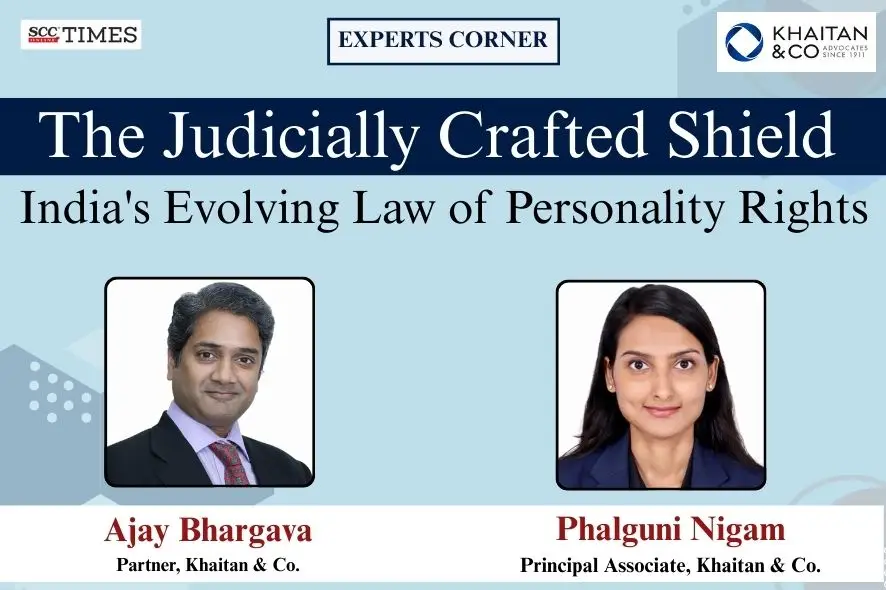
*Partner, Khaitan & Co.
**Principal Associate, Khaitan & Co.
1. Copyright Act, 1957, S. 2(qq).
2. Copyright Act, 1957, S. 38.
3. Jaikishan Kakubhai Saraf v. Peppy Store, (2024) 2 HCC (Del) 253.
4. R. Rajagopal v. State of T.N., (1994) 6 SCC 632.
11. Copyright Act, 1957, S. 27.
15. Ravi Shankar v. John Doe(s)/Ashok Kumar(s), 2025 SCC OnLine Del 6332.
16. Suniel V. Shetty v. John Doe S. Ashok Kumar, I.A No. 32198 of 2025, decided on: 10-10-2025.
17. Kateryna Moskalenko, “The Right of Publicity in the USA, the EU, and Ukraine”, (2015) 1(2) Int’l. Comparative Juris.
18. Anna E. Helling, “Protection of ‘Persona’ in the EU and in the US: A Comparative Analysis” (2005) LLM Theses and Essays 45, available at <https://digitalcommons.law.uga.edu/stu_llm/45>.