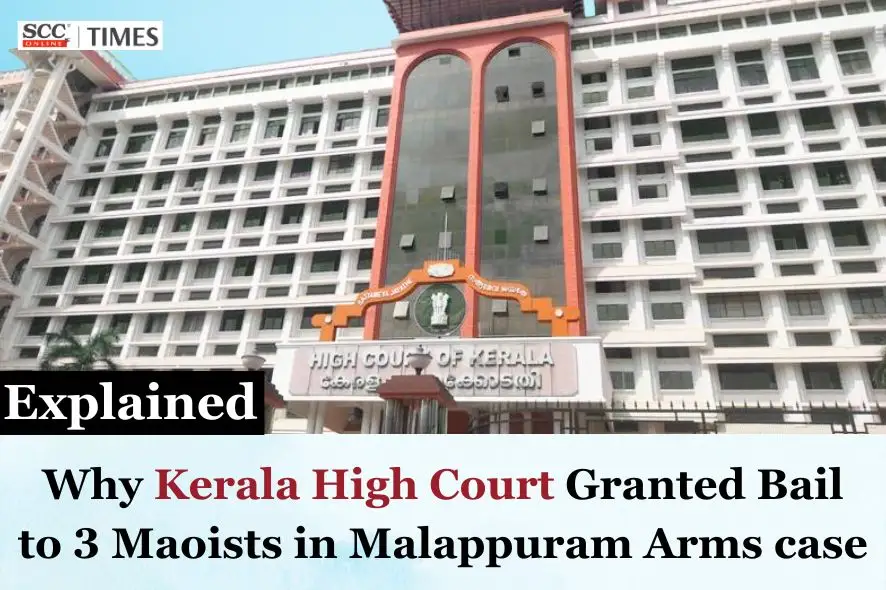
Kerala High Court: In a criminal appeal arising from an order refusing bail in Malappuram Arms case, the Division Bench of Gopinath P.* and P.M. Manoj, JJ., examined whether continued detention of undertrial accused was justified despite prolonged custody and grant of bail to similarly situated co-accused. The Court held that long incarceration as undertrial prisoners, coupled with parity considerations with co-accused, entitled the accused persons to be released on bail. Accordingly, the appeal was allowed, and the impugned order of the Special Court was set aside, granting bail to 3 Maoists.
Also Read: SC: Calcutta HC to decide applicability of UAPA in Beldanga violence
Background
The appellants were arraigned as accused in a sessions case pending before the Special Court for trial of NIA cases. They faced charges under Sections 120-B, 121, 121-A and 122, Penal Code, 1860 (IPC), Section 27(1)(e)(iv), Kerala Forest Act, 1961, Section 7 read with Section 27(2), Arms Act, 1959, and Sections 18, 18-A, 20, 38 and 39, Unlawful Activities (Prevention) Act, 1967 (UAPA). The allegations against them were that they, along with other accused persons, had entered into the deep forest areas at Nilambur and underwent arms training. Their counsel contended that they had been in judicial custody since 2020 and 2021, and the Court had already granted bail to the other accused persons who were facing the same charges. On the principle of parity and prolonged detention, release on bail was sought.
The respondent opposed the appeal, contending that bail was granted to the co-accused on account of delay in starting trial, whereas the present trial was ongoing, with 94 out of 287 witnesses already examined, and was likely to be completed by June 2026. It was further submitted that the offences alleged against them were serious in nature, and they could even be sentenced to imprisonment for life if the charges were proved, and that the appellants were not residents of Kerala, raising a chance of absconding if they were released on bail.
Also Read: SC on pending cases under UAPA that pose reverse burden of proof
Analysis and Decision
The Court opined that the long period of incarceration undergone by the appellants as undertrial prisoners was a crucial factor to bet taken into consideration. The Court noted that bail had already been granted to co-accused and adequate and stringent conditions were imposed on them to secure their presence during trial. The Court observed that the accused persons could also be released subject to the same conditions.
Consequently, the Court allowed the appeal and set aside the impugned order. The Court directed that the accused persons must be released on bail subject to strict conditions, including residence within the Ernakulam District, regular appearance before the investigating officer, using only one mobile number during the bail period which must not be discarded or switched off, non-tampering with evidence, among others, with liberty to the prosecution to seek cancellation of bail in the event of breach of any of the conditions.
[Rajan C.G v. Union of India, 2026 SCC OnLine Ker 4395, decided on 21-4-2026]
*Judgment authored by: Justice Gopinath P.
Advocates who appeared in this case:
For the Accused: Shaiq Rasal M., Abdul Khader Kunju S., Advocates.
For the Respondent: O.M. Shalina, Deputy Solicitor General of India, Alka Warriar, CGC.
Buy Penal Code, 1860 HERE