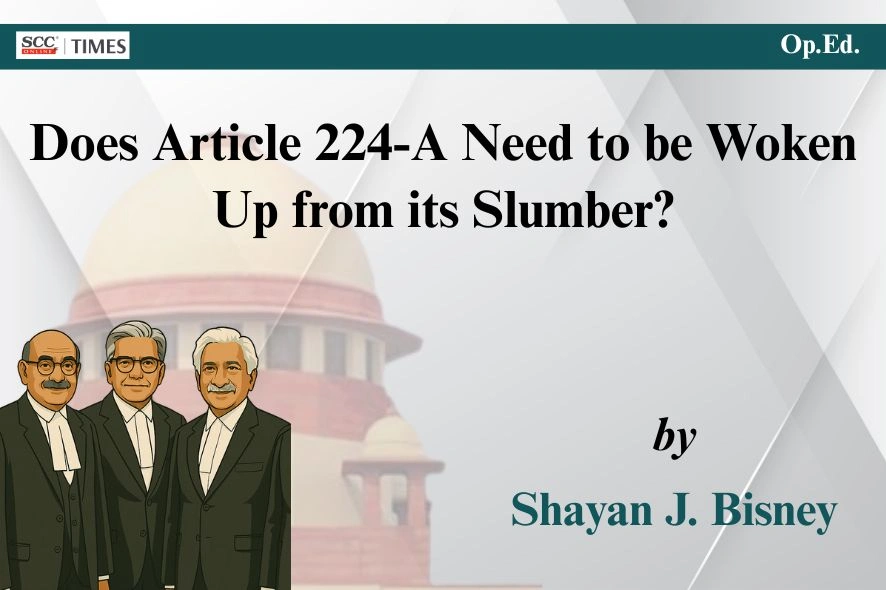
The Collegium has taken a unique route this time which, though available as a provision in the Constitution of India, is rarely evoked — to appoint ad hoc Judges to a High Court under Article 224-A.
The Supreme Court of India in its Collegium meeting dated 3 February 2026 approved the proposal of appointment of five-Judges as ad hoc Judges to the High Court of Judicature at Allahabad under Article 224-A of the Constitution of India.
Article 224-A reads as under:
1[224-A. Appointment of retired Judges at sittings of High Courts.—Notwithstanding anything in this Chapter,2 (the National Judicial Appointments Commission on a reference made to it by the Chief Justice of a High Court for any State, may with the previous consent of the President), request any person who has held the office of a Judge of that Court or of any other High Court to sit and act as a Judge of the High Court for that State, and every such person so requested shall, while so sitting and acting, be entitled to such allowances as the President may by order determine and have all the jurisdiction, powers and privileges of, but shall not otherwise be deemed to be, a Judge of that High Court:
Provided that nothing in this article shall be deemed to require any such person as aforesaid to sit and act as a Judge of that High Court unless he consents so to do.]
The Collegium has taken a unique route this time which, though available as a provision in the Constitution of India, is rarely evoked — to appoint ad hoc Judges to a High Court under Article 224-A. Article 224-A was inserted in the Constitution of India by the 15th Constitutional Amendment dated 5 October 1963. This Constitutional Amendment also raised the age of retirement of Judges of the High Court from 60 to 62 years.
The reason I say that the route taken by the Collegium is a road less travelled by the Collegium is because there have not been many instances of appointing ad hoc Judges to High Courts since Article 224-A was inserted in 1963. Three instances of the use of Article 224-A can be recalled. Justice Suraj Bhan was appointed as an ad hoc Judge in 1972 for one year. Justice P. Venugopal was appointed as an ad hoc Judge in 1982 for a year and subsequently renewed for another year. The last known instance of invoking Article 224-A was in 2007 to appoint Justice O.P. Srivastava to the Allahabad High Court to hear the Ayodhya case.
There are several positives to invoke Article 224-A.
The first would be to reduce the ever-increasing volume of pendency of cases. Ad hoc Judges are appointed to work on a war footing to clear ongoing cases and reduce the burden of sitting High Court Judges. For instance, in criminal matters concerning dowry harassment where almost all members of the family are made parties to the first information report (FIR), the regular practice is for them to approach the High Court to not only quash their names from the FIR but also seek in their prayer to dispense with their appearance at the police station where the FIR is filed. Such matters can be dealt with by ad hoc Judges who would reduce the burden of Judges of that High Court by great length as the volume of such cases in each High Court is very high.
The second positive from this is to reduce vacancy of Judges in High Courts. Most High Courts in the country perform with high number of vacancies, some even functioning at 50 per cent of their sanctioned Bench strength. This puts a huge burden on Judges of that High Court and matters which do not need much deliberation to pass orders can be assigned to ad hoc Judges. This will not only reduce the burden of Judges of that High Court but also increase their efficiency in their working.
A third positive would be that a Judge who retired and commanded great respect of the Bar and the Bench coming back to the Bench would be a huge boost not only for the Bar and Bench but for also for the litigants. His reputation and work ethic would precede him bringing back confidence of the citizens in the judiciary of the State.
A fourth positive would be for an ad hoc Judge to groom newly appointed Judges to the High Court. It is often said that the first Judge, a newly appointed Judge sits with shapes the way he performs as a Judge. By having an ad hoc Judge sharing his knowledge, expertise and most importantly experience with newly appointed Judges, the functioning and efficiency of the High Court is highly likely to improve.
It is important that the Collegium of the Supreme Court of India take into confidence Chief Justices of all High Courts to identify such Judges in each High Court. It is no secret that the judiciary is extremely overburdened and Article 224-A could most certainly help reduce the burden of the already overburdened judiciary.
The single most important factor to appoint an ad hoc Judge should be to make sure his experience, merit and knowledge of the law help dispose matter in a time-bound manner. Justice must not only be done but seen to be done. Article 224-A was inserted way back in 1963. In 2026, we are 63 years from its insertion and the instances of its use can be counted on one hand.
Article 224-A has been woken up from its slumber. One can only hope it does not go back to where it was and should be used for the better administration of justice. It would only be appropriate if more ad hoc Judges are appointed to High Courts to bring back the trust of the citizenry of India in the judiciary. If the citizenry of India does fully lose faith in their judicial system, heavens will truly fall and under no circumstance could we as a nation let that happen.
*Advocate, High Court, State of Telangana. Author can be reached at: shayanbisney@gmail.com.
1. Ins. by the Constitution (15th Amendment) Act, 1963, S. 7 (w.e.f. 5-10-1963).
2. Subs. by the Constitution (99th Amendment) Act, 2014, S. 9 (w.e.f. 13-4-2015). Prior to substitution it read as:
“the Chief Justice of a High Court for any State may at any time, with the previous consent of the President”. Portion in italics held to be unconstitutional in Supreme Court Advocates-on-Record Assn. v. Union of India, (2016) 5 SCC 1.