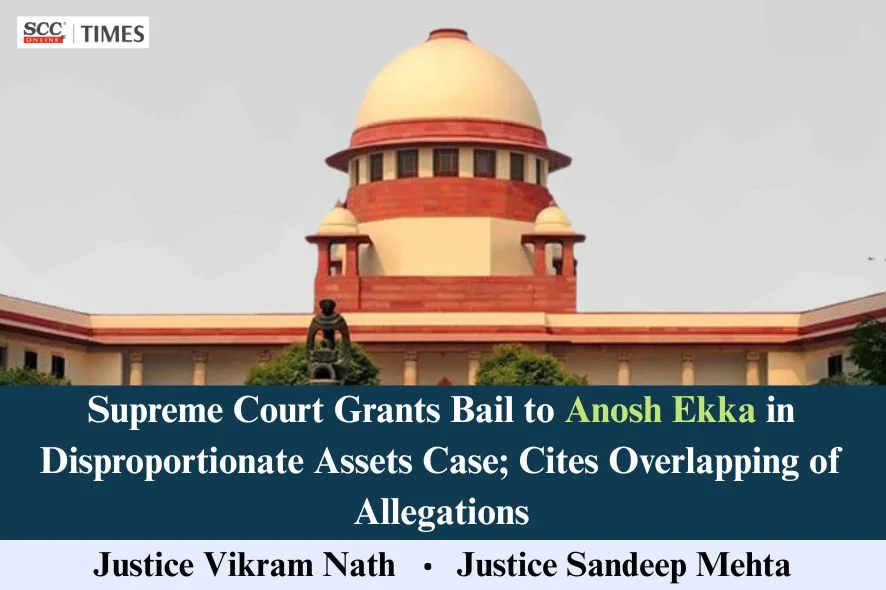
Supreme Court: In a criminal appeal concerning suspension of sentence of ex- Jharkhand Minister in disproportionate assets case, a Division Bench of Vikram Nath and Sandeep Mehta, JJ., allowed the appeal and set aside the High Court’s order refusing bail. The Court held that where two split charge-sheets arising from the same FIR led to overlapping allegations, and the sentence in a connected case had already been suspended, the appellant was entitled to similar relief.
Emphasizing the period of custody already undergone and the pendency of appeal, the Court directed release of the appellant on bail subject to conditions, while leaving the issue of maintainability of parallel prosecutions to be decided by the High Court.
Background
An FIR was registered in 2008 alleging that the appellant, a former Minister in Jharkhand, had amassed assets disproportionate to his known sources of income. Pursuant to directions of the High Court in 2010, the investigation was transferred to the CBI. It was alleged that the appellant accumulated assets worth about Rs 57.01 crores against pre-check assets of Rs 10.48 lakhs, and illegally acquired tribal lands in violation of the Chota Nagpur Tenancy Act, 1908, in the name of his wife using false documents and in connivance with public officials. He was also accused of floating construction firms in his wife’s name, securing their registration as contractors despite ineligibility, and awarding them government contracts from departments under his control.
The CBI initially filed a charge-sheet in 2012, leading to the appellant’s conviction in one case, against which his appeal is pending and sentence stands suspended pursuant to this Court’s order dated 28 April 2023. Subsequently, a second charge-sheet was filed, resulting in his conviction on 29 August 2025 with a sentence of seven years’ rigorous imprisonment under the Prevention of Corruption Act, 1988 and two years under the Penal Code, 1860 (IPC).
The appellant’s appeal against the said conviction is pending before the High Court, and his application for suspension of sentence having been rejected on 18 December 2025, he approached this Court by way of the present appeal.
Analysis
The Court, upon giving its thoughtful consideration to the submissions advanced and perusing the material on record, observed that two split charge-sheets had been filed against the appellant arising from the same FIR, leading to the institution of two cases, wherein many of the allegations appeared to be overlapping. It was further noted that in the earlier case, the appellant had remained in custody for more than four years, after which this Court had suspended the sentence and granted bail.
As regards the contention of the appellant that two separate prosecutions on overlapping allegations were impermissible, the Court observed that the said issue would have to be examined by the High Court in the pending appeals and did not express any opinion on the same. However, the Court took note of the fact that the appellant had already undergone custodial incarceration of more than ten months in the present case.
Considering that the sentence awarded to the appellant in the connected disproportionate assets case had already been suspended by this Court, the Court held that the appellant was entitled to similar relief in the present case as well.
Decision
Accordingly, the impugned order was set aside and the appellant was directed to be released on bail by suspending the substantive sentence, subject to the condition of filing an undertaking to assist in restoration of tribal land, along with such other conditions as may be imposed by the trial court. The appeal was allowed.
[Anosh Ekka v. CBI, 2026 SCC OnLine SC 589, decided on 13-4-2026]
Buy Prevention of Corruption Act, 1988 HERE
Buy Penal Code, 1860 HERE