AI-made fake precedents surface in trial court order; Supreme Court issues notice
“A decision based on such non-existent and fake alleged judgments is not an error in the decision making.”
The Arbitral Tribunal was justified in awarding post-award interest, but the rate of interest required modification.
This month saw several significant rulings from the Supreme Court and High Courts on custody, maintenance, adoption, property disputes, and personal law.
Covering all the important service law legislative updates and cases across various High Courts and Supreme Court, this roundup provides a quick summary of cases and links to other roundups.
The Supreme Court Lawyers Welfare Trust has selected 3 people for the JS Verma Fellowship 2026 Edition, namely, Archita Nigam, Surabhi Vaya, and Mallika Agarwal.
The matter revolves around the alleged forgery/genuineness of the agreements containing the arbitration clause.
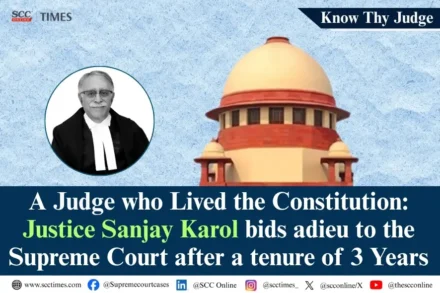
Justice Nongmeikapam Kotiswar Singh served as the Chief Justice of Jammu & Kashmir and Ladakh High Court, prior to being elevated as Judge of the Supreme Court of India on 18-7-2024.
“Continued underutilisation, despite availability of infrastructure, reflects a systemic indifference to deploy reformative mechanisms and warrants immediate corrective measures.”
“The nomenclature “sharbat” does not strip the product of its essential character as a fruit-based beverage concentrate, particularly where its composition and intended use align with that understanding.”
Unapproved restructuring of loan facility not in compliance with the Debenture Trust Deed cannot defeat the admission of Section 7 IBC application once financial debt and default are established.
Observing that decontextualised criticism in a school curriculum may undermine institutional dignity and influence impressionable minds, the Supreme Court ordered seizure of all copies of the NCERT Grade-8 textbook and issued show-cause notices for criminal contempt.
“Having slept over the matter for that length of time, the DoT cannot take advantage of its own lassitude and seek to mulct upon the respondent interest liability for that period.”
Culling out the basic factors for imposition of sentence, the Court stated that, “The supreme objective of law is the protection of society and creating a deterrence against crime by imposing adequate punishment.”
“Despite all the latitude that is shown to a “State”, we are of the clear opinion that 10 the cause sought to be shown here by the State of Odisha is not an explanation but a lame excuse. No case for exercise of discretion has been set up.”
“Nepotism and self-aggrandizement are anathema to a democratic system, more so when it happens within a society comprising members of the government service, enabling housing facilities to its members by transparent allotment.”
“The question of law is kept open to be decided in an appropriate case.”
“The filing of a charge-sheet, taking of cognizance, or issuance of summons does not terminate protection unless special reasons are recorded.”
The Court impleaded Union of India through Secretary, Department of Legislation and State of Uttar Pradesh through its Chief Secretary as new party respondent.
In the present case, the Government of India directed the NIA to investigate a FIR filed by West Bengal Police under multiple laws. The State argued that, even without investigation or supporting material, the order itself claimed the FIR allegations fall under Section 15(1)(a) of Unlawful Activities (Prevention) Act, 1967.
“Article 32 of the Indian Constitution is deemed to be “heart and soul” of the Constitution as it empowers any citizen to directly approach the Supreme Court for the enforcement of fundamental rights.”