2025 SCC Vol. 4 Part 3
Court can consider any document with intrinsic worth having bearing on lis decided earlier

Bringing you the Best Analytical Legal News


Court can consider any document with intrinsic worth having bearing on lis decided earlier

“The right to know and to effectively respond to the charges has been recognized as a fundamental feature of any administrative adjudicatory process. It is a fundamental principle of fairness that a party should have prior notice of the case against him and an opportunity to properly respond to the same”

“The High Court can interfere with the order of punishment only in case of violation of the provisions of rules or principles of natural justice are proved.”
“Principles of natural justice are not applicable at the stage of reporting a criminal offence. Providing an opportunity of being heard prior to the commencement of a criminal action, would frustrate the very purpose of initiating a criminal proceeding, which is to meet the ends of justice”.

“It is only in rare and exceptional cases that the Court may substitute its own view as to the quantum of punishment.”
“A person’s identity is not lost when he is not recognized by a machine, and in such circumstances, his claim has to be verified on the basis of the documents which he possesses regarding his identification.”
The Finance Act No. 02 of 2024, which came into effect on 01-09-2024, brought about significant amendments to the Income Tax Act. Among the key changes are revisions to Sections 148 and 148A, which pertain to the provisions for assessment and reassessment of income. In addition, Section 152 has been amended to introduce two new sub-sections.
The petitioner’s right to organize and participate in a religious event is protected under Article 25 of the Constitution of India and merely based on certain objections raised by the member of one community, it cannot be denied.

A quick legal roundup to cover important stories from all High Courts this week.
As per Annual Confidential Reports, the petitioner’s overall grade was average or below average. Since, the petitioner completed 50 years of age, this decision of compulsory retirement could have been taken by the State authorities. The un-communicated adverse remarks cannot be made a basis to disturb the finding recorded by the competent authority.
Court reiterated out that availability of an alternative remedy, would not be an embargo on the High Court’s power to entertain the petition under Article 226 in certain contingencies.
“The enquiry is nothing but an eye wash because the same was conducted without following any procedure which had to be mandatorily followed.”
“Judged by moral standards of the CWC members, the petitioner may not be a good person, but that does not make her a bad mother.”
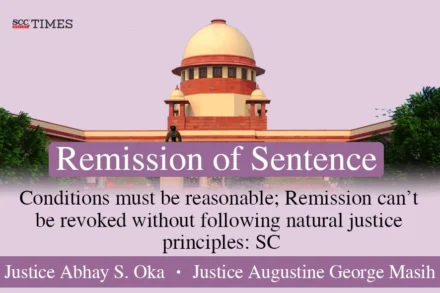
The Court further explained that Registration of a cognizable offence against the convict, per se, is not a ground to cancel the remission order. Every case of breach cannot invite cancellation of the remission order.
While the impugned orders are elaborate and explicitly cite specific provisions and clauses of the Haj Policy, 2023, which the petitioners were found to be violating, the show cause notices do not refer to any violations of the Haj Policy, 2023, attributable to the petitioners.

“Even while passing administrative order having civil consequences, the reasons are not only to be recorded but are to be supplied to the affected parties.”
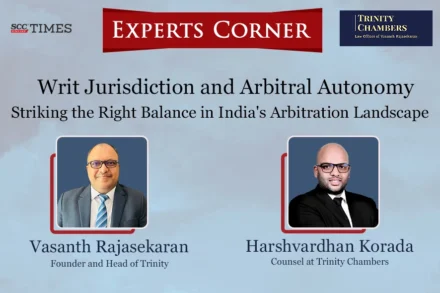
by Vasanth Rajasekaran* and Harshvardhan Korada**
The Court held that the petitioner’s termination was based on a misapplication of the policy, as no qualified ST candidate was available, and therefore, no preference could have been applied.
The Court held that the de-empanelment order was issued in contravention of natural justice principles due to the lack of proper notice and opportunity for the petitioner to respond.
In the administrative action where the decision of authority may result in civil consequences, a hearing before taking a decision is necessary.