Non-compete fee: Revenue or capital expenditure? Supreme Court explains
“Non-compete fee only seeks to protect or enhance the profitability of the business, thereby facilitating the carrying on of the business more efficiently and profitably.”
Identity of the person making the purchase, or the value of the transaction, is not conclusive to determine whether the transaction or activity is for a commercial purpose. Dominant intention or purpose is required to be seen.
The Court further restored the case of the file of the High Court for fresh decision in accordance with law as neither the High Court nor the Trial Court has enlisted the entire evidence available on record; therefore, it was difficult for the Court to take a decision with precision.
Where statutes in pari materia serve a common object in absence of any provision indicating to the contrary, it is permissible for a court of law to ascertain the meaning of the provision in the enactment by comparing its language with the other enactment relating to the same subject matter.
“Similarly, a clause which states that “if the parties so decide, the disputes shall be referred to arbitration” or “any disputes between parties, if they so agree, shall be referred to arbitration” would not constitute an arbitration agreement”.
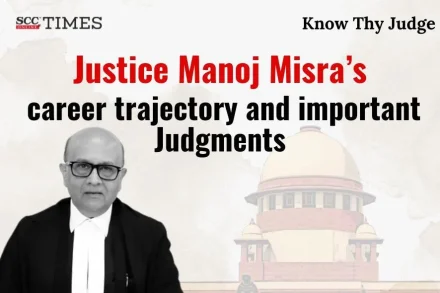
Justice Manoj Misra is the sitting Judge of the Supreme Court of India. He was elevated to the Supreme Court in February 2023 and has formerly served as a Judge in the High Court of Judicature at Allahabad.
“The High Court erred in bisecting the claim of the appellant into two parts, one arbitrable and the other non- arbitrable, when it found arbitration agreement to be there for settlement of disputes between the parties.”
“In cases of group clashes where a large number of persons are involved, an onerous duty is cast upon the Courts to ensure that no innocent bystander is convicted and deprived of his liberty.”
The Court examined the question that whether the High Court correctly exercised its supervisory jurisdiction under Article 227 in granting the respondent one more opportunity to cross-examine the appellant’s witness, despite the Arbitral Tribunal rejected such a prayer.
“The IBC is a complete code in itself, having sufficient checks and balances, remedial avenues and appeals. Adherence of protocols and procedures maintains legal discipline and preserves the balance between the need for order and the quest for justice.”
“‘Henderson Principle’ is a core component of the broader doctrine of abuse of process, aimed at enthusing in the parties a sense of sanctity towards judicial adjudications and determinations. It ensures that litigants are not subjected to repetitive and vexatious legal challenges. This rule not only supports the finality of judgments but also underscores the ideals of judicial propriety and fairness.”
“Only the Court that entertains the petition of compromise can determine its legality, at the time of recording the compromise or when it is questioned by way of a recall application. No other remedy is available to the party who is aggrieved by the compromise decree as an appeal and fresh suit are not maintainable under the CPC.”
The Arbitration and Conciliation Act, 1996 does not prohibit Public Sector Undertakings from empanelling potential arbitrators, however, an arbitration clause cannot mandate the other party to select its arbitrator from the panel curated by PSUs.
“Central to the principles of reasonable accommodation and the individualized experience of disability is the right to access legal protections without undue mental hardship. If persons with disabilities must repeatedly turn to the courts to correct the missteps of authorities, then the rights recognized by this Court and the RPWD Act risk becoming hollow assurances.”
The 9-Judge Bench unanimously held that Article 31-C of the Constitution remains in force to the extent that it was upheld in Kesavananda Bharati v. State of Kerala, (1973) 4 SCC 225.
The Court also reiterated that FIR is not an encyclopedia of all imputations. Therefore, to test whether an FIR discloses commission of a cognizable offence, what is to be looked at is not any omission in the accusations, but the gravamen of the accusations contained therein to find out whether, prima facie, some cognizable offence has been committed or not.
States and Union Territories have been directed to revise and change the prison manuals to end caste-based allotment of work.
Supreme Court acknowledged that the petitioner’s admission had been delayed through no fault of his own. It requested the Director of IIT Dhanbad to utilize his good offices to facilitate the petitioner’s ability to complete the coursework for the time already elapse.
Dismissing the appeal, the Court opined that the respondents had all throughout shown their intention to pay the balance consideration for execution of the sale deed whereas the appellants appeared interested only in challenging the decree before higher Courts.
The NGT had directed to restrict the total number of Dhol, Tasha, Zanj Groups to only 30 per group along with real time monitoring of noise pollution around each Ganesh pandal and initiating criminal proceedings against the violators.