
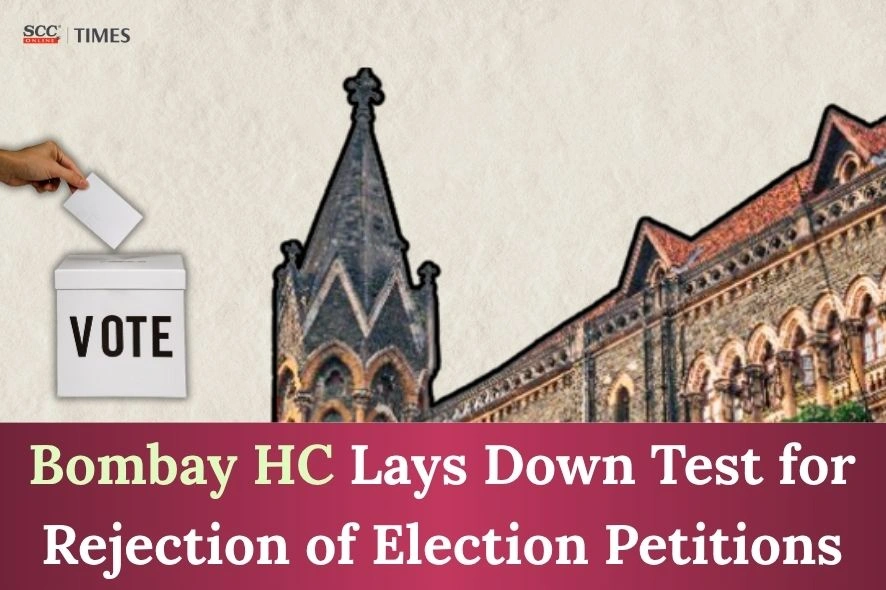
Bombay High Court: In an application seeking rejection of the election petition challenging the election results and a declaration that the petitioner be returned as duly elected, the Single Judge Bench of Sharmila U. Deshmukh, J., held that while the petition was not barred by limitation, it failed to disclose a cause of action as the petition failed to demonstrate the alleged discrepancies materially affected the election result. The Court further held that for seeking a declaration under Section 101, Representation of the People Act, 1951 (RP Act), the petitioner must plead that he had secured a majority of votes, which was not done in the present case.
Background
The present application sought dismissal of the election petition, which questioned the election of the returning candidate and sought to declare the petitioner as the duly elected candidate of the Kalyan Rural Assembly constituency, Thane District, Maharashtra.
The petitioner sought directions for the recounting of votes to declare applicant-Respondent 1’s election as void and to declare the petitioner as the elected candidate.
The applicant-Respondent 1 made an application under Order 7 Rule 11 CPC, to dismiss the said election petition for being barred by limitation, non-disclosure of the cause of action, and, under Section 86(1), RP Act, for non-compliance with Section 81.
Issue
Whether the election petition was barred by limitation, or lacked a cause of action?
Analysis and Decision
The Court, dealing with the issue of limitation first, stated that an election petition questioning any election may be instituted within 45 days from “the date of election” of the returned candidate. The said election petition can be filed under Section 81, on grounds laid under Sections 100(1) and 101, RP Act, before the High Court. For the purposes of Section 81, “the date of election” is the date of declaration of results by the Returning Officer. The Court stated that under Section 12, Limitation Act, 1963, the day from which the period of limitation is to be reckoned is excluded while computing the limitation. Accordingly, the date of declaration of results shall not be counted, and the period of 45 days will be calculated from the next day. For instance, in the present case, the date of declaration of results was 23 November 2024, which will be excluded, and the period of 45 days will be counted from 24 November. Accordingly, the limitation period would expire on 7 January 2025 and not 6 January.
The Court observed that the concise statement of material facts under Section 83, RP Act, was filed after 45 days, and the applicant claimed that it would entail dismissal of the election petition in limine. The Court noted that Section 86 provides for dismissal of the election petition at the threshold only for violations of Sections 81, 82 or Section 117, RP Act. The Court, while referring to T.M. Jacob v. C. Poulose, (1999) 4 SCC 274, stated that the non-compliance of Section 83 is capable of being dealt with under the doctrine of curability. Similarly, the non-joinder of the Election Officer and the Returning Officer is a curable defect, which cannot result in dismissal of the petition. Accordingly, the Court stated that the election petition cannot be held to be barred by limitation nor can it be dismissed under Section 86.
Dealing with the issue of non-disclosure of the cause of action under the RP Act, the Court noted that the election can be questioned only on the grounds set out in Section 100(1); however, since the petitioner also sought to be declared as elected, the provisions of Section 101 were also attracted. The Court observed that the main ground of dispute was the discrepancy between the vote count shown in the control unit of Electronic Voting Machines (EVM) and the Voter Verified Paper Audit Trail (VVPAT) slips.
“During the process of elections, the VVPAT machine generates paper slips which contains the necessary details as to the political party symbol, name of candidate etc. After the vote is cast, the voter gets to view the slip on the VVPAT to verify correct casting of vote.”
The Court examined the grounds one by one to determine whether the allegations gave rise to a cause of action for the election petition to proceed for trial. Firstly, discrepancies were alleged in the Ballot Unit (BU) and Control Unit (CU) numbers and Form 17C. The Court referred to Rule 49-S, Conduct of Election Rules, 1961, which prescribes Form 17C, which provides for accounts of the votes recorded.
“Rule 49-S of the Conduct of Election Rules, 1961 provides that the presiding officer at the close of the poll shall prepare an account of votes recorded in Form 17C and to furnish to every polling agent present at the close of the poll a true copy of the entries made in Form 17C.”
The Court stated that the basic material facts to be pleaded were the BU and CU numbers, which were mentioned on the EVM in contradistinction to the Form 17C. The Court noted that the election petition did not mention the numbers appearing either on the EVM or Form 17C, and merely annexed Form 17C. Accordingly, the Court held that the election petition did not disclose any case about discrepancies insofar as the EVM and Form 17C were concerned.
The next allegation pertained to the discrepancy in the list provided by the Election Commission of India and the list provided by the Returning Officer/ECI in respect of 3 EVMs, which could not be tallied. The Court stated that the pleading itself should have mentioned the details of EVMs; however, it was difficult to discern from the pleading which EVMs, at which serial numbers, of which list could not be tallied. The Court observed that no list, which was allegedly provided by the Election Commission through the Returning Officer, was annexed, nor were there any pleadings explaining how the alleged discrepancy led to improper reception of votes or acceptance of void votes.
On the allegations of improper sealing of EVMs, the Court stated that the allegation appeared to be based on the direction given by the Supreme Court in Assn. for Democratic Reforms v. Election Commission of India, (2025) 2 SCC 732. Wherein, post announcement of the results, the burnt memory/micro-controller in 5 per cent of EVMs, i.e. the control unit, ballot unit and VVPAT, should be checked and verified by a team of engineers from the manufacturers of the EVMs for any tampering or modification. The Court noted that the directions were only applicable or could be invoked on a written request made by a candidate who was at serial number 2 or 3 behind the highest polled candidate. The decision does not direct the 5 per cent burnt memory/micro-controllers as an ordinary procedure. The Court thus held that the allegation was premised on an incorrect reading of the judgment, and an illusory cause of action was shown. Further, there was no pleading related to any such written request that was made by the petitioner.
The Court noted that the representation made by the petitioner before the Returning Officer did not contain any request for such checking and verification, and merely requested a recounting of VVPAT slips.
The Court stated that perusal of the pleading did not disclose any cause of action as to the improper reception of votes or void votes. The Court held that unless it was specifically pleaded that the alleged discrepancies had resulted in improper reception of votes, a mere assertion of discrepancy in the EVM or Form 17C was not sufficient to disclose a cause of action under Section 100(1)(d)(iii), RP Act. The Court stated that the requirement under Section 100(1)(d) is that the results of the election must be shown to have been materially affected insofar as the returned candidate is concerned. Accordingly, the petitioner was required to plead material facts showing the discrepancy between the Control Unit and VVPAT slips and demonstrate how such discrepancy materially affected the election result. Mere reference to the provision, without specific pleadings that improper reception of votes led to the returned candidate being declared elected, is insufficient. The Court further held that for seeking a declaration under Section 101, the petitioner must plead that he had secured a majority of votes, which was not done in the present case.
Conclusion
The Court stated that the importance of precise pleadings in an election petition cannot be undermined. The Court stated that while considering an application under Order 7 Rule 11(a) CPC, the test is whether the petition, even if unopposed, would entitle the petitioner to a favourable verdict; if not, it discloses no cause of action. In election petitions, pleadings must be specific and unambiguous as required under Section 83, RP Act; where a holistic reading of the petition fails to disclose a cause of action, it is liable to be dismissed.
Accordingly, the Court allowed the application under Order 7 Rule 11 and rejected the election petition for lack of cause of action.
[Pramod Ratan Patil v. Rajesh Govardhan More, Application (L) No. 10196 of 2025, decided on 9-4-2026]
Advocates who appeared in this case:
For the petitioner: Nilesh Pandey, Sameer S. Vispute, Sayali Shinde and Rishabh Dubey, Advocates
For the Respondent 1: Chirag Shah, Bhavya Shah i/b Vishal Acharya, Advocates