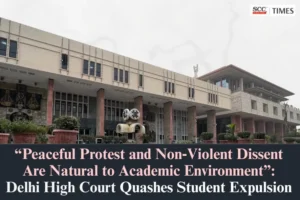

Delhi High Court: In a Writ Petition challenging the expulsion of the petitioner, a student, for allegedly participating in a sit-down protest, a Single Judge Bench of Jasmeet Singh, J., held that penalising a student for a sit-down protest is wholly untenable in law, as it strikes at the very heart of the spirit of democracy and the freedoms guaranteed under Article 19(1)(a) and (b) of the Constitution of India.
The Court emphasized that a university is not merely a place where students attend classes, but a space for development of independent thought, critical thinking, and engagement in discourse. It was observed that peaceful protest and non-violent dissent are a natural and integral part of such an environment. The Court reiterated the broader educational role of universities and held that suppression of dissent is impermissible, and that disciplinary action must be proportionate, particularly in the absence of any disruption to academic functioning.
Background:
The present case arose out of allegations of severe ragging and bullying made by the petitioner, a student of Dr. B.R. Ambedkar University, who claimed that she had been subjected to derogatory, vicious, and gender-insensitive remarks by fellow students, which allegedly drove her to self-harm. Aggrieved thereby, the petitioner had lodged complaints and participated in protests against the inaction of the University authorities. Consequently, the respondent (University) had placed the petitioner under suspension. Challenging the said suspension, the petitioner had approached the Delhi High Court. The Court, vide interim order had permitted the petitioner to attend classes, subject to the condition that she should not participate, directly or indirectly, in any protest or demonstration concerning the incident and that she should maintain discipline on campus. Subsequently, the Respondent had issued a show cause notice dated 27-5-2025 alleging that the petitioner had violated the aforesaid direction by participating in a campus-wide boycott organised by the student body (AUDSC). The petitioner, in her reply, had denied the allegations and had stated that she had merely been present at the site to meet a friend when her photograph had been taken by security personnel. However, not being satisfied with the explanation, the respondent had treated her presence as participation in the protest and, holding it to be a breach of the Court’s order as well as the student code of discipline, had imposed the penalty of expulsion upon the petitioner. Thus, being aggrieved the present Writ Petition was filed.
Analysis:
The Court held that the expulsion of the petitioner for allegedly participating in a sit-down protest was wholly untenable in law, as it struck at the very heart of the spirit of democracy and the freedoms guaranteed under Article 19(1)(a) and (b) of the Constitution of India. Placing reliance on Ramlila Maidan Incident, In Re (2012) 5 SCC 1, the Court reiterated that the right to peacefully and lawfully assemble together and to freely express oneself is guaranteed under Article 19 and is inherently linked with the right to life and liberty under Article 21. Further, in light of Mazdoor Kisan Shakti Sangathan v. Union of India (2018) 17 SCC 324, the Court emphasized that the right to protest is a fundamental right and a crucial pillar of democracy.
The Court observed that a university, being an instrumentality of the State, carries out an indispensable public function and cannot restrict speech and peaceful expression merely because the views expressed by students do not align with the ideology of the management. It was noted that a university is not merely a place for attending classes but a space for development of independent thought, critical thinking, and engagement in discourse, where peaceful protest and non-violent dissent form a natural part of the academic environment. Suppression of dissent, the Court held, would defeat the broader educational role of such institutions.
In the present case, the Court noted that the petitioner had denied participation in the protest; however, even assuming such participation, the protest was a peaceful sit-down protest and there were no allegations that it interfered with the functioning of the University or academic pursuits of other students. The Court held that expulsion on such grounds amounted to a highly disproportionate disciplinary action. It further held that the alleged violation of the Court’s earlier order dated 15-4-2025 could not be a ground for punishment by the University, as the authority to deal with breach of court orders vests solely with the Court. The impugned action, being predicated on such violation, was therefore unsustainable.
Decision:
Accordingly, the Court concluded that the punishment imposed on the petitioner was disproportionate and liable to be set aside, and the petition was allowed. However, taking note of the fact that the petitioner had already lost one academic year, the Court directed that the said period be treated as punishment and permitted the petitioner to resume studies from the 3rd Semester in July 2026.
[Nadia v. Dr. B R Ambedkar University, Delhi, W.P. (C) 12636 of 2025, decided on 13-3-2026]
Advocates who appeared in this case:
For the Petitioner: Abhik Chimni, Pranjal Abrol, Gurpal Singh, Ayan Dasgupta Samarendra, Moksha Sharma, Advocates
For the Respondent: Mohinder Rupal, Hardik Rupal, Aishwarya Malhotra and Tripta Sharma, Advocates
Buy Constitution of India HERE