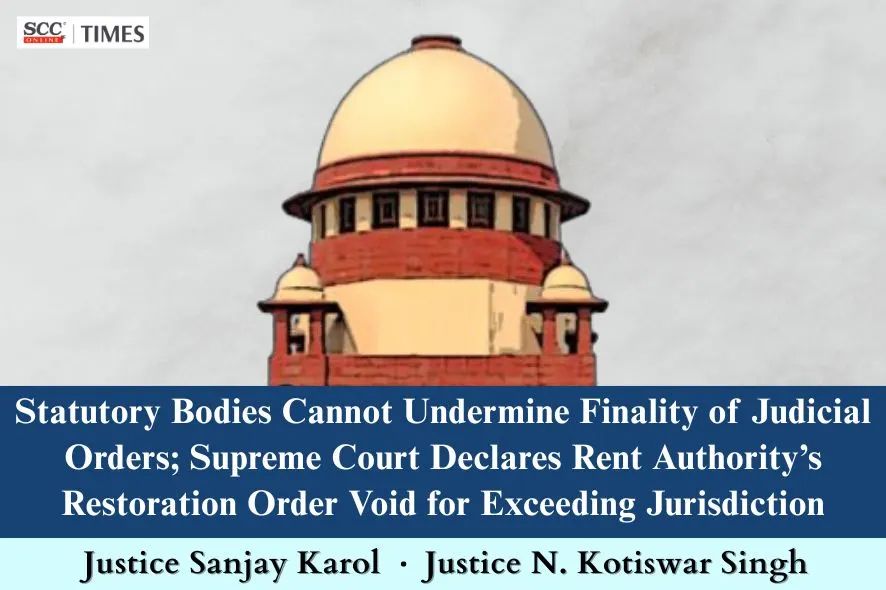
Supreme Court: In a landlord-tenant dispute where the core controversy concerned with the Rent Authority undermining finality of judicial order by permitting to reopen the proceedings that had already attained finality before the Supreme Court and allowing the restoration application by order dated 15 May 2025, the Division Bench of Sanjay Karol* and N. Kotiswar Singh, JJ., declared the Rent Authority’s restoration order as void for lack of jurisdiction. The Court held that “respect for the authority of orders passed post adjudication by a judicial activity, be it this Court or the High Court is a basic principle of judicial comity, more so, upon attaining finality”.
Regarding the show-cause notice issued to the Additional District Magistrate, the Court accepted the unconditional apology tendered and clarified that the proceedings would not affect the officer’s career progression.
Also Read: Restoring Justice through Compliance and Fixing Accountability
Factual Matrix
The instant dispute arose out of eviction proceedings concerning a tenanted property situated at Saharanpur, Uttar Pradesh. The landlord initiated proceedings under Section 21(2), Uttar Pradesh Urban Premises Rent Control Ordinance, 2021 (U.P. Rent Control Ordinance), on the ground of non-payment of rent.
The Rent Authority, by order dated 7 September 2022, held that a landlord-tenant relationship existed between the parties and directed eviction of the tenant within 30 days. This finding was successively affirmed by the appellate authority, the High Court under Article 227, and ultimately by the Supreme Court upon dismissal of the special leave petition. The Supreme Court further granted time to vacate the premises subject to conditions, including filing of an undertaking.
Despite this finality, the tenant pursued multiple proceedings, including a review petition and miscellaneous application, all of which were dismissed. Even thereafter, the tenant filed a restoration application before the Rent Authority seeking recall of the original eviction order.
Surprisingly, the Rent Authority allowed the restoration application by order dated 15 May 2025. Aggrieved, the landlord approached the High Court, whereby the restoration order was set aside, and the matter was remanded back for fresh consideration.
Parallelly, contempt proceedings were initiated for non-compliance with the Supreme Court’s direction to vacate the premises.
Issues for Determination
Whether the Additional District Magistrate (acting as Rent Authority) acted in disregard of binding judicial orders by entertaining and allowing a restoration application after the matter had attained finality up to the Supreme Court?
Court’s Analysis
At the outset, the Court noted that Section 21(2), UP Rent Control Ordinance permits eviction for non-payment of rent and Section 38 limits the jurisdiction of the Rent Authority strictly to tenancy matters and excluding questions of title.
The Court observed that the landlord-tenant relationship stood “established beyond reproach” and had been conclusively affirmed at all judicial levels, including the Supreme Court. Any subsequent attempt to reopen the matter was impermissible.
The Court emphasised that once the Supreme Court had directed the tenant to vacate the premises, such direction became binding and operative. The Court expressed its inability “to conceive of a situation” where the Rent Authority could pass an order effectively nullifying the findings affirmed by the Supreme Court.
The Court reiterated that “the question of title which was sought to be challenged by the tenant in the restoration proceedings, alleging that the landlord in fact had no title, is squarely within the domain of the Civil Court, and not the Rent Authority, more so, when the statute under which the Rent Authority exists, itself states that the only question such an Authority can consider is the existence of a landlord-tenant relationship and not title”.
A critical aspect noted by the Court was that the Additional District Magistrate acted in dual capacities, first as an administrative authority preparing a report on alleged forgery, and then as Rent Authority relying on that report to recall the eviction order. The Court held this overlap to be impermissible and contrary to statutory limitations. The Court further held that the order dated 15 May 2025 allowing restoration was passed without jurisdiction and therefore was a nullity in law.
Citing Baradakanta Mishra v. Bhimsen Dixit, (1973) 1 SCC 446, Union of India v. Kamlakshi Finance Corpn. Ltd., 1992 Supp (1) SCC 443 and M.A. Murthy v. State of Karnataka, (2003) 7 SCC 517, the Court reiterated foundational principles of judicial discipline, binding precedent, and hierarchical authority, observing that subordinate authorities are bound to follow orders of higher courts. It stressed that failure to follow binding decisions undermines the rule of law and creates uncertainty in administration of justice.
Lastly, the Court observed that “jurisdiction especially at the level of the trial Courts is a creation of specific statutes and the learned judges must be cognizant, always of the differences in the jurisdiction conferred upon them thereby”.
Court’s Decision
The Court declared the impugned restoration order dated 15 May 2025 passed by the Rent Authority as void for lack of jurisdiction. The Court, by order dated 22 September 2025, has directed the tenant to deposit costs of ₹5 lakhs with the Supreme Court Middle Income Group Legal Aid Society.
Regarding the show-cause notice issued to the Additional District Magistrate, the Court accepted the unconditional apology tendered and clarified that the proceedings would not affect the officer’s career progression.
[Rajesh Goyal v. Laxmi Constructions, 2026 SCC OnLine SC 475, decided on 25-3-2026]
*Judgment by Justice Sanjay Karol
Advocates who appeared in this case:
Mr. Kaushik Choudhury, AOR, Counsel for the Appellant
Mr. Rohit Amit Sthalekar, AOR, Mr. Ali Rahim, Adv., Mr. Mohsin Rahim, Adv., Mr. Siddhant Singh, Adv., Mr. Arvind Sangwan, Sr. Adv., Mr. Deepak Swami, Adv., Mr. Shantanu Singh Sangwan, Adv., Mr. Shaurya Sahay, Adv., Mr. Manish Sharma, Adv., Mr. Yashasvi Singh, Adv., Mr. Saurabh Sharma, AOR, Counsel for the Respondents