
The law now seems to be moving away from a strictly expiry-based view of arbitral timelines towards a more workable model of judicial supervision grounded in continuity.
Section 29-A was introduced1 in the Arbitration and Conciliation Act, 1996 (the Act/Arbitration Act) as an antidote to arbitral delay. The provision sought to address one of the most persistent criticisms of the Indian arbitration regime, namely, the prolonged pendency of proceedings and the absence of any meaningful statutory discipline over the timeline for making an award.
Yet, over time, Section 29-A itself generated a distinct set of interpretative conflicts. Courts differed not only on the forum competent to entertain an application under Section 29-A, but also on whether the statutory power survived expiry of mandate and, more controversially, whether that power could still be exercised after an award had been rendered beyond time. A provision intended to preserve arbitral efficiency thus became, in practice, a new source of threshold litigation.
If the relevant “court” under Section 29-A of the Act was the Court defined in Section 2(1)(e), one set of consequences followed. If, however, the Court under Section 29-A was the Court that had acted first at the referral stage under Section 11 of the Act, an entirely different jurisdictional pathway emerged.
Likewise, if expiry of the Tribunal’s mandate was treated as an event from which the arbitral process could still be judicially revived, the statutory scheme retained a curative character. But if expiry was understood as a point of irreversible collapse, Section 29-A would cease to be a supervisory mechanism and would instead operate as a trapdoor. These questions lay at the heart of the judicial conflict that had already begun to take shape across several decisions.
It is against that background that the recent decisions of the Supreme Court assume particular significance. Read in isolation, each judgment appears to answer a narrow procedural question. Read together, however, Mohan Lal Fatehpuria v. Bharat Textiles2, C. Velusamy v. K. Indhera3, Viva Highways Ltd. v. M.P. Road Development Corpn. Ltd.4, and Ankhim Holdings (P) Ltd. v. Zaveri Construction (P) Ltd.5 reveal something larger. They point towards an emerging judicial preference for continuity over collapse, for preserving arbitral proceedings rather than allowing them to be defeated by technical disruption, and for interpreting the provisions under the Act as a framework that seeks to salvage the process wherever possible without compromising discipline.
Mohan Lal case6 is the natural starting point, but it is also the decision that generated the subsequent misunderstanding. There, while dealing with a case in which the earlier arbitrator’s mandate had already ceased and the factual record justified replacement, the Supreme Court observed that Section 29-A(6) empowers and “obligates” the Court to substitute the arbitrator.
On the facts of that case, the Supreme Court substituted the Arbitral Tribunal and directed that the proceedings resume from the stage already attained. The difficulty, however, arose not from the relief actually granted, but from the manner in which the judgment began to be read thereafter. The expression “empowers and obligates” came to be treated in some quarters as though it laid down a universal rule that termination of mandate necessarily and invariably required substitution. That understanding risked reducing the court’s discretion under Section 29-A(6) to a mere formality.
It is precisely the above over-reading that the C. Velusamy case7 and the Viva Highways case8 corrected. The C. Velusamy case9 clarified that Section 29-A contains no threshold bar for entertaining of an application for extension merely because an award has been rendered after expiry of mandate. Such an award may be ineffective or unenforceable unless the Court intervenes, but it does not denude the Court of jurisdiction. The Supreme Court also made clear that substitution under Section 29-A(6) is discretionary, not automatic, and that the relevant “court” for the purpose of Section 29-A is the Court under Section 2(1)(e), not the Court which may have exercised power under Section 11 of the Act at the referral stage. Viva Highways case10 carried that clarification forward by expressly holding that Mohan Lal case11 did not lay down a rule that substitution is an inevitable consequence.
Legislative design of Section 29-A, Arbitration Act
The text and structure of Section 29-A of the Act support a broader reading. The provision is not framed merely as a deadline followed by extinction. It contemplates a supervisory role for the Court in extending time, imposing conditions, substituting the Tribunal where necessary, and ensuring that the arbitral process can continue without being rendered futile. Significantly, Section 29-A(4) itself recognises that the mandate of the arbitrator terminates upon expiry of the prescribed period unless the Court has either prior to or after the expiry of the period extended the same. The inclusion of the words “or after” is of considerable importance. It indicates that Parliament did not treat lapse of time as an event that necessarily forecloses judicial intervention. On the contrary, the statutory design preserves a curative power capable of operating even after the period has expired.
That feature assumes even greater significance when Section 29-A is read with sub-sections (5) (6) and (7). The Court may extend time on sufficient cause being shown. It may substitute one or all of the arbitrators. Where substitution occurs, the arbitral proceedings are to continue from the stage already reached on the basis of the evidence and material already on record, unless the Court directs otherwise. The legislative preference, therefore, is evident. The statute does not favour destruction of the arbitral record, nullification of prior procedural steps, or automatic recommencement. It favours continuity, economy, and preservation. Section 29-A, properly understood, is thus not a self-defeating provision. It is a mechanism that disciplines delay while, as far as possible, keeping the underlying arbitral process alive.
Confusion on appropriate forum and timing
The judicial divergence arose because courts were not ad idem either on the proper forum under Section 29-A or on the extent of the power exercisable thereunder.
One line of authority proceeded on the footing that where the Arbitral Tribunal had been constituted by the High Court or the Supreme Court in exercise of powers under Section 11 of the Act, any subsequent application for extension of time ought also to be moved before that very court. It was considered incongruous that a tribunal whose mandate had, in a sense, been initiated by a higher court could later have its mandate revived, extended, or otherwise altered by a court lower in the judicial hierarchy. In other words, the view was that a District Court, being subordinate in the hierarchy, could not be seen as competent to revive a mandate originating from an order issued by the High Court or the Supreme Court.
The competing view rested on the text of Section 29-A itself. According to this approach, the expression “court” in Section 29-A had to carry the meaning assigned to it by Section 2(1)(e) of the Act, namely, the Principal Civil Court of original jurisdiction in a district, or the High Court exercising ordinary original civil jurisdiction, as the case may be. On that construction, the forum under Section 29-A was not determined by the Court that had appointed the arbitrator under Section 11, but by the statutory definition of “court” contained in the Act.
The second area of uncertainty concerned the stage at which the powers under Section 29-A could be invoked. One question was whether extension could be sought only so long as the Tribunal’s mandate remained alive, or whether the Court could also intervene after the prescribed period had already expired. A further and more difficult question was whether the position changed where the Tribunal had gone on to render an award after expiry of the mandate. Did the making of such an award exhaust the matter entirely, or could the Court still exercise its power and cure the defect? It was this combination of uncertainty as to forum and timing that turned Section 29-A into a recurring source of threshold litigation.
The Case in Mohan Lal and the problem of over-reading
In Mohan Lal case12, the Supreme Court observed that the provisions in Section 29-A of the Act empower and obligate the Court to substitute the arbitrator. However, the force of that observation must be located in its factual setting. The Supreme Court was dealing with a case where the Arbitral Tribunal’s mandate had already lapsed, the situation warranted replacement, and the facts justified exercise of the power of substitution. It was not, in any real sense, engaged in laying down a universal rule that every termination of mandate must inexorably lead to substitution.
The danger lies in reading Mohan Lal case13 at too high a level of generality. If the phrase used in that judgment were detached from context and elevated into a rigid principle, the consequence would be to erase the court’s discretion under Section 29-A(6) of the Act. Such an approach would make the very possibility of curative intervention largely illusory. The later decisions of the Supreme Court are significant precisely because they restore the balance in interpreting Section 29-A of the Act.
Restoring the balance in C. Velusamy
C. Velusamy case14 is, in that sense, the real turning point in the recent development of the law. The Supreme Court squarely addressed the most difficult issue arising under Section 29-A of the Act, namely, whether an application for extension could still be entertained after the Tribunal’s mandate had expired and even after an award had been made beyond the prescribed period. The Supreme Court answered that question in the affirmative. It held that nothing in the text of Section 29-A creates a threshold bar that strips the Court of jurisdiction merely because the award was rendered after expiry of the mandate. Such an award may remain ineffective unless the Court grants appropriate relief, but that is a different matter from saying that the Court itself lacks power to act. The possible invalidity of the award does not, by itself, extinguish the court’s jurisdiction under Section 29-A.
The judgment is equally important for the clarity it brings to the question of forum. C. Velusamy case15 rejects the assumption that the Court which exercised powers under Section 11 must necessarily continue to supervise all later questions relating to the Tribunal’s mandate. The Supreme Court explained that the expression “court” in Section 29-A must be read in the sense assigned by Section 2(1)(e) of the Act. The power to appoint an arbitrator and the power to extend the mandate arise under different provisions and operate in different fields. The fact that the arbitrator may have been appointed by the High Court or the Supreme Court under Section 11 does not alter the statutory forum designated for proceedings under Section 29-A of the Act.
Perhaps most importantly, C. Velusamy case16 makes clear that substitution under Section 29-A(6) is discretionary, not automatic. That conclusion follows from the language of the provision itself. Parliament has conferred an enabling power, not imposed an inflexible duty. The Court may substitute the Tribunal where the facts justify such a course, including where the conduct of the arbitrator or the history of the proceedings makes continuation inappropriate or unworkable. But the statute does not support the view that every lapse of mandate must inevitably lead to replacement. By restoring that distinction, the judgment returns Section 29-A to its proper balance, namely, a provision that equips the Court to respond to delay with flexibility and control, without reducing the statutory scheme to a rigid rule of compulsory substitution.
Reaffirmation in Viva Highways
Viva Highways case17 is important because it demonstrates how quickly Mohan Lal case18 had come to be read too broadly, and how decisively the Supreme Court moved to correct that reading. The Supreme Court expressly clarified that Mohan Lal case19 did not lay down any rule that substitution must invariably follow upon termination of mandate. The strong language employed in that decision was not to be understood as exhausting judicial discretion or as converting Section 29-A(6) of the Act into a provision of automatic replacement. The mere fact that the Tribunal’s mandate had expired did not, by itself, compel the Court to substitute the arbitrator in every case. The Court also reiterated that the competent forum under Section 29-A of the Act is the Court contemplated by Section 2(1)(e), and not the High Court merely because it had earlier exercised jurisdiction under Section 11.
Ankhim Holdings and the principle of continuity
Ankhim Holdings20 (supra) does not arise under Section 29-A of the Act, but it forms part of the same broader judicial approach. The issue before the Court arose under Section 15(2), yet the reasoning adopted there is of clear relevance in the present context. The Supreme Court held that where the statute provides for substitution of the arbitrator, the Court cannot use that power as a basis to assume some wider authority to reopen, unsettle, or invalidate earlier steps in the arbitral process unless the Act itself permits such a course. Substitution, in other words, is not a licence to dismantle what has already taken place.
The Supreme Court was equally clear that substitution should not ordinarily result in the arbitral proceedings being driven back to their starting point. The proper course is continuation from the stage already reached, subject always to any specific direction that may be required in law or on the facts of the case. Seen in that light, the principle underlying Ankhim Holdings case21 sits comfortably alongside the recent decisions under Section 29-A of the Act. The common thread is that judicial intervention must remain anchored in the statute and must be exercised in a manner that supports, rather than dislocates, the arbitral process.
Comments
Read together, these decisions go a long way in restoring coherence to what had become an unsettled understanding of Section 29-A. The law now seems to be moving away from a strictly expiry-based view of arbitral timelines towards a more workable model of judicial supervision grounded in continuity. Delay remains a matter of real concern, and the statutory timeline is by no means illusory. Courts continue to possess sufficient authority to control the course of proceedings, decline extension where the facts do not justify indulgence, and substitute the Tribunal where such a course is warranted. What the recent decisions make clear, however, is that expiry of time does not, by itself, require the arbitral process to collapse.
That shift matters not only for the interpretation of Section 29-A, but for the larger direction of Indian arbitration law. It reflects a deeper judicial understanding that the Act is meant to facilitate and sustain arbitration, not defeat it through unnecessary procedural breakdown.
Properly read, the decisions discussed above do not dilute statutory discipline. What they do instead is place that discipline within a framework of continuity, proportionality and fidelity to the statutory scheme. In that sense, the recent case law does more than resolve a cluster of procedural uncertainties. It restores Section 29-A to its true role as a provision intended to preserve arbitral efficacy, rather than one that triggers arbitral collapse.
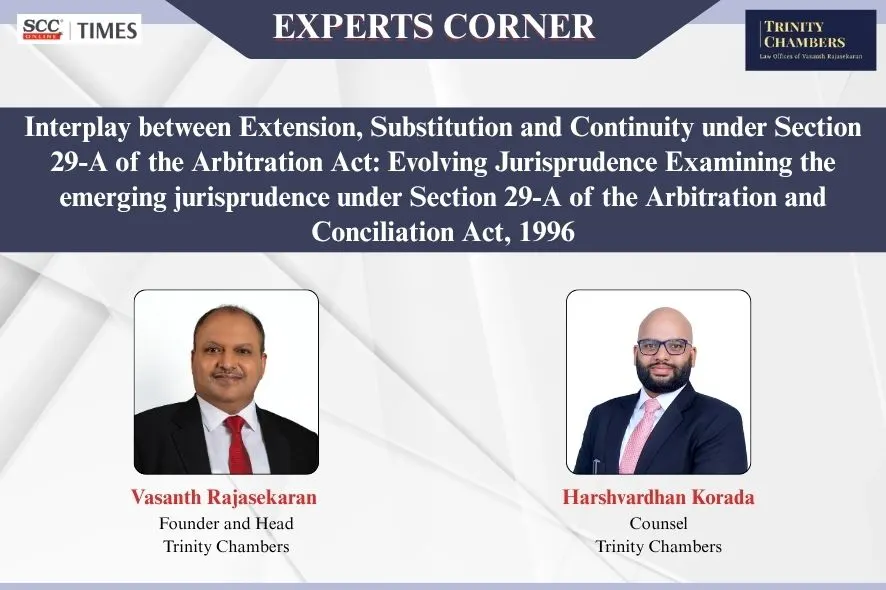
*Founder and Head of Trinity Chambers, Delhi.
**Counsel at Trinity Chambers, Delhi.
1. S. 29-A of the Act was instituted by Act 3 of 2016 (w.e.f. 23-10-2015). Subsequently, the provisions under S. 29-A were amended by Act 33 of 2019 (w.e.f. 30-8-2019).
6. Mohan Lal Fatehpuria v. Bharat Textiles, 2025 SCC OnLine SC 2754.
7. C. Velusamy v. K. Indhera, 2026 SCC OnLine SC 142.
8. Viva Highways Ltd. v. M.P. Road Development Corpn. Ltd., 2026 SCC OnLine SC 195.
9. C. Velusamy v. K. Indhera, 2026 SCC OnLine SC 142.
10. Viva Highways Ltd. v. M.P. Road Development Corpn. Ltd., 2026 SCC OnLine SC 195.
11. Mohan Lal Fatehpuria v. Bharat Textiles, 2025 SCC OnLine SC 2754.
12. Mohan Lal Fatehpuria v. Bharat Textiles, 2025 SCC OnLine SC 2754.
13. Mohan Lal Fatehpuria v. Bharat Textiles, 2025 SCC OnLine SC 2754.
14. C. Velusamy v. K. Indhera, 2026 SCC OnLine SC 142.
15. C. Velusamy v. K. Indhera, 2026 SCC OnLine SC 142.
16. C. Velusamy v. K. Indhera, 2026 SCC OnLine SC 142.
17. Viva Highways Ltd. v. M.P. Road Development Corpn. Ltd., 2026 SCC OnLine SC 195.
18. Mohan Lal Fatehpuria v. Bharat Textiles, 2025 SCC OnLine SC 2754.
19. Mohan Lal Fatehpuria v. Bharat Textiles, 2025 SCC OnLine SC 2754.
20. Ankhim Holdings (P) Ltd. v. Zaveri Construction (P) Ltd., 2026 SCC OnLine SC 170.
21. Ankhim Holdings (P) Ltd. v. Zaveri Construction (P) Ltd., 2026 SCC OnLine SC 170.