
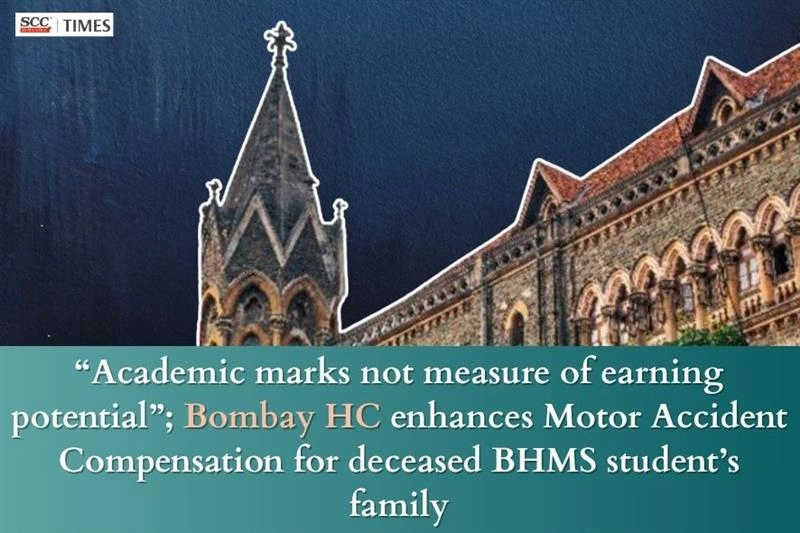
Bombay High Court: In cross appeals under Section 166, Motor Vehicles Act, 1988 (MV Act), arising from an award of compensation by the Motor Accident Claims Tribunal (Tribunal), Sangli, a Single Judge Bench of M. M. Sathaye, J., held that the Tribunal was not justified in assessing the deceased’s income based on his academic marks. The Court observed that even academically average students may earn well in practice, and therefore, the Tribunal’s reasoning was unjustifiable. Holding that partial enhancement was warranted, the Court dismissed the Insurance Company’s appeal and partly allowed the claimants’ appeal, enhancing the compensation to Rs 46,06,000 with interest.
Background
The deceased, aged 23 years, was a third-year BHMS student. On 7 November 2014, while riding his motorcycle, he was dashed by a truck, resulting in his death. His mother, father, and brother filed a claim petition under Section 166, MV Act seeking Rs 1,32,25,000. The Tribunal assessed the monthly income at Rs 20,000 and applied a multiplier of 18, awarding Rs 21,93,000 with interest.
However, the Insurance Company denied liability, contending that the deceased was rash and negligent, and solely responsible for the accident. It argued that the deceased was a below-average student, and therefore Rs 20,000 per month was excessive and Rs 10,000 would have been appropriate. It also contended that none of the claimants were dependents.
The claimants sought enhancement, submitting that the deceased aspired to become a homeopathy doctor and could have earned Rs 30,000 to Rs 35,000 per month.
Analysis and Decision
The Court emphasised that the deceased was a third-year BHMS (homeopathy) student, who had scored less than 50 per cent, however it cannot be assumed that the deceased could not have earned well as a future homeopathy doctor. The Court highlighted that the Tribunal, based on the marks obtained in the second-year BHMS exam (less than 50 per cent), held that it is an exaggeration to hold that by running a homeopathy clinic, Rs 40,000 could have been earned.
The Court noted that such direct connection between “marks obtained during academics” and “potential to earn after becoming a professional” cannot be justified. It was observed that “academic excellence” is different and “ability to earn as a professional” is different, and just as it is true that an academically excellent student may or may not earn well, it is also equally true that an academically average or even below-average student may earn very well in practice or profession. The Court opined that what is necessary to be considered is that a student aspiring to become a homeopathy doctor, who had reached the third year of the degree course concerned, was lost in the accident, therefore, the reason based on which the amount is reduced is found unjustifiable.
The Court referred to Chandra v. Mukesh Kumar Yadav, (2022) 1 SCC 198, wherein it was held that merely because the claimants were unable to produce documentary evidence to show the monthly income, same does not justify adoption of lowest tier of minimum wage while computing the income. The Court further relied upon Prabhavathi v. Bangalore Metropolitan Transport Corpn., 2025 SCC OnLine SC 455, where it was observed that under the MV Act it is established that in compensation cases, the strict rules of evidence used in criminal trials do not apply.
The Court emphasised that reasonable guesswork attached to reality is both necessary and permitted based on the facts and circumstances of each case, and thereby, considering the overall background of the claimants’ family and the fact that the deceased was a student of the medical profession of homeopathy, partial enhancement needs to be granted to the extent of Rs 30,000 per month. The Court further noted that the argument about absence of dependency has no merit since the Insurance Company has not led any evidence to indicate that the mother is receiving pension.
Finally, the Court dismissed the Insurance Company’s appeal and partly allowed the claimants’ appeal, enhancing the compensation to Rs 46,06,000 with interest at 7 per cent per annum.
[National Insurance Co. Ltd. v. Sou. Malan Anil Holkar, First Appeal No. 924 of 2022, decided on 16-3-2026]
Advocates who appeared in this case:
For the Appellant: Akshay Kulkarni a/w Avesh Ghadge and Aditya Ghadge
For the Respondents: Vishwjeet A. Desai a/w Amey V. Mahajan i/b Ashok Desai