
Disclaimer: This has been reported after the availability of the order of the Court and not on media reports so as to give an accurate report to our readers.
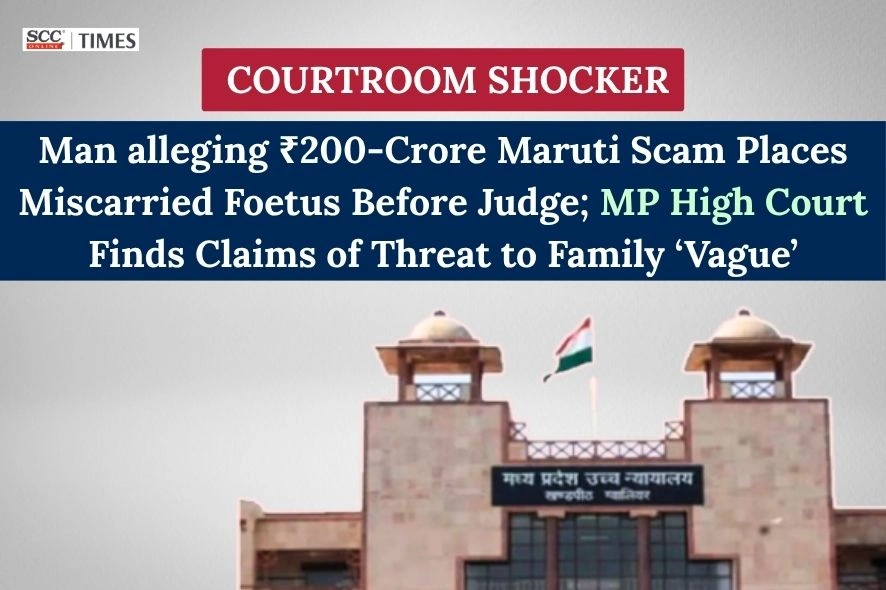
Madhya Pradesh High Court: In a writ petition filed by a man seeking relief against alleged attacks made on him and his family due to his alleged exposure of Rs 200 Crore embezzlement by Maruti Suzuki India Limited (Maruti), the Single Judge Bench of Himanshu Joshi, J., dismissed the petition, holding that the petitioner’s allegations were misconceived, vague, and not supported by material particulars. The Court also rebuked the petitioner for attempting to evoke the Court’s sympathy by placing his wife’s miscarried foetus in front of the Court dais, stating that such conduct was highly objectionable, improper, and amounted to lowering the dignity and decorum of the Court.
Background
The petitioner alleged that he had exposed embezzlement and theft of more than Rs 200 Crores in Maruti, and due to this, he and his family members were being subjected to threats and physical attacks on several occasions. He claimed that he submitted complaints to various authorities, including the President of India, Central Government authorities, and State Government authorities, but no action was taken against the alleged attackers.
He further contended that recently, he, his wife, and his daughter were attacked by a car, which allegedly resulted in his wife’s miscarriage. In a previous incident of a fire attack on his car, his elder daughter sustained severe injuries and was rendered disabled. The incident has caused immense physical, emotional, and financial hardship to the family, and the effects of the same continue to persist. According to him, despite filing complaints, the police authorities have not taken any action and instead have been harassing him by issuing notices.
Aggrieved by such inaction, the petitioner filed the present petition under Article 226 of the Constitution seeking multiple reliefs including directions to the respondent police authorities to conduct an impartial investigation, consideration of his representations by various authorities, recovery of an alleged amount of more than Rs 200 crore from Maruti, and payment of compensation to the petitioner as well as to the Government of India and Madhya Pradesh.
During the course of the proceedings, the petitioner placed a foetus in front of the Court dais.
Analysis
After hearing the arguments and on perusal of the record, the Court stated that the petition was completely vague and bereft of any material particulars. The petitioner levelled serious allegations involving the commission of offences, large-scale embezzlement, and attacks upon his family members without producing any supporting documents or material to substantiate the same. The alleged complaints made before the police authorities were also not filed with the petition.
The Court remarked that, “The manner in which sweeping allegations have been made against various authorities and a private company, without any cogent material, clearly indicates that the petition lacks bona fides. The extraordinary jurisdiction of this Court under Article 226 of the Constitution cannot be invoked on the basis of vague and unsubstantiated allegations.”
The Court noted that the petitioner had previously approached the Court by filing two writ petitions regarding the same incident, and both the petitions were subsequently withdrawn with liberty to avail the appropriate remedy before the competent forum. Furthermore, before filing the amended petition, the petitioner had sought relief of euthanasia but had now altered his stand to seek compensation and damages for himself. Thus, the Court stated that, “Such shifting stands and repeated invocation of the writ jurisdiction of this Court, without placing any cogent supporting evidence or material on record, clearly indicates that the petitioner is indulging in vexatious and speculative litigation.”
Referring to the remedy of filing a complaint before a magistrate under Section 175(3), Nagarik Suraksha Sanhita, 2023, the Court stated that the petitioner’s conduct reflected that he is a litigious person attempting to repeatedly agitate the same issue before the Court without pursuing the aforesaid statutory remedy or the remedies as earlier directed.
Thus, the Court held that the present petition was misconceived, unsupported by material particulars, appeared to be bogus, and did not deserve to be entertained in the exercise of writ jurisdiction.
Accordingly, the petition was dismissed. However, if the petitioner was aggrieved by any inaction or action on the part of the police authorities, he could avail an appropriate remedy before the jurisdictional Magistrate concerned as per law, including by invoking the remedy available under Section 175(3).
Regarding the incident of placing a foetus in front of the Court dais during the proceedings, apparently with a view to evoking sympathy of the Court, the Court remarked that such an act was highly objectionable, improper, and amounted to lowering the dignity and decorum of the Court. Court proceedings cannot be converted into a platform for emotional display or for attempting to secure undue sympathy.
While expressing its sympathy for any personal loss or grief that the petitioner and his family may have suffered, the Court stated that it was equally necessary to emphasise that the Court functions on the basis of law and evidence. The Court is the same for every litigant, and the grief or suffering of one party cannot be weighed against that of another to influence the judicial process.
“Justice is administered strictly in accordance with law and on the basis of legally admissible material placed on record, and not on emotional considerations or theatrical conduct in the Courtroom.”
The Court added that bringing a miscarried foetus into the courtroom by a private individual is wholly improper and contrary to law. Additionally, a foetus is required to be handled and disposed of strictly in accordance with the provisions of the Biomedical Waste Management Rules, 2016. Thus, unauthorised carrying and display of such remains in a public place like a courtroom not only violates the prescribed procedure, but also, prima facie, amounts to offering indignity to a human corpse, punishable under the Nyaya Sanhita, 2023.
Thus, the Court further cautioned the petitioner against repetition of such conduct in the future before the Court, any other judicial forum, or any public authority.
[Dayashankar Pandey v. His Excellency the President of India, 2026 SCC OnLine MP 3191, decided on 11-3-2026]
Advocates who appeared in this case:
For the petitioner: Petitioner in person
For the respondent: Deputy Advocate General Vivek Sharma, Govt. Advocate Priyanka Mishra, Senior Advocate Manoj Sharma, and advocate Lavanya Verma