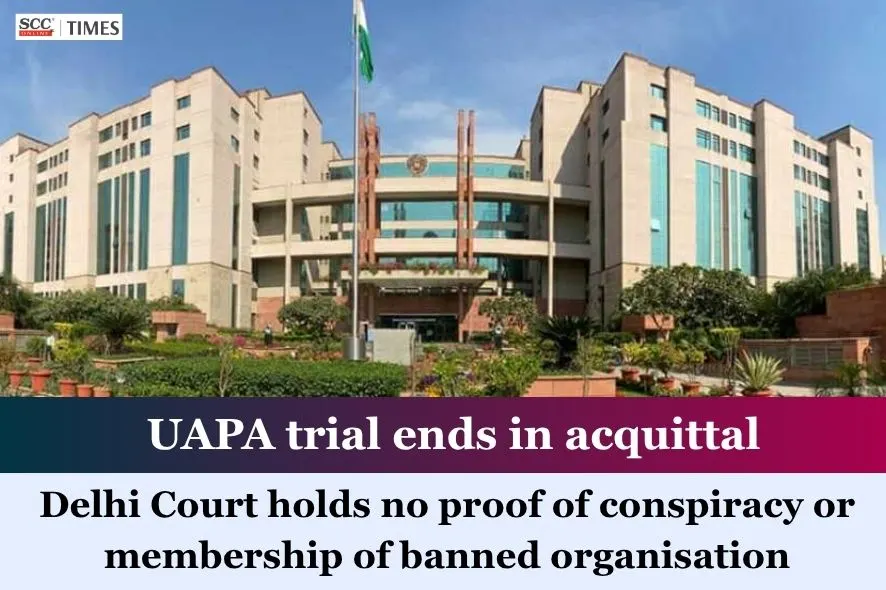
Delhi Court: While deciding a sessions trial under Sections 18 and 20 of the Unlawful Activities (Prevention) Act, 1967 (UAPA) and Section 25 of the Arms Act, 1959 (Arms Act), a Single Judge Bench of Amit Bansal, J., observed that the prosecution failed to establish that the accused persons had conspired to commit a terrorist act or were members of a banned terrorist organisation. The Court noted that although pistols and cartridges were recovered and electronic evidence in the form of mobile phone data was placed on record, the prosecution’s case rested primarily on the testimony of police officials, with no independent public witness joined despite availability. Emphasising that the prosecution was required to prove its case through admissible and reliable evidence, the Court held that the material on record was insufficient to establish the charges beyond reasonable doubt and accordingly acquitted the accused persons of all offences.
Background
The case arose from an input received through reliable sources in the office at Special Cell that some radicalised youth of Jammu & Kashmir had pledged allegiance with banned terrorist organization ISIS/DAESH and were involved in terrorist activities and for that purpose were procuring sophisticated weapons through their contacts in Uttar Pradesh. On 6 September 2018, acting upon such information, a raiding party was constituted and the accused persons were apprehended near Jama Masjid bus stop, Netaji Subhash Marg, New Delhi, where upon search, one pistol of 7.65 mm calibre along with five cartridges was recovered from each of the accused persons from their respective bags.
It was the case of the prosecution that the accused persons had pledged allegiance with ISIS/DAESH, were in touch with their associates through BBM chats and had procured arms and ammunition from Uttar Pradesh for executing terrorist acts in Jammu & Kashmir. It was further alleged that they were in contact with co-accused persons and that weapons were arranged through certain persons for a total amount of Rs 52,000.
The prosecution examined 23 witnesses including members of the raiding team, forensic experts and other formal witnesses and relied upon recovery of pistols and cartridges, disclosure statements and electronic evidence including data retrieved from mobile phones.
The accused persons pleaded not guilty and claimed trial and challenged the case of the prosecution including the absence of independent public witnesses and the insufficiency of material to establish conspiracy or membership of terrorist organisation.
Analysis and Decision
The Court emphasised that to establish the offences under Sections 18 and 20 UAPA, the prosecution failed to prove that the accused persons were propagating the ideology of terrorist outfit ISIS in India and that they were in touch with another ISIS militant. Similarly, no material was placed on record to prove that the accused persons were members of the terrorist organization IS-JK and conspired with other co-accused persons to commit a terrorist act or acts preparatory to the commission of a terrorist act.
The Court observed that no satisfactory explanation was offered for the prolonged custody of the mobile phones with the Investigating Officers (IOs). Further, it was not explained why the devices were not deposited in the malkhana and promptly sent for forensic examination, which raised a strong doubt of tampering. Without any plausible or satisfactory explanation, the prolonged custody of the devices remained with the IOs in an unsealed condition. In these circumstances, the Court noted that no reliance could be placed on the alleged data, including the screenshots of BBM chats, as allegedly recovered from the mobile phones.
The Court highlighted that it was evident that the place of alleged recovery was a busy area where public persons were present but were not joined as witnesses at any stage, including the alleged recovery proceedings of arms and ammunition from the accused persons. The Court observed that the failure to join independent witnesses, especially when public witnesses were available, raised a strong doubt on the prosecution version regarding the recovery of the said arms and ammunition.
The Court emphasised that no explanation was given by the prosecution as to how the FIR number was mentioned on the documents, raising a doubt about the genuineness of the arms and ammunition allegedly recovered from the accused persons. The Court noted that the FIR number given on the top of the documents clearly indicated that either the FIR was recorded prior to the alleged recovery or the number was inserted after its registration. In both situations, the Court observed that it seriously reflected upon the veracity of the prosecution’s version and created a great deal of doubt about the recovery of arms and ammunition in the manner alleged.
The Court referred to Anvar P.V. v. P.K. Basheer, (2014) 10 SCC 473 wherein the Supreme Court held that under Section 65B(4) of the Evidence Act, if it is desired to give a statement in any proceedings pertaining to an electronic record, it is permissible provided conditions are satisfied: (a) there must be a certificate identifying the electronic record, (b) describing the manner in which it was produced, (c) furnishing particulars of the device involved, (d) dealing with conditions under Section 65B(2), and the certificate must be signed by a responsible official ensuring source and authenticity. The Court, while applying the above principles, observed that the electronic record, particularly the screenshots of the requisite chat session in the mobile phone, could not be read in evidence and became inadmissible. Moreover, the Court noted that the prosecution also failed to prove that the accused persons communicated with their handlers on the BBM App and failed to prove the BBM App IDs of the accused.
The Court therefore concluded that the prosecution failed to prove the charge against both accused persons that on 6 September 2018 they, being members of the banned terrorist organisation ISIS, conspired with each other and with other persons to commit a terrorist act or any act preparatory to the commission of a terrorist act within Indian territory, and in pursuance of the said conspiracy purchased/collected weapons for the purpose of committing a terrorist act and had chats with the said persons through BBM and WhatsApp in that context.
Accordingly, the Court held that both accused persons are acquitted under Sections 18 and 20, UAPA and also under Section 25(1B)(a), Arms Act.
[State v. Jamsheed Zahoor Paul, SC No. 115 of 2019, decided on 19-03-2026]
Advocates who appeared in this case:
For the State: Ld. Addl. PP
For the Accused: Ahmad Ibrahim, Tamanna Pankaj, Archit Krishna, Priya Vats, Ld. Advocates