
Disclaimer: This has been reported after the availability of the order of the Court and not on media reports so as to give an accurate report to our readers.
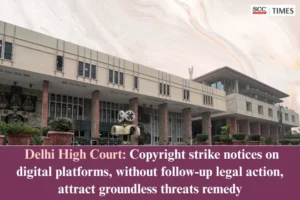
Delhi High Court: In a suit seeking to restrain the alleged copyright owners from issuing any groundless threat of copyright infringement and declare that there was no infringement, the Single Judge Bench of Tejas Karia, J., held that the extent of use of the copyrighted material fell within “fair use” and does not amount to infringement. The Court explained that Section 60, Copyright Act, 1957, allows any person aggrieved of groundless threats of legal action by the copyright owner, to institute a declaratory suit, however, the remedy is only available if the alleged copyright owner did not take proper legal action to settle the dispute between the parties.
Background
Plaintiff is in the media and broadcasting business with presence on both traditional and digital platforms, including YouTube, in the name and style of “TV9”. The plaintiff, for covering various news events, used some on-ground footage from various sources available online (subject work) to create and upload original news programs on its YouTube channel. Thereafter, the plaintiff received copyright strike notices from Defendants 2 to 5 on the said videos (subject videos) uploaded by the plaintiff on YouTube, alleging copyright infringement.
The plaintiff approached Defendant 2 for an amicable settlement. However, the plaintiff was approached by a US law firm, purportedly acting on behalf of Defendants 2 to 4 and threatened with adverse consequences if the plaintiff did not comply. Defendant 5 remained unresponsive to the plaintiff.
The plaintiff filed a counter-notification as per the YouTube policy. Defendant 3 initiated proceedings in the US in respect of its claim of copyright infringement of the “subject works”. The plaintiff instituted the present suit seeking an injunction against Defendants 2 to 5, restraining them from issuing any groundless threat of copyright infringement.
Aggrieved by the non-appearance of Defendants 2 to 5, the plaintiff filed an application under Order XIII-A, Civil Procedure Code, 1908, seeking summary judgment.
Issues
-
Whether the plaintiff is entitled to a declaration that the “subject videos” and the usage of the “subject works” do not amount to copyright infringement of the “subject works”.
-
Whether the plaintiff’s use of the “subject works” in the “subject videos” falls within the doctrine of de minimis non curat lex, as recognised in copyright jurisprudence.
-
Whether the plaintiff is entitled to a decree and order restraining Defendants 2 to 5 from issuing any groundless threat to the plaintiff alleging copyright infringement in respect of the “subject videos”.
Analysis and Decision
At the outset, the Court noted that the right of Defendants 2 to 5 to file a written statement was already closed, and no affidavit of admission/denial was filed either. The Court accordingly stated that all the averments made in the plaint were deemed admitted.
The Court examined whether the limited use of the “subject works” within the “subject videos” falls within “fair use” in terms of Section 52(1)(a)(iii) of the Act. The Court stated that Section 52(1)(a)(iii) provides an exception for a copyright infringement in cases when a work is used fairly while reporting current events or current affairs.
“The Courts, in ascertaining whether extracts taken from copyrighted work have been put to fair use, have considered the extent and the length of the extracts as a relevant factor and have also held that the long extracts followed by short comments may, in certain circumstances, be unfair, while short extracts followed by long comments may be fair. However, the Courts have also observed that it is impossible to define what is ‘fair dealing’ and that it is a question of fact and degree of impression.”
The Court observed that in the present case, the material-on-record, including the tabulated details of the “subject videos”, demonstrated that only limited portions of the “subject works” have been used, and that too for brief durations within the overall content. The Court noted that only brief and segmented portions of the “subject works” were used within the “subject videos”, forming part of a larger narrative and commentary, and not as standalone or independent exploitation. The Court noted that the extracted portions were minimal in comparison to the total duration of the respective videos.
The Court relied on India TV Independent News Service (P) Ltd. v. Yashraj Films (P) Ltd., 2012 SCC OnLine Del 4298, wherein it was held that the doctrine of de minimis excludes trivial copying causing no demonstrable harm to the copyright owner. The Court accordingly held that, in view of the limited use of the “subject works” and the absence of any demonstrable harm, such use fell within the doctrines of fair use and de minimis, and did not constitute copyright infringement.
The Court examined the next issue pertaining to Section 60 of the Act and the groundless threat of legal proceedings by Defendants 2 to 5, alleging copyright infringement in respect of the “subject videos”.
The Court noted that the plaint specifically pleaded that substantial portions of the “subject works” in the “subject videos” were sourced under an appropriate licence. The Court held that in the absence of any rebuttal, and considering the material-on-record, the plaintiff had prima facie established that the “subject videos” did not constitute infringement. The Court further held that the plaintiff had successfully demonstrated that the threats issued by Defendant 2 to 5 were groundless, as no alleged copyright infringement could be made out.
The Court stated that even in cases where the alleged infringement was not established, the courts must still examine the proviso to Section 60 of the Act. The Court stated that the proviso excludes relief where the person issuing threats commences and prosecutes an action for the alleged copyright infringement, with due diligence. The Court, relying on Manya Vejju v. Sapna Bhog, observed that “due diligence” requires good faith and reasonable care, and “commences and prosecutes” mandates a genuine and earnest pursuit of legal proceedings, not mere empty threats. The Court further noted that the term “action” is governed by the expression “commences and prosecutes … for infringement of copyright” under the proviso, which refers to a meaningful proceeding capable of effectively and completely resolving the dispute on infringement; proceedings lacking such capacity would not qualify as an “action” under Section 60.
The Court noted that the term “obtain an injunction against the continuance of such threats” under Section 60 indicates that the Court is empowered not merely to examine past conduct but to restrain the repetition or persistence of such threats. The Court examined the actions taken by Defendants 2 to 5 in respect of the alleged copyright infringement. The Court noted that Defendant 3 did initiate a US case, but the same was voluntarily dismissed and did not qualify as commencement and prosecution of ‘an action for infringement of the copyright claimed’ within the meaning of the proviso to Section 60. The Court noted that no action by other defendants was evidently shown to have been instituted pursuant to the counter-notification issued in respect of the “subject videos” by the plaintiff. The Court held that Defendants 2 to 5’s issuance of strike notices, accompanied by demands for the documents coupled with communications indicating adverse consequences in the event of non-compliance, cannot be construed as commencement and prosecution of an action for infringement of the copyright claimed in the “subject works”. The Court noted a strike notice is an intermediary-driven compliance process and does not, by itself, amount to recourse before a competent court of law.
Hence, the Court held that the defendants did not initiate any action before a competent court to resolve the dispute on alleged infringement, despite the plaintiff having filed counter-notifications. The Court, therefore, held that the issuance of strike notices, in the absence of any such action under Section 60, makes the threats actionable. The Court restrained Defendants 2 to 5 from issuing any groundless threats to the plaintiff, alleging copyright infringement in respect of the “subject videos”. The Court declared that the “subject videos” and the usage of the “subject works” therein do not constitute copyright infringement of the “subject works”.
Accordingly, the Court allowed the present application and decreed the suit against Defendants 2 to 5.
[Associated Broadcasting Co. Ltd. v. Google LLC, 2026 SCC OnLine Del 815, decided on 28-2-2026]
Also read: Groundless Threats of Legal Proceedings: An Analysis under the Trade Marks Act, 1999
Advocates who appeared in this case:
For the plaintiff: Harsh Kaushik, Shwetank Tripathi, Deepank Singhal, Devangini & Harsh Prakash, Advocates
For the defendant 1: Aishwarya Kane, Advocate