


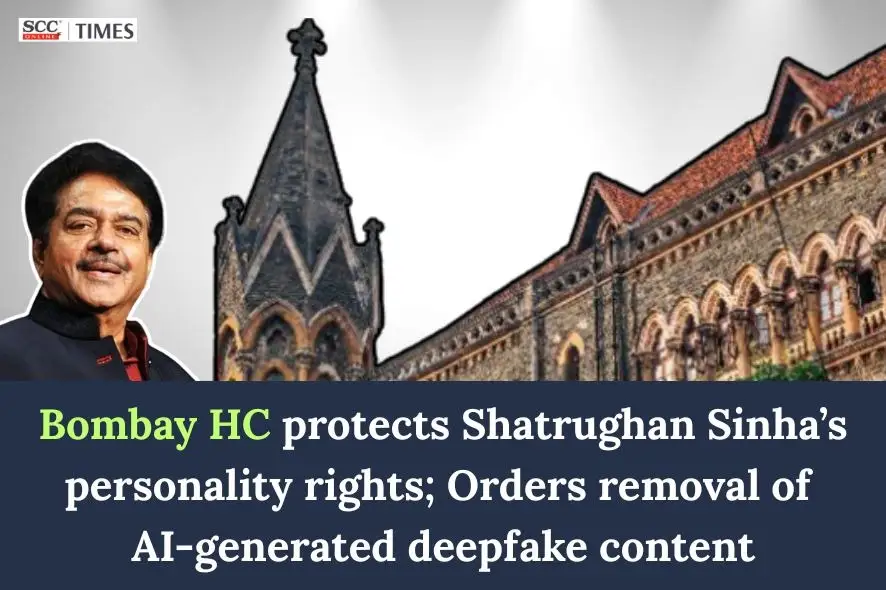
Bombay High Court: While hearing a plaint filed by the acclaimed actor Shatrughan Sinha (plaintiff) seeking protection of his personality rights, a Single Judge Bench of Sharmila U. Deshmukh, J., observed that the plaintiff’s name, voice, image, likeness, catchphrase, and other attributes are protectable elements of his persona and right to publicity. The Court, therefore, granted an ex parte ad interim injunction restraining the defendants from creating, publishing, or disseminating any artificial intelligence (AI)-generated images, videos, manipulated content, or merchandise that misuses and infringes upon the plaintiff’s personality rights.
Background
The suit was instituted seeking permanent and mandatory injunction against the defendants to restrain infringement and unauthorised commercial exploitation of the plaintiff’s personality rights, including his name, screen name, dialogue delivery, likeness, voice, and other attributes. The plaintiff’s screen persona has earned him the iconic sobriquet “Shotgun”, and his distinctive dialogue delivery and unique manner of delivering of term “khamosh” has become inseparably associated with him and is regarded as one of Hindi cinema’s most memorable cinematic expressions.
The defendants comprise social media platforms, pornographic websites, ecommerce portals, content-sharing platforms, blogs, caricature websites, celebrity portals, and certain government departments impleaded as proforma defendants to facilitate enforcement of the orders.
The plaintiff submitted that he is a renowned actor who has acted in numerous films, performed live shows, and enjoys moral rights in his performances. It was contended that his persona has been exploited without authorisation through fake profiles, memes, GIFs, digital stickers, and AI-generated illustrations. Several platforms and websites have misused his name and image for advertisements and content.
It was further pointed out that ecommerce sites are selling merchandise bearing his name and image, and that AI-generated deepfakes, face morphing, and pornographic content have been disseminated, thereby degrading his reputation and causing irreparable harm to his dignity and goodwill.
Consequently, the plaintiff sought ex parte ad interim relief for protection of his personality rights.
Analysis and Decision
The Court emphasised that the plaintiff’s personality attributes are protectable elements of his personality right as well as right to publicity. The Court noted that the concept of personality right has gained momentum by reason of unauthorised exploitation on digital platforms and social media for commercial gain, which often results in tarnishing or damaging the personality rights of an individual and more often of a renowned and well-known personality.
The Court emphasised that the right of protection of the personality right can be prima facie traced to the provisions of passing-off under the Trade Marks Act, 1999 (Trade Marks Act), as well as the moral rights protected under the Copyright Act, 1957 (Copyright Act). The Court further observed that Section 2(qq), Copyright Act defines “performer” to include an actor, and Section 38-B, Copyright Act protects the moral right of the performer to restrain or claim damages in respect of any distortion or mutilation of personality rights that would be prejudicial to his reputation.
The Court referred to Arun Jaitley v. Network Solutions Private Limited, 2011 SCC OnLine Del 2660, wherein it was held that the right to use one’s own name is a personal right as against the right to use the trade mark, which is merely a commercial right, and if the name, which besides being a personal name, is distinct due to its inherent distinctiveness, it also fulfils the criteria of a trade mark. The Court, in agreement with the view taken by the Delhi High Court in Arun Jaitley (supra), held that the plaintiff, who is an acclaimed actor and well-known personality not only in the Hindi film industry but also in politics, has a distinctive name that fulfils the criteria of a trade mark and is liable to be protected under Section 27(2), Trade Marks Act.
The Court noted that the defendants, in one or another manner, by sale of merchandise utilising the plaintiff’s persona, name, image, and photographs for commercial benefit, are passing off their goods as being associated with the plaintiff. The Court highlighted that the use of AI to produce images and videos of the plaintiff by morphing his face tarnishes the reputation and goodwill of the plaintiff. It was further observed that the creation of digitally manipulated photographs as well as AI-generated content by mutilating and distorting the plaintiff’s persona, including his image and photographs, violates the moral protectable right under Section 38-B, Copyright Act.
The Court noted that, in the present case at hand, there cannot be any justification for misusing the plaintiff’s personality for commercial exploitation, which ultimately results in dilution and tarnishing of the plaintiff’s image, since the creation of digital content without the authority of the plaintiff and exploiting the same unauthorisedly violates the plaintiff’s rights.
Accordingly, the Court restrained the defendants, as well as all persons acting on their behalf, from creating, sharing, or disseminating any product (including but not limited to clothes, t-shirts, postcards, images, posters, books) or content (including audiovisual content, images, videos, etc.) through the use of any technology, including but not limited to AI, Generative AI, machine learning, deepfakes, and face morphing. The Court further restrained them from violating the plaintiff’s personality rights and moral rights by using, exploiting, or misappropriating the plaintiff’s name, voice, image, signature phrase/catchphrase “khamosh” and other aspects of his persona that are identifiable with him, for any commercial or personal gain or otherwise.
The Court directed the defendants to take down all links and websites infringing the plaintiff’s personality rights. It further ordered that the matter be listed for hearing on 30 March 2026, and clarified that the ad interim relief already granted shall continue until that date.
[Shatrughan Prasad Sinha v. John Doe, 2026 SCC OnLine Bom 1241, decided on 16-2-2026]
Advocates who appeared in this case :
For the Plaintiff: Hiren Kamod, Nidhi Singh, Abha Shah and Amisha Upadhyay i/b India Law
Really interesting to see how courts are stepping in to protect a person’s identity online — not just name and image, but voice, likeness, and even style from being used without consent, especially with AI deep-fakes becoming more common. This ruling makes the idea of personality rights feel much more real and relevant in the digital age, and it’s a strong reminder that public figures still have control over how their persona is used online.