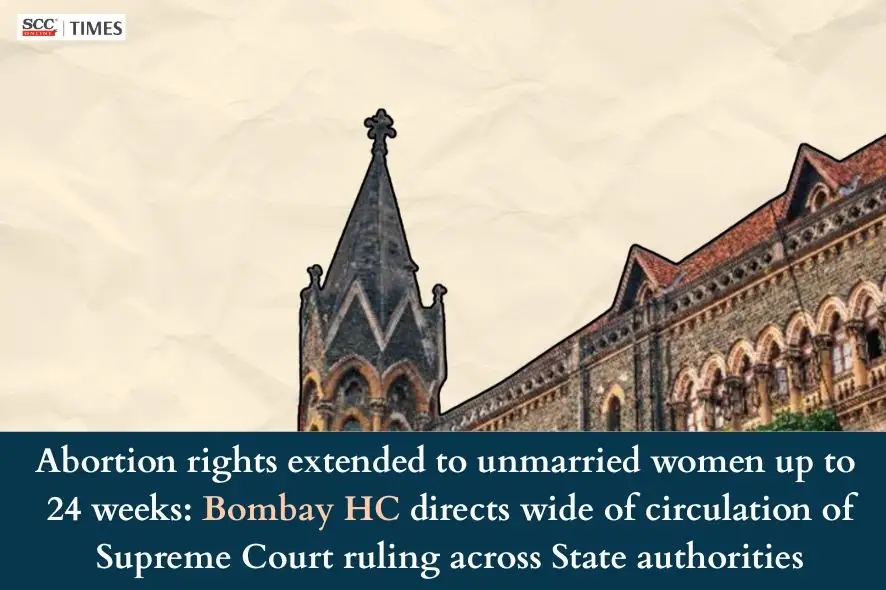
Bombay High Court: In a writ petition under Article 226 of the Constitution, the Division Bench of Bharati Dangre* and Manjusha Deshpande, JJ., held that an unmarried woman carrying a pregnancy of 22 weeks was entitled to medical termination. The Court observed that the authoritative pronouncement of the Supreme Court had already clarified that unmarried women cannot be excluded from the ambit of Section 3(2)(b) of the Medical Termination of Pregnancy Act, 1971 (‘MTP Act’), read with Rule 3-B of the Medical Termination of Pregnancy Rules, 2003 (‘Rules’). Emphasising that reproductive autonomy, dignity, and privacy under Article 21 of the Constitution extend equally to unmarried women, the Court reaffirmed that the right to seek termination of pregnancy up to 24 weeks must be interpreted purposively.
Background:
The instant matter arose from a writ petition filed by a 26-year-old unmarried woman whose pregnancy had advanced to 22 weeks. She contended that the pregnancy was unwanted, arising out of failure of contraceptive device, and that as an unwed mother she would face social stigma and lack of family support.
It was submitted that forcing her to continue the pregnancy would violate her right to live with dignity and compromise her mental health. The petitioner challenged Section 3(2)(b) of the MTP Act and Rule 3-B of the Rules as unconstitutional, arguing that the exclusion of unmarried women was discriminatory and violative of Articles 14 and 21 of the Constitution.
The petitioners approached the Court seeking directions to permit medical termination of pregnancy and to uphold the fundamental rights of unmarried women under the Constitution.
Analysis and Decision:
The Court emphasised that interpretation of subordinate legislation must be consistent with the enabling Act, and that such legislation must be reasonable, in consonance with the legislative policy, and interpreted in a meaningful manner so as to give effect to the purpose and object of the Parent Act. The Court highlighted that an approach in harmony with the statutory scheme must be adopted.
The Court noted that Rule 3-B of the Rules was introduced to remove mischief and to cover women unable to access abortions when their lives underwent significant changes impacting their physical and mental health, and whose decision to have a child was restricted once the length of the pregnancy exceeded twenty weeks. The Court observed that the common thread running through each category of women in Rule 3-B of the Rules was that the woman is in unique and often difficult circumstances with respect to her physical, mental, social, or financial state, and all the different categories of women seek an abortion after twenty weeks either due to delay in recognizing the pregnancy or because of some other change in their environment.
The Court referred to Suchita Srivastava v. Chandigarh Admn., (2009) 9 SCC 1, wherein a woman’s right to make reproductive choices was considered a dimension of “personal liberty” under Article 21 of the Constitution. The Court emphasised the woman’s right to privacy, dignity, and bodily integrity. It further relied on X2 v. State (NCT of Delhi), (2023) 9 SCC 433, where it was held that a narrow interpretation of Rule 3-B of the Rules, limited only to married women, would render the provision discriminatory towards unmarried women and violative of Article 14 of the Constitution, which requires the State to ensure equality before the law and equal protection of laws.
The Court pointed out that by virtue of Article 144 of the Constitution, every authority, civil and judicial, in the territory of India is duty bound to act in aid of the Supreme Court, and therefore all those involved in implementing the provisions of MTP Act and the Rules are bound by the said authoritative pronouncement.
The Court requested the Public Health Department of the State of Maharashtra to ensure wide circulation of the Apex Court’s decision to all functionaries involved in implementing the MTP Act and the Rules. The Court held that since the issue has been put to rest and Rule 3-B of the Rules has received a purposive interpretation by the Supreme Court, the writ petition stands disposed of.
[ABC v. State of Maharashtra, 2026 SCC OnLine Bom 967, decided on 29-01-2026]
*Judgment authored by: Justice Bharati Dangre
Advocates who appeared in this case:
For the Petitioner: Kranti L. C.
For the Respondents: M. P Thakur, AGP, Punima Awasthi, Advocate
Buy Constitution of India HERE