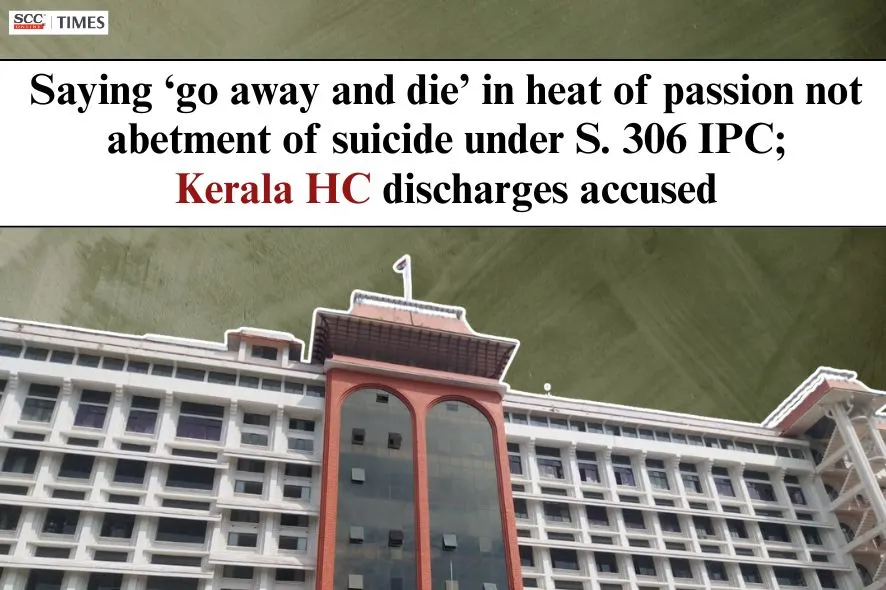
Kerala High Court: While deciding the issue whether the alleged utterance ‘go away and die’ during a wordy altercation could amount to abetment of suicide within the meaning of Section 306 of the Penal Code, 1860 (‘IPC’), a Single Judge Bench of C. Pratheep Kumar, J., held that saying ‘go away and die’, in a heat of passion while quarrelling, without the requisite intention to instigate, is not abetment of suicide. Consequently, the Court set aside the order of framing charge and discharged the accused of the offences under Sections 306 and 204 IPC.
Background
The case originated from an extra marital relationship between Accused 1 (‘accused’) and Accused 2 (‘deceased’). When the deceased came to know that the accused was about to marry another woman, she inquired about the same over the phone, and enraged by the query, the accused scolded the deceased and said, ‘go away and die’. The deceased feeling mentally disturbed, jumped into a well along with her daughter and committed suicide on 15-09-2023 between 5:10 a.m. and 6:00 a.m.
The accused’s counsel submitted that even if the entire allegations levelled against him were believed, the same would not constitute the offences punishable under Sections 306 and 204 IPC. He contended that the comment ‘go away and die’ was made in a heat of passion without any intention to abet suicide. The accused prayed to set aside the Session Judge’s order to frame charges, and his prayer was opposed by the Public Prosecutor.
Analysis and Decision
The Court noted that Section 306 IPC punishes abetment of suicide and that Section 107 IPC defines abetment as instigating, conspiring, or intentionally aiding the commission of an offence. The Court relied on Sanju v. State of M.P., (2002) 5 SCC 371, where in it was held that to:
“tell the deceased ‘to go and die’, itself does not constitute the ingredient of ‘instigation’. The word ‘instigate’ denotes incitement or urging to do some drastic or unadvisable action or to stimulate or incite. Presence of mens rea, therefore, is the necessary concomitant of instigation. It is common knowledge that the words uttered in a quarrel or in a spur of the moment cannot be taken to be uttered with mens rea. It is in a fit of anger and emotional”.
The Court also referred to Swamy Prahaladdas v. State of M.P., 1995 Supp (3) SCC 438, wherein it was observed that words which are casual in nature and are often employed in the heat of the moment between quarrelling people does not amount to abetment of suicide.
The Court observed that in the present case, the words ‘go away and die’ were said by the accused while quarrelling with the deceased, in a heat of passion without having any intention to instigate her to commit suicide, and thus, the offence under Section 306 IPC was not made out. The Court further opined that since the allegations did not constitute the offence under Section 306 IPC, the offence under Section 204 IPC was also not attracted.
Consequently, the Court held that the Sessions Judge’s order to frame charges was liable to be set aside. The Court allowed the criminal revision petition and discharged the accused under Sections 438 and 442 of the Bharatiya Nagarik Suraksha Sanhita, 2023.
[Safwan Adhur v. State of Kerala, 2026 SCC OnLine Ker 1175, decided on 28-1-2026]
Advocates who appeared in this case:
For the Accused: R. Anas Muhammed Shamnad, C.C. Anoop, Saleek C.A., Thareek T.S., Hamdan Mansoor K., Advocates.
For the Respondent: A. Vipin Narayan, SR. PP.
Buy Penal Code, 1860 HERE