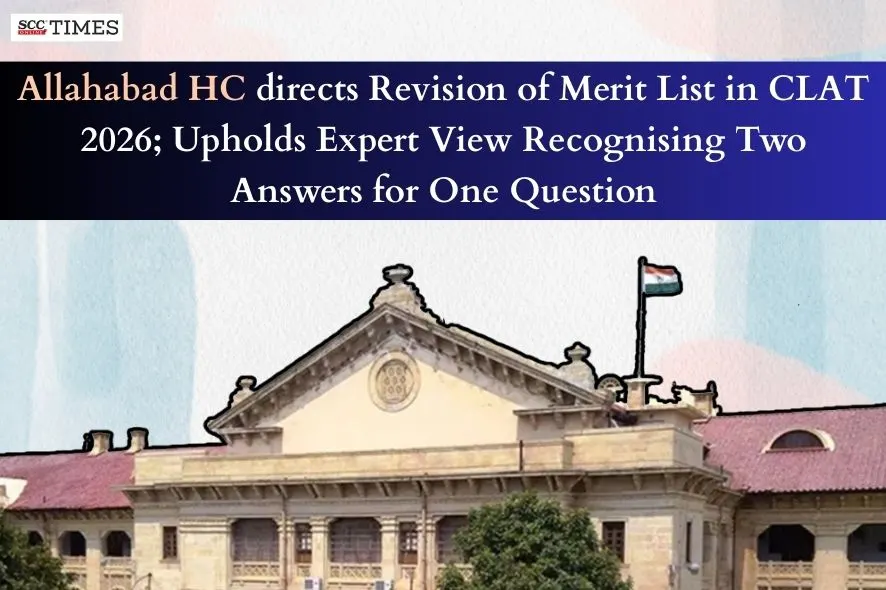
Allahabad High Court: In a big relief to CLAT aspirants, the Allahabad High Court settled the CLAT 2026 two answers for one question issue by directing revision of the merit list after finding that one question had two valid correct answers as per expert evaluation. Deciding the writ petition filed by a law aspirant against incorrect assessment of his marks in the Common Law Admission Test-2026 (“CLAT 2026”), the Single Judge Bench of Vivek Saran, J., partly allowed the petition, holding that the Oversight Committee had, without giving any reason, overruled the decision of the Expert Committee regarding one question which had two correct answers. Accordingly, the Court directed the Consortium of National Law Universities (“CLAT Consortium”) to revise the merit list and republish/renotify the same within one month.
Background
The petitioner appeared in the CLAT 2026. When the provisional answer key was released and the CLAT Consortium invited objections, the petitioner submitted detailed objections against three questions. Thereafter, the final answer key was released, wherein no change of the answers was recorded. The petitioner was selected and called to participate in the counselling. However, contending that his answers were correct and his objections were improperly considered and wrongly rejected, the petitioner approached the Court, ventilating his grievance.
Issues and Analysis
1. Whether the Court had territorial jurisdiction to decide the issue?
Considering the aspect of territorial jurisdiction under Article 226 of the Constitution, the Court stated that even for a small fraction of a cause of action which takes place within the territorial limit of the High Court, it would have jurisdiction to decide the matter.
Thus, the Court held that since the petitioner participated in the District Ghaziabad, UP, a part of the cause of action arose within the territorial jurisdiction of the Court and therefore it had jurisdiction to decide the matter.
2. Whether this Court can enter into the merits of the matter, and if so, what relief can be granted?
At the outset, the Court referred to Ran Vijay Singh v. State of U.P., (2018) 2 SCC 357, wherein the Supreme Court held that the Courts should restrain themselves from re-evaluating or scrutinizing the answer sheets of a candidate as they have no expertise. The Court also referred to U.P. Public Service Commission v. Rahul Singh, (2018) 7 SCC 254, wherein the Supreme Court held that judges cannot take on the role of experts in academic matters. Unless the candidate demonstrates that the key answers are patently wrong on the face of it, the Courts cannot enter into the academic field, weigh the pros and cons of the arguments given by both sides, and then conclude as to which of the answers is better or more correct.
Having gone through the records and the judgments cited by both parties, the Court opined that the answers to such a competitive examination should be left to the wisdom of the experts.
In the instant case, the Court noted that the Expert Committee considered the objections made by the petitioner and answered as follows:
-
For question 6 of booklet C (question 88 of booklet A), option ‘B’ was correct.
-
For question 9 of booklet C (question 91 of booklet A), both options ‘B’ and ‘D’ were correct.
-
For question 13 of booklet C (question 95 of booklet A), option ‘C’ was correct.
Thus, the Court held that the said answers given by the Expert Committee needed no alteration.
However, the Court noted that regarding question 9, the Oversight Committee overruled the said decision of the Expert Committee and retained the correct option as answer ‘B’ for the aforesaid question without assigning any reasons. Furthermore, the Court noted that the members of the Expert Committee were experts in the field, whereas the members of the Oversight Committees were former high dignitaries. While overruling the decision of the said Expert Committee, no reasons were recorded for concluding; the Court held that the same was contrary to settled law.
The Court stated that the CLAT Consortium, in their counter-affidavit, failed to bring on record the reasons for overruling the decision. Although in their written submissions, the CLAT Consortium tried to support the decision of the Oversight Committee by enclosing the reasons of the original paper setter, the same was not filed on an affidavit. Additionally, once the Expert Committee has given its answer after going through the entire record, then the view of the original paper setter was of no relevance.
Thus, in the absence of any reason for overruling the decision of the Expert Committee by the Oversight Committee with respect to question 91 of booklet A/ question 9 of booklet C, the Court quashed the impugned decision and sustained the answers of the Expert Committee.
Accordingly, the Court directed CLAT Consortium to revise the merit list by awarding marks against question 9 of booklet C/ question 91 of booklet A and to all other questions which correspond to the same in different booklets of CLAT-2026 by treating both ‘B’ and ‘D’ as correct answers. The Court further directed CLAT Consortium to revise the merit list and republish/renotify the same within one month.
Since the first round of counselling had already been finalized, the Court directed that the students/candidates who had already taken admission pursuant to the first round of counselling shall not be disturbed, for further counselling, CLAT Consortium shall act on the revised/re-notified merit list.
With the aforesaid directions, the writ petition was partly allowed.
[Avneesh Gupta (Minor) v. Consortium of National Law Universities, 2026 SCC OnLine All 220, decided on 03-02-2026]
Advocates who appeared in this case:
For the petitioner: Petitioner in person
For the respondent: Avneesh Tripathi