Disclaimer: This has been reported after the availability of the order of the Court and not on media reports, so as to give an accurate report to our readers.
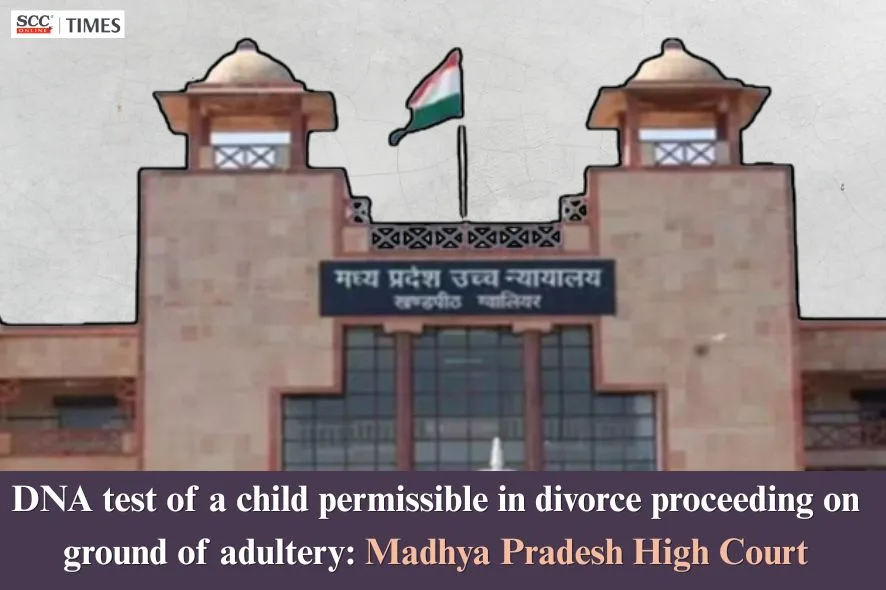
Madhya Pradesh High Court: In a petition filed by the petitioner-wife, challenging the Jabalpur Family Court’s order directing a Deoxyribonucleic Acid (‘DNA’) test of a minor girl child in divorce proceedings to determine if the child is born out of wedlock, the Single Bench of Vivek Jain, J., held that where a divorce petition is founded on allegations of adultery and is supported by specific pleadings of non-access, ordering a DNA test to ascertain the if the grounds hold, does not violate the statutory presumption of legitimacy under the Evidence Act. The Court upheld the Family Court’s direction and dismissed the petition.
Background:
In the instnat matter, the wife challenged the order of the Family Court, Jabalpur, which allowed the respondent-husband’s application seeking a DNA test of the child born during the subsistence of the marriage. The husband had instituted divorce proceedings alleging adultery.
The wife contended that such testing would invade privacy, stigmatise the child, and undermine the statutory presumption of legitimacy under S. 112 of the Evidence Act. She also argued that DNA testing cannot be directed ‘at mere asking’ and that courts must protect the child’s dignity, best interests and legitimacy. The petitioner placed reliance on the case of Aparna Ajinkya Firodia v. Ajinkya Arun Firodia (2024) 7 SCC 773 (‘Aparna Ajinkya Firodia case’).
On the other hand, the husband contended that the divorce petition contained specific pleadings of non-access. He asserted that, being posted in the Army, he had limited access to his wife and that the timeline of pregnancy rendered the biological paternity of the child doubtful. It was submitted that DNA evidence was necessary to establish adultery.
Issue:
Whether a Court can direct the DNA test of a child in a divorce petition alleging adultery?
Analysis
At the outset, the Court noted that the petition did not concern the husband’s willingness to maintain the child. It was only concerned with the DNA test to prove the adultery of the wife. The Court relied on Dipanwita Roy v. Ronobroto Roy (2015) 1 SCC 365 (‘Dipanwita Roy case’) to examine the scope and object of S. 112 of the Evidence Act. This Section embodies a rule of public policy that there is a conclusive presumption of legitimacy in respect of a child born during the subsistence of a valid marriage. In the Dipanwita Roy case, the Court recognised that:
“in the process of substantiating his allegation of infidelity, the respondent husband had made an application before the Family Court for conducting a DNA test which would establish whether or not he had fathered the male child born to the appellant wife.”
Further, the Court observed:
“But for the DNA test, it would be impossible for the respondent husband to establish and confirm the assertions made in the pleadings.”
In light of both judgments, Dipanwita Roy case and Aparna Ajinkya Firodia case, the Court stated that inferences regarding the requirement of a DNA test are to be drawn based on the facts and circumstances of each individual case.
In furtherance of this, the Court referred to Ivan Rathinam v. Milan Joseph 2025 SCC OnLine SC 175, which reiterated that an order for DNA testing must satisfy a threshold of “eminent need” and ‘balancing of competing interests’. It noted that the Courts must consider the existing evidence to assess the presumption of legitimacy. It also cautioned that only where the existing evidence is insufficient and the interests of justice outweigh the potential harm to privacy and dignity, the Court should consider allowing the DNA test of a child. The Court ultimately observed that:
“There are thus, two blockades to ordering a DNA test : (i) insufficiency of evidence; and (ii) a positive finding regarding the balance of interests.”
Lastly, the Court referred to R. Rajendran v. Kamar Nisha, 2025 SCC OnLine SC 2372, where one of the parties relied on the Dipanwita Roy case to argue for DNA testing of a child. The Supreme Court clarified that DNA testing cannot be ordered if the object of the test is to dislodge the statutory presumption of legitimacy that safeguards the child. Such a test can only be ordered if the proceedings were in the context of a petition for divorce on the grounds of adultery.
From the perusal of the aforementioned judgments, the Court conclusively held that DNA testing can be ordered in a divorce petition when the issue relates to the adultery of the wife and sufficient pleadings of non-access are presented by the party. Importantly, such a petitioner must not seek any declaration on the illegitimacy of the child.
Applying the aforesaid principles to the facts of the case, the Court found that the husband had made specific and detailed pleadings regarding non-access during the probable period of conception. The Court noted that the pleadings were not vague or speculative and set out relevant circumstances relating to the posting of the husband in the Army, his limited visits to the matrimonial home, and the medical improbability of the pregnancy timeline asserted by the wife.
The Court held that where a divorce petition is founded on specific allegations of adultery supported by pleadings of non-access, directing a DNA test to ascertain the truth is legally permissible and does not violate the presumption of legitimacy under S. 112 of the Evidence Act. Therefore, the Court upheld the direction of the Family Court for DNA testing and dismissed the petition.
[X v. Y, 2026 SCC OnLine MP 428, decided on 20-01-2026]
Advocates who appeared in this case:
For the petitioner: Mr Anuj Pathak
For the respondents: Ms Sheetal Tiwari