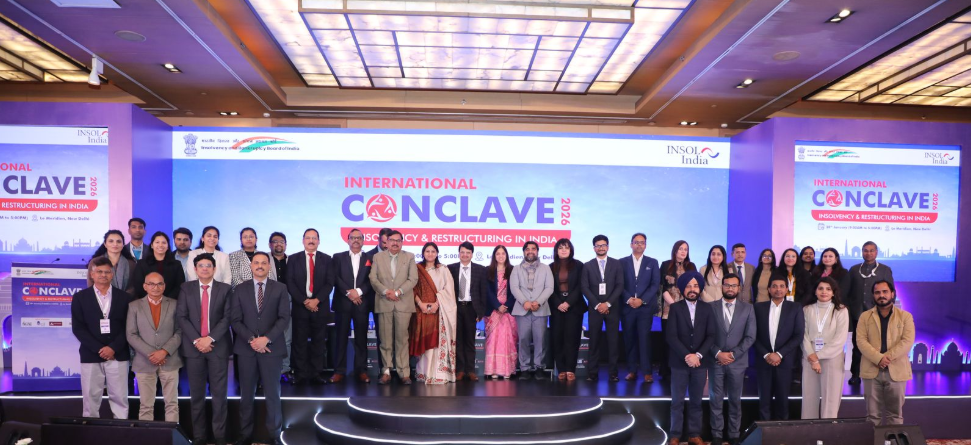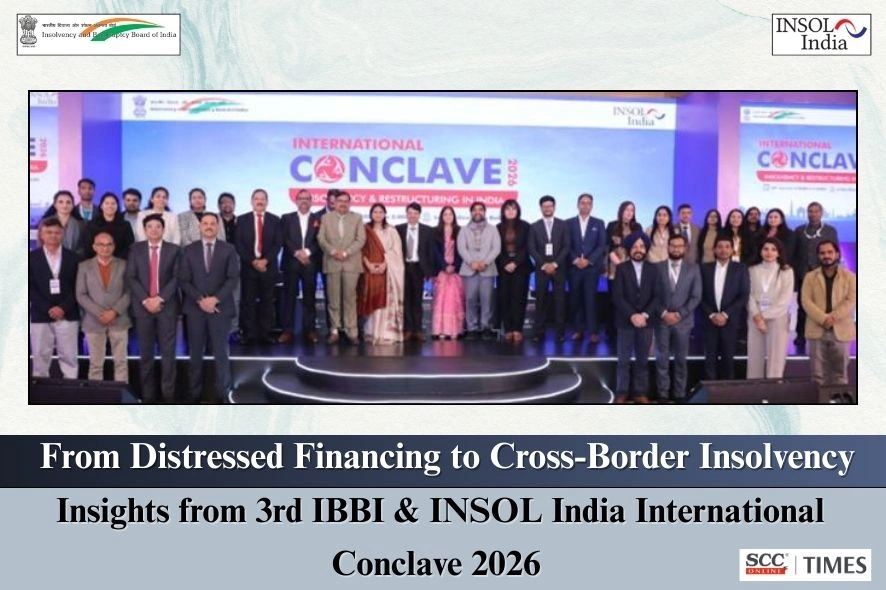
Hosted jointly by the Insolvency and Bankruptcy Board of India (‘IBBI’) and INSOL India, the 2026 Conclave convened regulators, practitioners, investors, academics, and restructuring professionals to examine key developments and emerging challenges under India’s insolvency and restructuring framework.
Building on insights from nearly a decade of implementation of the Insolvency and Bankruptcy Code, 2016 (‘IBC’), the Conclave served as a platform for structured dialogue on strengthening pre-insolvency mechanisms, deepening distressed investment markets, and preparing India for a Model Law—based cross-border insolvency regime. With participation from experts across multiple jurisdictions, the discussions offered a forward-looking and comparative perspective on the next phase of insolvency reform in India.
Panel III: Out-of-Court Workouts & Pre-Pack Solutions
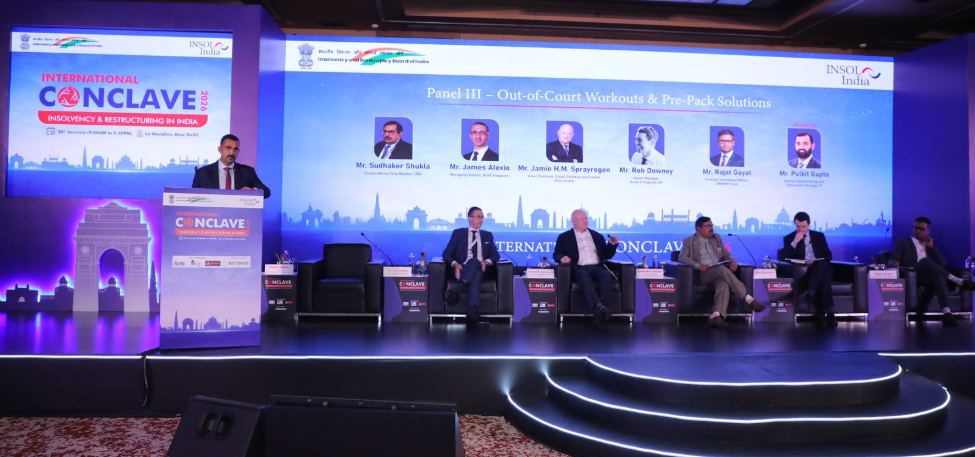
With the IBC nearing a decade of implementation, the session focused on alternative resolution pathways that operate outside the formal insolvency process. Emphasis was placed on the growing relevance of pre-packaged insolvency and out-of-court workouts as tools that encourage early intervention and value preservation.
Moderating the session, Mr. Pulkit Gupta, Partner, Restructuring and Turnaround Strategy, EY, observed that globally, such mechanisms are frequently preferred as a first resort before triggering formal insolvency proceedings, owing to their speed, flexibility, and ability to preserve enterprise value.
Opening the discussion, Mr. Sudhaker Shukla, Former Whole Time Member, IBBI, reflected on India’s nine-year insolvency journey, highlighting that beyond behavioural change and improved recoveries, there has been a “decisive shift towards sectoral outcomes.” He pointed to regulatory interventions in the real estate sector as unprecedented, noting that despite initial scepticism, such measures remained unchallenged and effective. Emphasising MSMEs, he referred to the introduction of pre-packaged insolvency as a game changer, while candidly acknowledging that uptake has been slower than anticipated. He further observed that regulatory corrections had addressed perverse incentives favouring liquidation, reinforcing the primacy of resolution.
Looking ahead, Mr. Shukla identified the emergence of hybrid models where the debtor remains in possession while creditors retain control as a pragmatic middle path. He stressed that while “pre-packs are a must,” their expansion beyond MSMEs should be incremental, allowing room for institutional learning. He also flagged future developments, including digital governance platforms, individual insolvency, environmental claims, and municipal insolvency, as areas likely to shape the next phase of India’s insolvency ecosystem.
Offering a UK perspective, Mr. Rob Downey, Senior Manager, Bank of England, traced the evolution of informal workouts alongside statutory insolvency law. He noted that the UK Insolvency Act, 1986 was a watershed moment, enabling rescue-oriented procedures and fostering the “London Approach,” characterised by standstill agreements, inter-creditor coordination, and shared information. He observed that having a credible threat of insolvency drives real deals before insolvency, and suggested that India’s IBC has played a similar catalytic role in encouraging pre-admission settlements.
From the US experience, Mr. James H. M. Sprayregen, Vice-Chairman, Global Strategy and Growth, Hilco Global, explained that pre-packaged and pre-arranged restructurings evolved largely through professional practice rather than statutory design. He cautioned that while such mechanisms are very speedy compared to formal insolvency, they require compromise, which can sometimes result in suboptimal capital structures.
“If you act proactively and far enough in advance where you do have the liquidity, you have more leverage on the creditors and often you can salvage either control equity or some of the equity that you otherwise might have been wiped out.”
Adding a practitioner’s perspective, Mr. James Alexio, Managing Director, Kroll Singapore, underscored that successful out-of-court solutions depend on liquidity, professional management, and transparency. He observed that “if there is no money in the business, it is a non-starter,” and emphasised the importance of early engagement, noting that promoters often hold on too long, leading to value erosion. He also highlighted the relevance of out-of-court tools for asset-light and contract-heavy businesses, where formal insolvency can trigger ipso facto clauses and destroy going-concern value.
“You need the company to be professionally managed, and they need to be transparent.”
From an investor’s standpoint, Mr. Rajat Goyal, Principal Investment Officer, SWAMIH Fund, identified asset-heavy sectors such as manufacturing and infrastructure as more suitable for pre-pack solutions, while cautioning that real estate presents unique challenges due to multiple stakeholders with misaligned interests. He acknowledged that India’s pre-pack regime offers strong protection to operational creditors, contributing to early success despite limited adoption.
The discussion highlighted that the effectiveness of out-of-court and pre-pack solutions hinges on speed, flexibility, early action, and stakeholder trust. The panel concluded that the future of India’s insolvency framework lies in strengthening pre-insolvency mechanisms that reduce litigation and deliver value-preserving outcomes.
Panel IV: Financing Distressed Acquisitions and Special Situations

This session examined the increasingly critical role of financing in enabling distressed acquisitions and value maximisation within India’s insolvency and restructuring ecosystem. As India’s distressed asset market matures, access to timely, flexible, and well-structured capital has emerged as a key determinant of resolution outcomes, particularly in complex special situations across sectors. The discussion brought together global and domestic perspectives on capital deployment, regulatory certainty, and investor confidence.
The session was moderated by Dr. Siddharth Srivastava, Partner, Khaitan & Co, who highlighted the rapid growth of private credit and special situation funds in India and underscored the importance of learning from mature jurisdictions while adapting solutions to India’s evolving insolvency framework.
Southeast Asia Perspective
Mr. Ashok Kumar, Partner, Bird & Bird (Singapore), outlined the diversity of legal and insolvency regimes across Southeast Asia, noting that while Singapore offers a relatively sophisticated insolvency and super-priority financing framework, cross-border deployment of distress capital remains complex due to limited harmonisation. Drawing from practice, he emphasised that distressed investments that succeed are rarely pure credit plays, observing that the investment structures that have worked are the ones where capital sits across the capital stack.
“But once that harmonisation takes place, I think the flow of distress capital throughout the region is going to grow.”
United States’ Experience
Mr. Steven T. Kargman, Founder & President, Kargman Associates, USA, described the US distressed investing “playbook,” built on predictable rules, deep capital markets, and strong judicial oversight. He discussed loan-to-own strategies, Debtor-in-Possession (‘DIP’) financing, credit bidding, and debt-for-equity swaps, while cautioning against mechanical transplantation of these tools into emerging markets. He observed that loan-to-own fails without an enforceable restructuring mechanism, and DIP financing is often very difficult to execute and moreover the effort to convert the debt-to-equity can run into regulatory obstacles, or other governmental obstacles.
“In many of these markets, the controlling shareholders, here in India, you call them the sponsors, the controlling shareholders can lay down major obstacles to the creditors obtaining any sort of control of the distressed company.”
India’s Perspective
From an Indian market standpoint, Mr. Apoorv Madhup, Managing Director and Head — India Financing, Deutsche Bank, highlighted how the Insolvency and Bankruptcy Code has reshaped investor perception, noting that “the Code has changed the perspective of lending into India by foreign investors.” He pointed to the emergence of diversified pools of capital including banks, credit funds, Asset Reconstruction Companies (‘ARC’), family offices, and wealth investors and the increasing use of hybrid debt-equity structures. He also stressed that improved access to reliable information could materially reduce the cost of capital.
Real Estate and Special Situation
Focusing on real estate, Mr. Abdul Kader Suriya, Chief Investment Officer, SWAMIH Fund, described the sector as highly stakeholder-intensive, requiring more than capital infusion. Drawing from SWAMIH’s experience, he emphasised that special situations in real estate rarely mean just providing capital it requires control, execution focus, and intervention rights, adding that disciplined structures can deliver recoveries in terms of getting the money back.
“Because one thing peculiar with real estate is that the governance and compliance standards as compared to other industry while it is improving particularly post RERA, post IBC has been, in many ways, a game changer.”
Future Readiness
Concluding the panel discussion, Mr. Akash Suri, Group Chief Executive Officer, Authum Investment and Infrastructure Ltd., reflected on the need for flexibility as distress shifts towards asset-light and service-oriented businesses. He stressed that genuine rescue capital is when capital is deployed early enough to prevent liquidation, not merely to fund Corporate Insolvency Resolution Process (‘CIRP’), and highlighted the growing importance of hybrid capital and servicing capabilities.
“If viable companies go to liquidation, it is in some sense the outcome is not good and hence this flexibility needs to be there to make sure that all of these companies have the kind of capital which is required to support them.”
Concluding the panel, Dr. Srivastava, also emphasised the importance of the proposed amendments and stated that the proposed IBC Amendment Bill takes into account the concerns of stakeholders to a large extent and if the Bill is passed, it will go a long way in giving comfort to investors/lenders financing the distressed assets.
Panel V: UNCITRAL Model Law and Cross-Border Insolvency
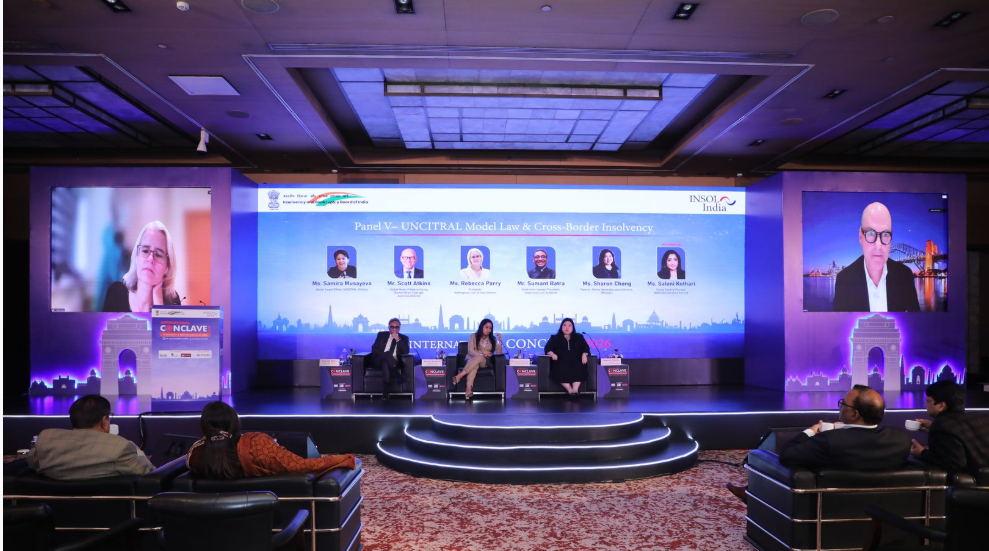
Moderating the final session of the day, Ms. Saloni Kothari, Group General Counsel, BDO India Services (P) Ltd, anchored the discussion on the United Nations Commission on International Trade Law (‘UNCITRAL’) Model Law on Cross-Border Insolvency, situating it within India’s ongoing efforts to develop its first formal cross-border insolvency framework. The session examined how principles such as recognition of foreign proceedings, court-to-court cooperation, and coordination of parallel insolvency processes can strengthen predictability and efficiency under the IBC.
Malaysia’s Adoption Experience
Ms. Sharon Chong, Partner, Skrine Advocates and Solicitors, Malaysia, explained that while Malaysia’s decision followed years of deliberation, implementation progressed swiftly once consensus emerged. She noted that prior reliance on common law principles meant that the principles of the Model Law were not foreign to Malaysia, but it operated procedurally rather than substantively. She highlighted Malaysia’s calibrated adoption, including carve-outs for regulated entities and enhanced protection for domestic creditors.
She highlighted that before adoption “there was no dedicated statutory framework, there was no automatic legal recognition of foreign proceedings, foreign orders and foreign insolvency practitioners had no standing before the Malaysian courts.”
UNCITRAL Perspective
From the UNCITRAL Secretariat, Ms. Samira Musayeva, Senior Legal Officer, UNCITRAL, emphasised that the Model Law does not impose uniform insolvency law, it creates interfaces between systems, while respecting national sovereignty. She underscored its procedural nature and flexibility, designed to facilitate cooperation without harmonising substantive insolvency laws.
“France’s intent was pragmatic and facilitative, to create a framework that would enable cooperation and coordination across borders, while fully respecting national sovereignty, procedural autonomy, and differences in substantive insolvency law.”
Australia and the United Kingdom
Mr. Scott Atkins, Global Head of Restructuring, Norton Rose Fulbright, Australia, shared the country’s experience as an early adopter, noting that courts can deliver relief with speed, certainty, and efficiency. He observed that within the principles of the model law, applications can be prepared in the morning, brought before the court in the afternoon, interim relief secured, and then revisited within a very short period to seek vital relief after appropriate notifications to creditors and other stakeholders. He emphasised that in every respect, the principles and design of the model law have been very effectively embraced within the Australian jurisdiction.
“For those who find themselves attached or interacting with the Australian jurisdiction when it comes to applying the model law, I think you’ll find a very happy outcome.”
Professor Rebecca Parry, Nottingham Law School, explained that the UK applies the Model Law within defined procedural and public policy safeguards, noting that it “provides a framework for recognition and relief, but it is subject to safeguards.” She emphasised that its subject to procedural expectations that the foreign office holder should have full and frank disclosure as well as it’s subject to the boundaries of the model law itself that only applies to collective procedures.
India’s Path Forward
Concluding the session, Mr. Sumant Batra, Insolvency Lawyer; President, Insolvency Law Academy; Past President, INSOL International, highlighted that recognition, interim relief, and court cooperation are substantive law issues that must be clearly anchored in the IBC. He cautioned that modified universalism should not be misunderstood as diluting core cross-border insolvency principles, and stressed the need for capacity building and judicial training.
“Modified universalism is not meant to dilute the basic fundamental principles of cross-border law. Cross-border law has enough adaptability, which can address any concerns that you might have in order to secure your public policies. But we should not be overzealous about it.”
The session concluded that India’s adoption of a Model Law—based cross-border insolvency framework is both timely and inevitable, with speakers underscoring the importance of careful legislative design, institutional preparedness, and a restrained approach to public policy exceptions in strengthening India’s standing in global insolvency practice.
Closing Remarks: Mr. Ravindra Beleyur, Member, Executive Committee, INSOL India
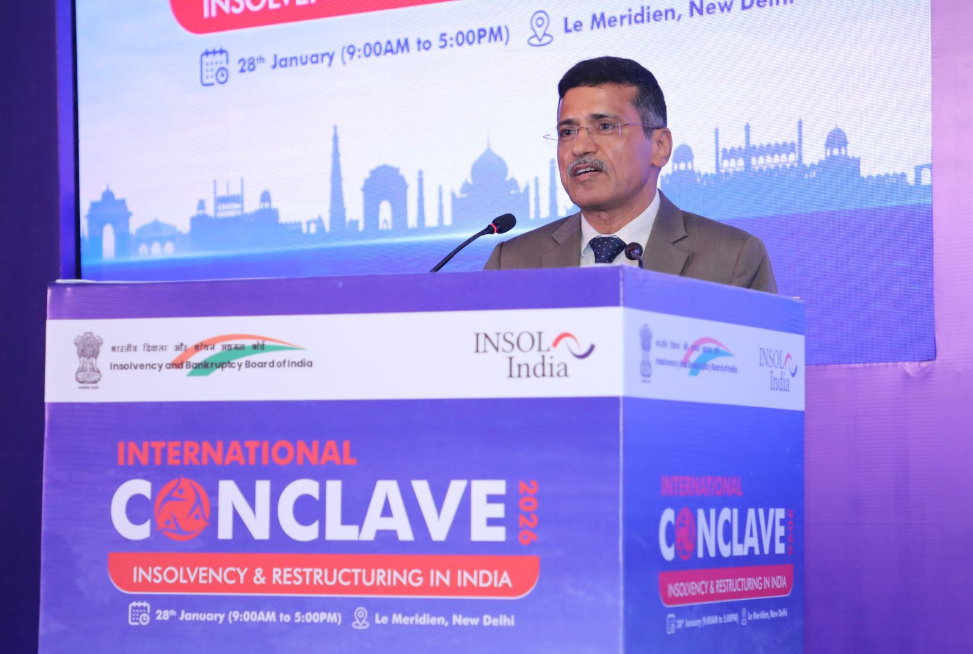
Mr. Beleyur thanked the audience and noted that the session marked the beginning of India’s journey in cross-border insolvency. He expressed optimism that further discussions would follow the formal adoption of the proposed amendments and thanked the panellists for their valuable contributions. He also acknowledged the support of Mr. Ravi Mittal, IBBI Chairperson and the IBBI team, appreciated the efforts of INSOL India President Ms. Pooja Mahajan and the INSOL India Events Committee, and expressed his gratitude towards senior dignitaries, speakers from India and abroad, sponsors, media partners, and delegates, in successfully conducting the event.