
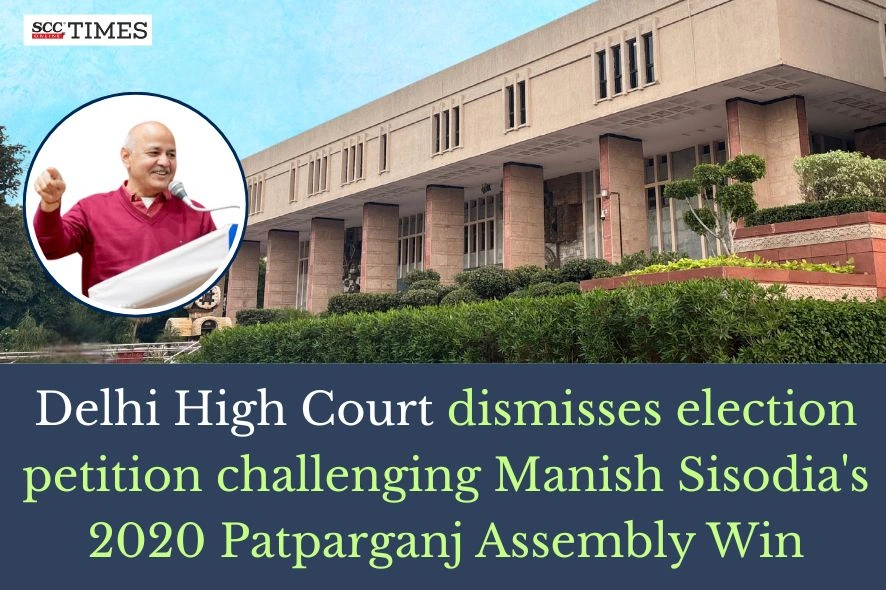
Delhi High Court: In an election petition filed under Sections 33A, 80, 81, 125, 126 read with Section 100 of the Representation of the People Act, 1951 (Representation of the People Act), seeking to set aside the election of the respondent and for declaration of the election as void, a Single-Judge Bench of Jasmeet Singh, J., allowed the application under Order VII Rule 11 CPC and dismissed the election petition against Manish Sisodia for want of cause of action and non-compliance with statutory requirements under Representation of the People Act.
In the instant matter, the Election Commission of India issued a notification dated 06-01-2020 for holding the General Elections to the Legislative Assembly of NCT of Delhi. The petitioner, Pratap Chandra, contested the election from Assembly Constituency No. 57, Patparganj, as a candidate of the Rashtriya Rashtrawadi Party. His nomination was accepted and a candidate identity card was issued. The respondent, Mr. Manish Sisodia, contested from the same constituency as a candidate of the Aam Aadmi Party. Upon completion of polling and counting of votes, the respondent was declared elected, having secured 70,163 votes, whereas the petitioner secured 95 votes.
The petitioner filed the present election petition under Sections 33A, 80, 81, 125, 126 read with Section 100 of the Representation of the People Act, seeking to set aside the election of the respondent and for declaration of the election as void.
The petitioner alleged that election campaigning and display of election material continued during the prohibited 48-hour period prior to polling. Despite representations dated 03.02.2020, 07.02.2020 and 08.02.2020 to the Chief Election Officer and the Election Media Certification and Monitoring Committee, no effective action was taken. It was further alleged that the respondent concealed FIR registered under the Prevention of Insult to National Honour Act, 1971 in his Form-26 affidavit, amounting to suppression of material facts and rendering his nomination liable to rejection.
The Court reiterated that the Representation of the People Act is a self-contained code and the right to challenge an election is purely statutory. The Court stated that “an election petition involves judicial interference with the electoral process and, consequently, with the mandate of the people” and therefore the provision of the Representation of the People Act must be constructed strictly.
“The right to challenge is a statutory right and flows from the RP Act, which in itself is a self-contained code. Therefore, the constituents of an election petition should be construed strictly as per the RP Act subject to the provisions of CPC, 1908 as mentioned in Section 87 of the RP Act.”
Relying upon Kanimozhi Karunanidhi v. A. Santhana Kumar, 2023 SCC OnLine SC 573 and Karim Uddin Barbhuiya v. Aminul Haque Laskar, 2024 SCC OnLine SC 509, the Court held that omission of even a single material fact would lead to an incomplete cause of action and render the petition liable to rejection under Order VII Rule 11 CPC.
The Court noted that the petitioner had confined himself to making general allegations; there was no pleading as to the nature, extent or impact of the alleged advertisements; there was no averment demonstrating how the alleged violation “materially affected” the election result and the photographs relied upon showed only generic party hoardings without reference to the respondent.
The Court held that “the pleadings are conspicuously silent on any nexus between the alleged continuance of election matter and the outcome of the election.” Relying on Dayanidhi Maran v. ML Ravi, 2025 SCC Online Mad 1296, the Court noted that “the General party propaganda publications having no reference to the candidate will not qualify as a ground for action under section 126 of the RP Act.” Further, the Court held that even assuming a breach of Section 126, the petitioner failed to plead that the breach materially affected the election result as mandated under Section 100(1)(d).
On the issue of non-disclosure of the FIR, the Court held that mere registration of an FIR does not trigger the obligation under Section 33-A. Disclosure becomes mandatory only when charges are framed or cognizance is taken by a competent court. However, in the preset case, no such contingency had arisen. The Court also found that the petition did not plead that the respondent had knowledge of the FIR, which was a necessary averment to sustain the allegation of deliberate concealment.
“Parliament has consciously employed the expression ‘in a pending case in which a charge has been framed by the court of competent jurisdiction’ in Section 33A of the RP Act.”
The Court held that the petition failed to establish a specific cause of action and did not comply with the mandatory requirements of Sections 83 and 100 of the Representation of the People Act.
“The petitioner has just made vague allegations and general pleadings… These omissions are not mere technicalities but go to the root of the maintainability of the election petition.”
Accordingly, the Court allowed the application under Order VII Rule 11 CPC and dismissed the election petition against Manish Sisodia for want of cause of action and non-compliance with statutory requirements.
[Pratap Chandra v. Manish Sisodia, 2026 SCC OnLine Del 222, Decided on 17-01-2026]
Advocates who appeared in this case:
Mr. Pratap Chandra-in-Person
Mr. Gautam Narayan Sr.Adv. with Mr Rishikesh Kumar, Ms. Asmita, Mr.Mohd Irsad Mr. Karan Sharma, Ms. Sheenupriya, Mr. Rajat Jain, Mr. Abhiram Venugopal, Counsel for the Respondent