
Disclaimer: This has been reported after the availability of the order of the Court and not on media reports so as to give an accurate report to our readers.
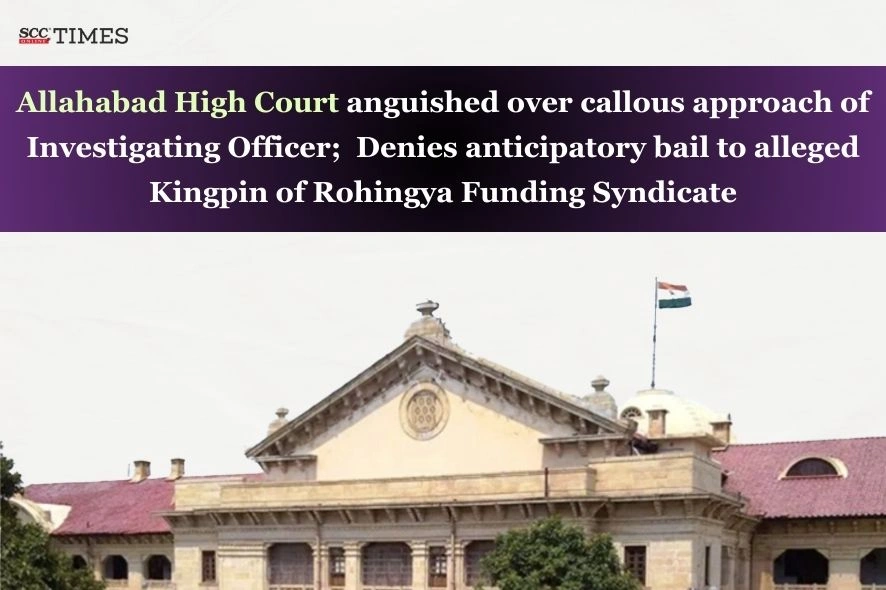
Allahabad High Court: In an appeal filed by the appellant under Section 21 (4) of the National Investigation Agency Act, 2008 challenging the order passed by the Special Judge, NIA/ Additional Sessions Judge (‘ASJ’) rejecting his anticipatory bail application in case under Foreigners Act, 1946 (‘Foreigners Act’), the Division Bench of Pramod Kumar Srivastava and Rajesh Singh Chauhan, JJ., expressed serious displeasure and anguish on the callous and careless approach of the Investigating Agency, particularly the Investigating Officers, for not taking appropriate and proper steps to apprehend the appellant in an issue where not only allegations were related for committing cognizable offences but on account of those offences the security, safety, peace and harmony of the country might likely be jeopardized.
Accordingly, the Court denied the appellant’s plea in the present case.
Background
The FIR in the present case was lodged in October 2023 under Sections 120-B, 419, 420, 467, 468, 471, 370 of the Penal Code, 1860 (‘IPC’), Section 14 of the Foreigners Act and Sections 12(1) and 12(2) of the Passport Act, 1967 against the appellant and nine other accused persons.
Pursuant to registration of the FIR, investigation was commenced by the Investigating Agency. During the course of investigation, seven charge sheets were filed at different stages. All the said charge sheets were filed against the co-accused persons. No charge sheet has been filed against the present appellant. Pursuant to the filing of the charge sheets, the accused persons concerned were arrested and subsequently enlarged on regular bail.
The appellant alleged that despite the passage of considerable time since lodging of the FIR and filing of as many as seven charge sheets, the Investigating Agency could not find sufficient material to submit a charge sheet against him. It was further stated that after lodging of the FIR, no steps were taken by the Investigating Agency to obtain search warrants for the official premises of the appellant, though such search could have yielded material relevant to ascertain the appellant’s alleged involvement.
During the course of investigation, non-bailable warrants were issued against the appellant in March 2024 and again in February 2025. Thereafter, through September 2025 order, proceedings under Sections 82 and 83 of the Criminal Procedure Code, 1973 (‘CrPC’) were initiated against the appellant. Aggrieved by the said proclamation order, the appellant approached the High Court by filing an application under Section 482 of the CrPC. In December 2025, the High Court set aside the said proclamation order and remanded the matter to the Special Judge, NIA/ASJ to pass a fresh order.
The appellant contended that subsequent to the said order, no application was moved by the prosecution before the Trial Court seeking issuance of fresh coercive process against him, nor any such order was passed. On the other hand, it was argued that the appellant was the main conspirator and kingpin of a syndicate allegedly involved in extending illegal assistance to foreign nationals, including Bangladeshi and Rohingya persons, through forged documents, financial transactions, and hawala channels.
Analysis and Decision
The Court expressed its serious displeasure and anguish over the callous and careless approach adopted by the Investigating Agency, particularly by the Investigating Officers, in a matter involving grave and serious allegations. The Court observed that the offences alleged were not only cognizable in nature but were such that, if established, they might jeopardize the security, safety, peace and harmony of the country. The Court stated that despite the seriousness of the allegations, appropriate and timely steps were not taken to apprehend the appellant, which reflected adversely on the manner in which the investigation was conducted.
The Court further opined that the said lapse on the part of the Investigating Agency should be brought to the notice of the Chief Secretary, Government of Uttar Pradesh, the Additional Chief Secretary (Home), Government of Uttar Pradesh, the Principal Secretary/Secretary to the Chief Minister of Uttar Pradesh and the Director General of Police, Uttar Pradesh for information and for taking appropriate action.
The Court noted the submission of appellant that even if some material or evidence existed against him, he was willing to cooperate with the investigation. However, the Court viewed that mere willingness to cooperate could not be a decisive factor for grant of anticipatory bail when the allegations are serious, and the investigation was still at a crucial stage.
The Court held that credible material and evidence were being collected by the Investigating Agency and that there existed a reasonable likelihood of custodial interrogation of the appellant. Thus, the Court viewed that grant of anticipatory bail at this stage could impede the investigation and adversely affect the process of unearthing the larger conspiracy involved.
The Court observed that although prolonged non-arrest of an accused might be a relevant consideration in certain cases, the same could not be applied mechanically. The Court further stated that the allegations in the present case were of a grave nature and had serious implications for national security and public order.
The Court, thus, held that the principles governing grant of anticipatory bail did not warrant interference as the present case was not fit for granting anticipatory bail.
Hence, the Court disposed of the present appeal and upheld the order rejecting the appellant’s application for anticipatory bail.
[Abdul Ghaffar v. State of UP, 2026 SCC OnLine All 20, decided on 9-1-2026]
Advocates who appeared in this case:
For the Appellant: Azizullah Khan, Mohammad Alishah Faruqi, Obaidullah, Pranjal Jain, Advocates
For the Respondent: G.A.
Buy Penal Code, 1860 HERE

Buy Code of Criminal Procedure, 1973 HERE