


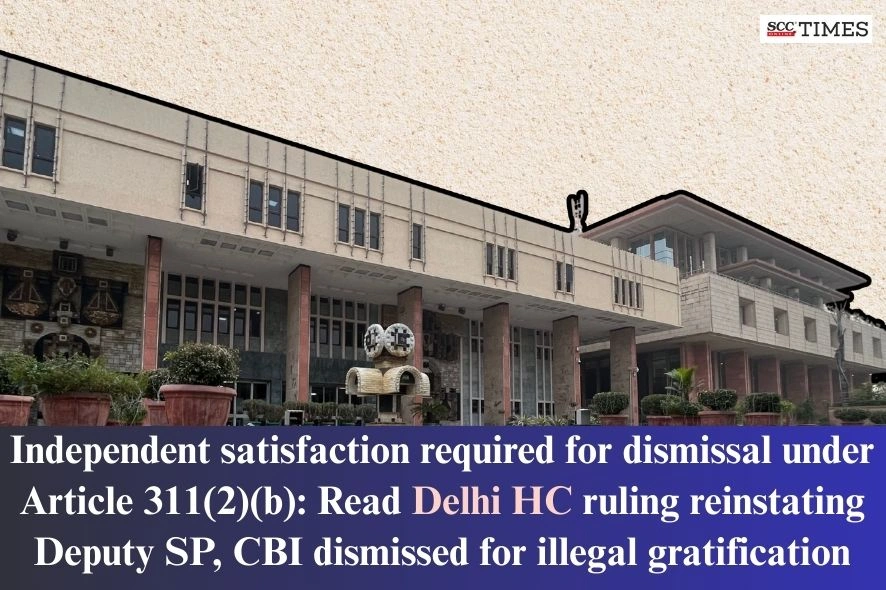
Delhi High Court: The issue for consideration in the present case was whether the respondents were justified in invoking Article 311(2)(b) of the Constitution, read with Rule 19(ii) of the Central Civil Services (Classification, Control and Appeal) Rules, 1965 [‘CCS (CCA) Rules’] to dismiss the petitioner from service without holding a departmental inquiry and whether the Tribunal was correct in sustaining such action.
The Division Bench of Navin Chawla and Madhu Jain*, JJ., noted that Respondent 3, who was only the supervising officer and not the Disciplinary Authority, had recommended the petitioner’s dismissal before any independent application of mind by the competent authority. Further, the disciplinary authority merely agreed with the reasons suggested by Respondent 3. The Court stated that this strikes at the foundation of Article 311(2)(b) of Constitution, which requires the authority to reach its own independent satisfaction and any satisfaction borrowed or induced from another source is no satisfaction in the eyes of law. Thus, the Court set aside the impugned order and directed the respondents to reinstate the petitioner in service with all the consequential benefits.
Background:
The petitioner joined the Central Industrial Security Force (CISF) as a Sub-Inspector served on various posts in CISF and NTPC for eleven years, until his selection on deputation to the Central Bureau of Investigation (CBI) as Inspector on 09-09-1999. The petitioner continued to serve in the CBI and was subsequently promoted as the Deputy Superintendent of Police on 20-01-2014, being posted thereafter in the Banking Securities & Fraud Cell (BS&FC) of CBI, Mumbai.
As a senior officer, the petitioner was entrusted with the investigation of several bank fraud matters. In pursuance of his duty, the petitioner found himself in disagreement with the then Superintendent of Police (BS&FC)-Respondent 3, regarding the mode of issuing and recording instructions in investigations.
On 22-04-2017, a complainant alleged that there were a demand and acceptance of illegal gratification by the petitioner. Thereafter, a trap was laid down in which the petitioner was apprehended and arrested. The petitioner remained in judicial custody until 06-05-2017. Consequently, the petitioner was deemed suspension from May 2017, and the Disciplinary Authority initiated proceeding in December 2017. Under Article 311(2)(b) of Constitution read with Rule 19(ii) of the CCS (CCA) Rules, they proposed dismissal of the petitioner from service without a regular inquiry, on the ground that it was not reasonably practicable to hold one. Union Public Service Commission (UPSC) acted as the advisory body to the referred matter, and dismissal was advised from the same. Consequently, the petitioner was dismissed from the services.
Analysis, Law and Decision
The principal question for consideration is whether the respondents were justified in invoking Article 311(2)(b) of the Constitution, read with Rule 19(ii) of the CCS (CCA) Rules to dismiss the petitioner from service without holding a departmental inquiry and whether the Tribunal was correct in sustaining such action.
The Court observed that the respondent’s reasoning and claims do not meet the standards of Article 311(2)(b), as they are broad and not specific to the case posed. Invoking Article 311(2)(b) requires specific evidential backing to show that there was a situation where conducting an inquiry became a genuine impossibility.
The Court noted that Respondent 3, who was only the supervising officer and not the Disciplinary Authority, had recommended the petitioner’s dismissal before any independent application of mind by the competent authority. Further, the disciplinary authority merely agreed with the reasons suggested by Respondent 3. The Court stated that this strikes at the foundation of Article 311(2)(b) of Constitution, which requires the authority to reach its own independent satisfaction. Satisfaction borrowed or induced from another source is no satisfaction in the eyes of law.
Thus, the Court set aside the impugned order and directed the respondent to reinstate the petitioner in service with all the consequential benefits, including restoration of seniority and notional continuity. The Court further gave liberty to the respondents to initiate disciplinary proceedings against the petitioner in accordance with the law.
[Neeraj Agarwal v. Union of India,. 2025 SCC OnLine Del 9613, decided on 24-12-2025]
*Judgment authored by: Justice Madhu Jain
Advocates who appeared in this case:
For the Petitioner- Suresh Sharma, Adv.
For the espondent- Rakesh Kumar, SPC with Sunil, Adv.; Yash Narain, Adv.
Buy Constitution of India HERE



Summons have been issued u/Sec. 420 and u/Sec. 34 IPC in a Complaint Case.
This is to be treated as summons case or warrant case?
Please guide.