
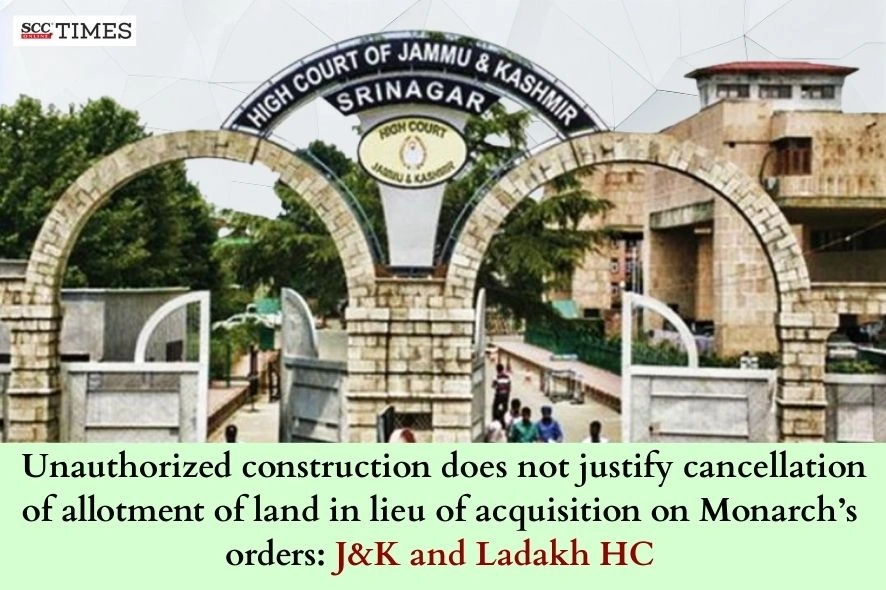
Jammu & Kashmir and Ladakh High Court: In a batch of petitions addressing the legality of a government order cancelling an allotment of land that had been granted in exchange for property acquired by the State decades earlier upon the Monarch’s orders, a Single Judge Bench of Moksha Khajuria Kazmi, J., while allowing the petitions, quashed the order holding that the allotment cancellation due to unauthorised construction was improper, irrational, and unsupported by law, and that mere unauthorised construction on the land did not justify the cancellation of the allotment.
Background:
The dispute arose when the land of the petitioner’s father was taken over by the State Authorities on the order of the then Monarch for its inclusion in his palace without compensation. Later, a directive was issued to provide land in exchange, but it was not implemented, leading to prolonged litigation. Eventually, the Court directed that land be allotted or compensation paid.
In compliance, the authorities sanctioned allotment of land at different sites, later modified through corrigendum, eventually granting one kanal at Rakh Bahu to the petitioner on free hold basis. He subsequently sold portions of this land to private purchasers through registered sale deeds, but later on, the respondents cancelled the allotment.
The petitioner and the subsequent purchasers challenged the cancellation, arguing it was irrational and violated their rights. However, the respondents contended that complaints were filed regarding the misuse of the land as unauthorized commercial construction was raised on the land that was given for rehabilitation purpose, and that the land carried higher market value than the acquired property.
Analysis and Decision:
The Court noted that the cancellation was based on two grounds:
-
the allotted land allegedly having higher valuation than the acquired land, and
-
the construction raised by the petitioner was commercial in nature which violated the objective of allotment that aimed at rehabilitation covering only residential construction.
The Court observed that the ground of higher valuation was weak, as the allotment had been issued, modified, and possession handed over before cancellation, during which time the land had already been sold to subsequent purchasers. The Court also noted that even the Advocate General had recorded that the cancellation order was improper, issued without affording an opportunity of hearing, and not supported by cogent reasons. The Court further observed that the respondents’ records showed the acquired land carried more fiscal value than the allotted land, undermining the justification for cancellation.
The Court opined that the authority, through bureaucratic alchemy, attempted to justify an order unsupported by any statutory provision, logic, reasoning and rationality. The cancellation order, on the face of it, appeared to be a brazen endeavour of the official machinery to deprive a land owner of his legitimate right to have an alternative in lieu of his acquired land by the State.
As to the allegation of commercial construction, the Court opined that merely because an unauthorized construction was raised over the land, it would not ipso facto render the allotment invalid. The unauthorized construction could be addressed under relevant provisions of law, but cancellation of allotment was not permissible. The Court noted that the there was nothing on record that suggested that the allotment was for rehabilitation. Rather, it was an alternative piece of land in lieu of property acquired by the State, granted after a long drawn legal battle spreading over decades. The Court also observed that by the time of cancellation, the land was no longer in the petitioner’s ownership, having been sold to purchasers who were now the recorded owners.
Consequently, the Court, while allowing the writ petitions, quashed the cancellation order.
[Daljit Singh Dogra v. State (UT of J&K), 2025 SCC OnLine J&K 1383, decided on 29-12-2025]
Advocates who appeared in this case:
For the Petitioners: Sunil Sethi, Sr. Advocate with Rahil Raja and Ankesh Chandel, Advocates.
For the Respondents: Chetna Manhas, Assisting Counsel to Monika Kiohli Sr. AAG, Suneel Sethi, GA, Atul Verma, Advocate.