
Disclaimer: This has been reported after the availability of the order of the Court and not on media reports so as to give an accurate report to our readers.
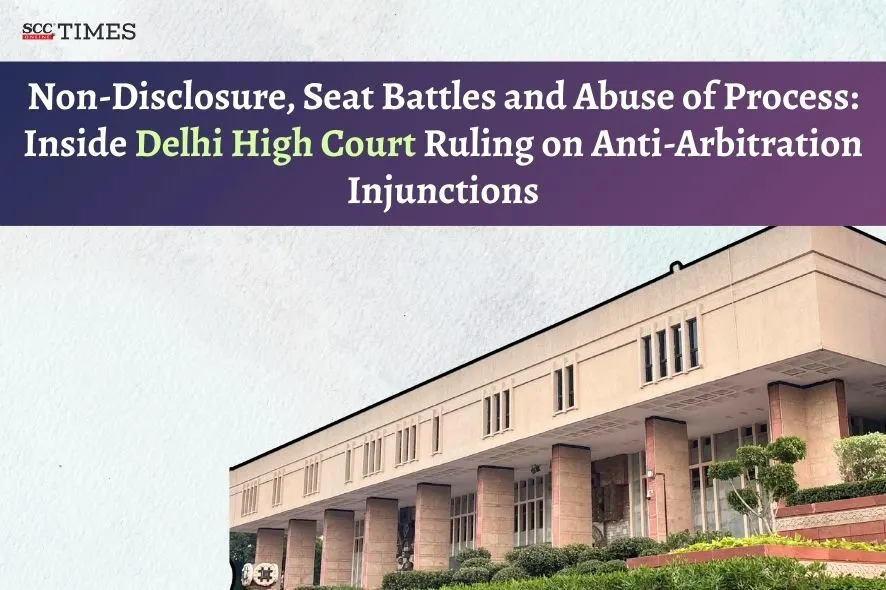
Delhi High Court: In an appeal challenging Single-Judge’s order granting an anti-arbitration injunction in an International Commercial Arbitration administered under the ICC Rules, a Division Bench of Anil Kshetarpal* and Harish Vaidyanathan Shankar, JJ., affirmed the Single Judge’s order and held that —
-
Indian courts had jurisdiction as the seat of arbitration was New Delhi.
-
The admitted and deliberate non-disclosure by the appellant’s nominee arbitrator justified judicial intervention.
-
The grant of an anti-arbitration injunction was warranted to prevent abuse of process and irreparable prejudice to the respondent.
Factual Matrix
In the instant matter, the appellant, MSA Global LLC Oman, is a military and security systems integrator based in Oman. The respondent, Engineering Projects India Ltd. (EPIL), is a public sector enterprise under the Ministry of Heavy Industries, Government of India, having its registered office at New Delhi.
On 29-06-2015, the Ministry of Defence, Sultanate of Oman appointed EPIL as the main contractor for a supply-and-build project relating to a Border Security System at the Oman—Yemen border. Pursuant thereto, on 21-09-2015, EPIL entered into a sub-contract agreement with MSA Global LLC for the design, supply, installation, integration, and commissioning of the Border Security System for specified project sections.
Article 19 of the agreement provided for dispute resolution through arbitration under the ICC Rules, stipulated that “the jurisdiction of the Contract Agreement shall lie with the Courts at New Delhi, India”, and further stated that the place of arbitration was to be mutually discussed and agreed upon. The agreement was also to be governed, construed, and take effect according to the laws and regulations of the Sultanate of Oman.
Disputes arose between the parties concerning delays and performance obligations. On 12-04-2023, the appellant invoked arbitration under the ICC Rules and nominated Mr. Andre Yeap, Senior Counsel from Singapore, as its co-arbitrator. In his Statement of Acceptance, Availability, Impartiality and Independence dated 19-03-2023, Mr. Yeap declared that he had “nothing to disclose”.
Subsequently, the ICC Court fixed Singapore as the place of arbitration. The arbitral proceedings continued, and on 19-06-2024, a First Partial Award was rendered, fastening a financial liability of approximately ₹30 crores on EPIL.
In January 2025, while preparing for evidentiary hearings, EPIL discovered a judgment of the Gujarat High Court dated 05-07-2024 in Neeraj Kumarpal Shah v. Manbhupinder Singh Atwal, wherein it was recorded that Mr. Yeap had earlier acted as a co-arbitrator in an arbitration involving MSA Global LLC and its Managing Director, a fact which had not been disclosed. That earlier award had ultimately been set aside by the Gujarat High Court.
Alleging lack of disclosure and raising serious doubts regarding independence and impartiality, EPIL filed a challenge before the ICC Court under Article 14 of the ICC Rules. Although the ICC Court termed the non-disclosure “regrettable”, it rejected the challenge on merits and permitted Mr. Yeap to continue.
Parallel proceedings ensued in Singapore, including challenges to the partial award and applications seeking termination of Mr. Yeap’s mandate. Simultaneously, EPIL instituted Civil Suit before the Delhi High Court seeking declaratory and injunctive reliefs, and contended that continuation of the arbitration was oppressive, vexatious, and unconscionable.
Vide order dated 25-07-2025, the Single Judge granted an anti-arbitration injunction, restraining continuation of the ICC arbitration. Aggrieved thereby, the appellant preferred the present appeal.
Moot Points
-
Whether Article 19 of the agreement determined the juridical seat of arbitration to be India or Singapore, and the legal consequences flowing therefrom?
-
Whether the admitted non-disclosure by a member of the arbitral tribunal was of such significance as to justify the exceptional grant of an anti-arbitration injunction by an Indian Court?
Court’s Reasoning
The Court observed that while arbitration is premised on minimal judicial intervention, such restraint is not absolute and cannot extend to situations where the arbitral process itself is shown, prima facie, to be contrary to fundamental principles of fairness, neutrality, and judicial propriety.
Jurisdiction and Seat of Arbitration
The Court examined Article 19 of the agreement and emphasised that an arbitration clause must be read “holistically, contextually and harmoniously,” and not in a fragmented or disjunctive manner.
The Court observed that Article 19.1 did more than merely refer disputes to arbitration under ICC Rules; it expressly stipulated that “the jurisdiction of the Contract Agreement shall lie with the Courts at New Delhi, India.” According to the Court, such a clause is a “clear and categorical expression of party intent” and ordinarily identifies the juridical seat, unless displaced by unmistakable contrary indicia.
The Court rejected the contention that the fixation of Singapore as the place of arbitration by the ICC Court amounted to a determination of the seat and held that the ICC Court’s role in fixing the place was administrative and based on convenience, and that such fixation could not override the parties’ contractual allocation of jurisdiction.
The Court further observed that Article 19.2, which made the laws of the Sultanate of Oman applicable, was confined to the substantive law governing the performance and operation of the contract and had no bearing on dispute resolution or the supervisory jurisdiction over arbitration. Likewise, Article 19.3, which referred to the “place” of arbitration being mutually agreed, was construed as a provision relating to venue rather than seat.
The Court observed that the seat of arbitration determines the supervisory jurisdiction and the applicable standards governing impartiality and independence of arbitrators. Once the seat was held to be India, Indian law, particularly Section 12 of the Arbitration and Conciliation Act, 1996, became determinative.
The Court, therefore, held that Delhi, India, was the juridical seat of arbitration and that Indian courts possessed supervisory jurisdiction over the arbitral process.
Maintainability of the Civil Suit
While addressing the objection to the maintainability of the suit, the Court reiterated that “the jurisdiction of the civil courts under Section 9 of the CPC is plenary, and unless specifically excluded, the civil courts have jurisdiction to try and decide all civil disputes.” Relying on Dhulabhai v. State of M.P., 1968 SCC OnLine SC 40, the Court observed that civil court jurisdiction remains intact where it is alleged that the statutory tribunal has not acted in conformity with the fundamental principles of judicial procedure.
The Court held that the suit before the Single Judge was not a proceeding under the Arbitration and Conciliation Act, 1996, but an independent civil action seeking declaratory and injunctive relief under the Specific Relief Act, 1963. Consequently, the Court asserted that neither Section 42 of the Arbitration and Conciliation Act nor principles relating to arbitral minimalism operated as a bar to the institution of such a suit.
Non-Disclosure and Arbitrator Neutrality
On the issue of non-disclosure, the Court noted that Section 12 of the Arbitration and Conciliation Act cast a continuous and mandatory obligation on arbitrators to disclose any circumstance likely to give rise to justifiable doubts as to independence or impartiality.
The Court noted that the arbitrator had admittedly failed to disclose his prior arbitral engagement involving the appellant and its Managing Director, despite becoming aware of it during the pendency of the proceedings. The Court found the explanation tendered by the arbitrator, that “had I made the disclosure, the possibility of the Respondent seeking to challenge my impartiality could not be discounted” when “tested against the objective standard of a reasonably informed and fair-minded third party, such omission undermines the necessity of neutrality and detracts from the integrity of the arbitral process” and consequently breach the safeguards envisaged under Section 12 of the Arbitration and Conciliation Act.
The Court affirmed the Single judge’s finding that the duty of disclosure is continuous and non-discretionary, and that “an arbitrator cannot withhold disclosure on the ground that, in his or her view, the fact or association is benign or too remote to influence impartiality.” The Court held that the Single Judge had correctly applied the statutory standard under Section 12 of the Arbitration and Conciliation Act.
Anti-Arbitration Injunction
While reiterating that anti-arbitration injunctions are to be granted sparingly, the Court affirmed that civil courts retain jurisdiction where continuation of arbitration would be oppressive, vexatious, or unconscionable, or where the arbitral process is conducted in breach of fundamental principles of fairness.
The Court concurred with the Single Judge’s assessment that the attending circumstances rendered continuation of the arbitration proceedings oppressive and unconscionable. Upon examining the conduct of the appellant holistically, the Court found no error in the conclusion that it reflected “a clear pattern of abuse of process intended not to resolve disputes in good faith, but rather to subject the respondent to procedural hardship and jurisdictional entanglement.”
The Court held that the Single Judge had correctly applied the settled principles governing interim injunctions and that all three requirements, existence of a prima facie case, balance of convenience, and likelihood of irreparable injury, stood satisfied.
Court’s Decision
Finding no perversity, illegality, or jurisdictional error in the impugned order, the Court affirmed the order and held that the discretion exercised by the Single Judge did not warrant appellate interference.
[MSA Global LLC v. Engineering Projects India Ltd., 2025 SCC OnLine Del 9617, Decided on 12-12-2025]
*Judgment by Justice Anil Kshetarpal
Advocates who appeared in this case:
Mr. Rajiv Nayar, Sr. Adv. with Mr. Kirat Singh Nagra, Mr. Kartik Yadav, Mr. Pranav Vyas, Ms. Sumedha Chadha and Mr. Sankalp Singh, Counsel for the Appellant
Mr. Sandeep Sethi, Sr. Adv. with Mr. Ajit Warrier, Mr. Angad Kochhar, Mr. Himanshu Setia, Mr. Vedant Kashyap, Mr. Sumer Dev Seth, Ms. Riya Kumar, and Ms. Richa Khare, Counsel for the Respondent/State
Buy Arbitration and Conciliation Act, 1996 HERE