
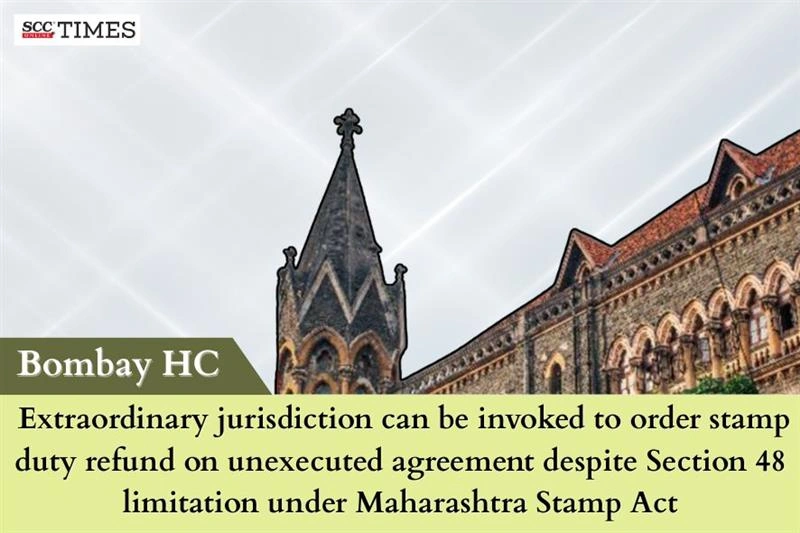
Bombay High Court: In a case revolving around the issue whether the extraordinary writ jurisdiction could be invoked to seek a direction of refund of stamp duty paid on an instrument that was never executed, a Single Judge Bench of Somasekhar Sundaresan, J., held that although the Stamp Authorities were correct in rejecting the application for refund on the ground of limitation under Section 48 of the Maharashtra Stamp Act, 1958 (‘Stamp Act’), the extraordinary jurisdiction of the Writ Court could nonetheless be exercised to grant relief. Thus, the Court quashed the impugned orders and directed that the refund of stamp duty be made within six weeks.
Background:
The petitioner was appointed as the legal guardian of his wife in 2019 because the wife suffered a 100 percent locomotor and mental disability arising out of an aneurysmal stroke. In July 2019, the petitioner finalised an agreement for sale with his neighbour for purchase of a flat in the same building. He paid an amount of Rs 10.80 lakh electronically through Punjab National Bank, into the treasury for the purchase of stamp on 06-07-2019 and he was issued a challan and certificate confirming receipt of the amount paid on a consideration amount of Rs 1.80 crore. The same challan also confirmed receipt of registration fee of Rs 30,000. The stamp duty amount appeared to have been credited into the State’s account with the Reserve Bank of India on 08-07-2019. The execution draft of the instrument was finalised but was not executed.
With the onset of the Covid-19 pandemic, the transaction was abandoned, and the applicant sought a refund on 15-09-2020 under Section 47(b) of the Stamp Act, contending that the document was written but not signed by any party. He contended that the payment of stamp duty electronically was a simple purchase of stamp, and this was never effectively impressed on any draft of any instrument and the stamps purchased were rendered useless. The Additional Controller of Stamps rejected the application, citing that it was filed beyond the six-month period prescribed under Section 48(3) of the Stamp Act. The petitioner filed an appeal impugning such an order, but that was also rejected by the Inspector General of Registration. Both these orders were impugned by the petitioner in the present petition.
Analysis and Decision:
The Court observed that for the charging provision of stamp duty to be attracted, an instrument must come into being. The scheme of the Stamp Act makes it clear that stamp duty is not a transaction tax, but a duty payable on an instrument, which must be executed to be chargeable.
The Court noted that the petitioner made an electronic payment of the stamp duty as calculated by him and was issued a certificate for the same, but it was not an adjudicated confirmation that full stamp duty has been paid. The Court opined that the Stamp Act being a fiscal statute, it must be construed strictly, and a necessary ingredient is that ‘full duty with which the instrument is chargeable’ is certified as having been paid for the certificate to constitute an impressed stamp.
The Court further noted that since the document was never executed, no ‘instrument’ came into existence in the eyes of the law for it to be chargeable with Stamp Duty. The Court emphasized that while Section 48 prescribes a six-month deadline, it is a procedural provision regulating the discretion of the Stamp Authorities, not one that extinguishes the substantive right to refund. The Court observed that an unexecuted document, intended to be a future instrument, and in respect of which stamp duty has been paid electronically with every intention to execute the ‘document’ to bring an ‘instrument’ into existence, would constitute an ‘impressed stamp’.
The Court opined that since Sections 48(1) and 48(2) of the Stamp Act dealt with ‘instruments’ i.e. documents that have been executed, the present case would attract Section 48(3) and the time limit for making the refund application would be six months from the date of purchase of stamps. The timing of actually affixing the stamp on the document is not linked to the deadline for the application, and therefore, for a refund to be claimed invoking Section 47(b) read with Section 48 of the Stamp Act, the deadline of six months from the purchase can be said to be stipulated. The Court observed that applying the deadline stipulated in Section 48, the petitioner had applied beyond the period of six months from the purchase of the stamps, and therefore, the Stamp Authorities were not wrong in their refusal to grant refund.
Discussing the exercise of extraordinary jurisdiction of the writ court to make an intervention, the Court referred to the Supreme Court’s decision in Committee-GFIL v. Libra Buildtech (P) Ltd., (2015) 16 SCC 31, where applying the maxim actus curiae neminem gravabit, it was held that denying refund solely on technical grounds of limitation, especially when no instrument was ever executed, would result in unjust enrichment by the State and that the extraordinary writ jurisdiction under Article 226 of the Constitution allowed intervention in deserving cases where injustice was writ large.
The Court relied on S.K. Realtors v. Inspector General of Stamps & Controller of Stamps, 2016 SCC OnLine Bom 14536, where it was observed that “the purpose behind incorporating Section 48 of the Stamp Act is clearly to ensure that in cases where transaction is not executed, or cancelled before execution, the State is not entitled to claim revenue for execution of the said document, and the State, therefore, is under an obligation to refund the said amount”.
The Court observed that the Writ Court would have the power to exercise its extraordinary jurisdiction to deal with the adjectival provisions of the deadline for an application in Section 48 of the Stamp Act, even while the Stamp Authorities would need to adhere to the stipulated deadlines.
The Court opined that if the stamp duty was retained by the State, it would constitute unjust enrichment and would result in an unfair outcome for the petitioner and his wife, where without a chargeable instrument even having come into being, an ailing couple would be out of pocket and denied an allowance of stamp duty on what was not even a still-born instrument but was an unborn instrument that had been aborted.
Consequently, the Court exercised its extraordinary jurisdiction and while allowing the petition, quashed and set aside the impugned orders and directed the refund of stamp duty to be paid within six weeks.
[Suresh Ramchandra Sancheti v. State of Maharashtra, 2025 SCC OnLine Bom 5198, decided on 12-12-2025]
Advocates who appeared in this case:
For the Petitioners: S. R. Nargolkar a/w Arjun Kadam & Neeta Patil, Advocates.
For the Respondent: Y. D. Patil, AGP.
Buy Constitution of India HERE