
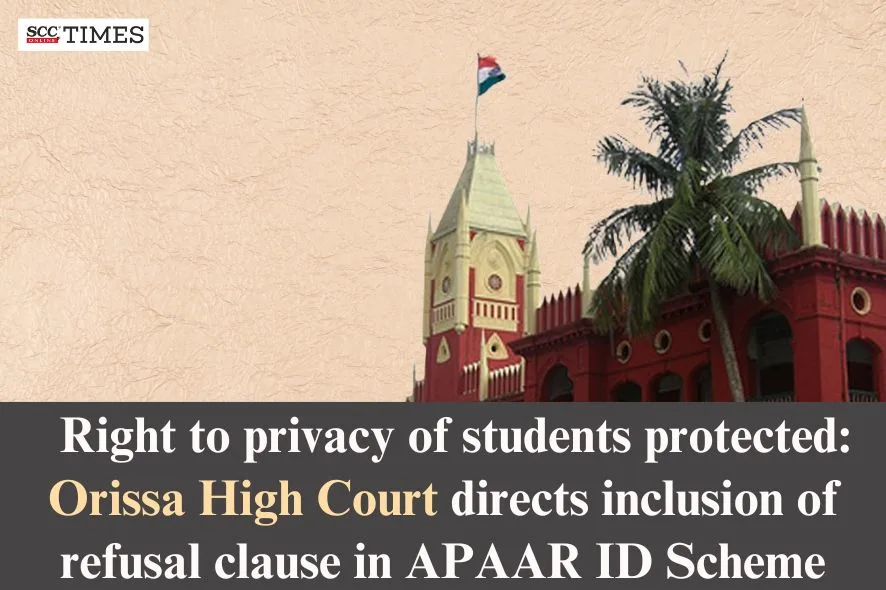
Orissa High Court: In a petition filed under Article 226 of the Constitution, the petitioner challenged the Automated Permanent Academic Account Registry (‘APAAR’) initiative citing violation of the right to privacy under Article 21 of the Constitution, a Single Judge Bench of Sashikanta Mishra, J., held that while the initiative is professed to be voluntary, the absence of an option to refuse consent in the model consent form effectively rendered it mandatory in nature. Accordingly, the Court directed the authorities to amend the consent form to include an opt out/refusal of consent clause, thereby safeguarding the fundamental right to privacy.
Background:
The dispute began when a school sent a letter to parents asking them to give consent for generating an Automated Permanent Academic Account Registry (‘APAAR’) ID for their children. The letter also required submission of Aadhaar details but did not provide any option to refuse consent or opt out.
The petitioners objected to this, saying that the consent form had clauses allowing personal information of students to be shared with different stakeholders such as the UDISE+ database, scholarship authorities, educational institutions, and recruitment agencies. They argued that this violated the right to privacy and, because there was no opt out clause, the initiative became mandatory in practice. They also raised concerns that this went against Section 6(1) of the Digital Personal Data Protection Act, 2023.
On the other side, the Ministry of Education explained that the APAAR initiative was voluntary. Schools were required to mark the consent status as either ‘Yes’ or ‘No’ in the UDISE+ database. The Ministry further stated that the consent form allowed parents to withdraw consent at any time, which meant privacy was protected. The State authorities and the school also maintained that they were only following government instructions and had not forced parents to submit Aadhaar details.
Analysis and Decision:
The Court emphasised that the case was not adversarial in nature, since all opposite parties agreed that the initiative was voluntary. However, the Court noted that the absence of an option to refuse consent at the initial stage created apprehension that the scheme was mandatory.
The Court observed that withdrawal of consent after submission could not be equated with the right to refuse consent altogether. The Court further opined that since the right to privacy is a fundamental right and though not absolute can only be subject to reasonable restrictions, the same has to be protected and respected by the State at all costs.
The Court highlighted the principles laid down in K.S. Puttaswamy (Aadhaar-5J.) v. Union of India, (2019) 1 SCC 1, particularly that children’s right to privacy requires special protection and that Aadhaar cannot be made compulsory for school admission under Article 21-A of the Constitution. It was observed that imposing Aadhaar requirements on children would fail the test of proportionality and infringe their fundamental rights.
The Court further noted that the model consent form was not worded strictly in consonance with the avowed objective of making the scheme voluntary. The Court observed that if the initiative is intended to be voluntary, appropriate provisions clearly specifying such fact ought to have been incorporated in the form by providing option to the parents to refuse to submit their consent or to opt out of it entirely. The Court found merit in the petitioners’ submission of a model consent form containing a refusal clause and directed the authorities to consider amending the existing form accordingly.
Consequently, the writ petition was allowed, and the authorities were directed to amend the consent form to include an opt out/refusal of consent clause within two months.
[Rohit Anand Das v. State of Orissa, 2025 SCC OnLine Ori 4535, decided on 12-12-2025]
Advocates who appeared in this case :
For the Petitioners: A. Jebraj, R. Shruti, A. Kar, Advocates
For the Respondents: S. Behera, AGA, P.K. Parhi, DSGI with D. Gochhayat, CGC, S.K. Sarangi, Sr. Advocate with S. Sarangi, Advocate