
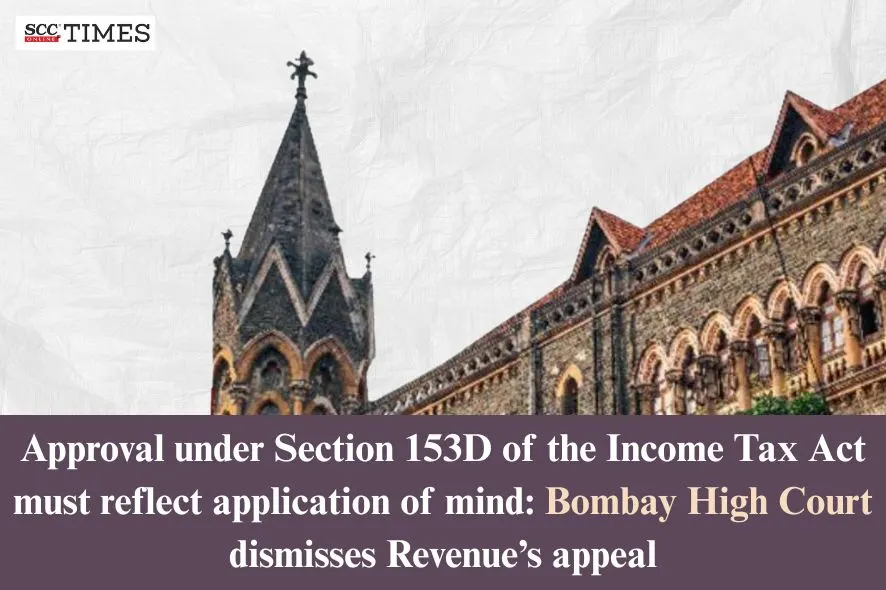
Bombay High Court: While deciding an appeal under the Income Tax Act, 1961 (‘the Act’) challenging the validity of proceedings initiated under Section 153-C of the Act, the Division Bench of M.S. Sonak* and Advait M. Sethna, JJ., dismissed the appeal after holding that the approval granted under Section 153D of the Act was vitiated by non-application of mind. The Court noted that the approval dated 06-08-2010 did not reflect even a minimum application of mind and had been granted mechanically. Therefore, in the absence of a valid approval, the proceedings under Section 153C of the Act were incompetent.
Background:
The dispute arose from approval dated 06-08-2010 granted by the Additional Commissioner of Income Tax Central Range Thane for proceedings under Section 153C of the Act. The Income Tax Appellate Tribunal (‘ITAT’), in its order, transcribed the approval letter and held that it did not indicate even prima facie any application of mind, deeming the approval to have been granted mechanically.
The Revenue argued that the case involved a raid by the State Police followed by a Special Audit under Section 142(2A) of the Act. It was submitted that statements of the assessee were recorded, and most of the additions were based on the Special Audit Report. Despite opportunities, no clarification or details were offered by the assessee. On this basis, it was contended that the approval was granted in the above circumstances and that such approval was not required to resemble a reasoned order.
It was, however, pointed out that the issue was already covered by decisions of various High Courts, and Special Leave Petitions against some of them were dismissed. It was submitted that the approval in question was mechanical and therefore invalid.
Analysis and Decision:
The Court emphasised that although an approval order is not required to resemble a reasoned judgment, it must reflect at least a minimum application of mind. The Court noted that an order which does not reflect even minimum application of mind cannot be saved by filing an affidavit claiming that there was material based upon which such approval could have been granted. The Court observed that such arguments had been expressly rejected in several decisions, including those referred to by the ITAT in its impugned order.
The Court highlighted its earlier judgment in CIT v. Citron Infraprojects Ltd., 2025 SCC OnLine Bom 4795 where several decisions on the aspect of grant of approvals under Section 153C of the Act were considered. It was noted that some of those decisions were questioned before the Supreme Court, but the Special Leave Petitions were dismissed.
By following the decision in Citron Infraprojects (supra) and the various decisions referred therein, the Court concluded that the approval dated 06-08-2010 was vitiated by non-application of mind. The Court observed that such approval is a mandatory pre-requisite, and in its absence, the proceedings under Section 153C of the Act would not be competent.
Accordingly, the substantial question of law was answered against the Revenue and in favour of the assessee, and the appeal was dismissed without costs.
[CIT v. Vrushali Sanjay Shinde, 2025 SCC OnLine Bom 4960, decided on 10-12-2025]
*Judgment authored by: Justice M.S. Sonak
Advocates who appeared in this case:
For the Appellant: Akhileshwar Sharma
For the Respondent: Vidhi Punamiya, Sankalp Mallik (through VC) & Sanket S. Bora, i/b Malik & Co, & SPCM Legal