
Top Legal Developments This Week [10-16 August 2026] | Tarun Tejpal’s Conviction; Bar Council Co-option; UPI Charges Clarified; and 20+ more stories
A quick roundup to cover all the important legal developments and cases this week.

Bringing you the Best Analytical Legal News


A quick roundup to cover all the important legal developments and cases this week.
The assessee’s submitted that the authorities wrongly disallowed the carry forward of losses only because the return was filed late on 1-11-2019 at 00:00:37, and therefore not treated as a valid return under Section 139(1) of the Income Tax Act, 1961.
“An order, which does not reflect even minimum application of mind, cannot be saved by filing an affidavit claiming that there was material based upon which such approval could have been granted.”
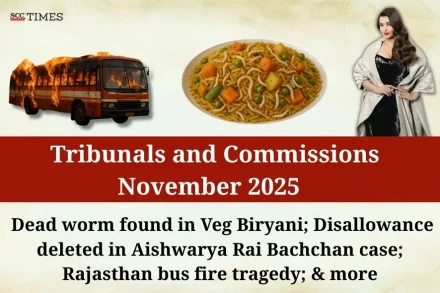
Explore the key legal developments of November 2025, featuring CCI’s power to examine patented product disputes, dead worm found in Veg Biryani, deletion of disallowance against Aishwarya Rai Bachchan, grieving father bribing ambulance, woman’s death at Jammu-based Super Specialty Hospital and Rajasthan bus fire tragedy.
For the purposes of Income Tax Act, 1961, the business which is involved in letting out premises on hire, would be said to have commenced right from the stage of repairing and furnishing of property for being rented out and cannot be treated as commenced only when the premises are actually let out to tenants.
Mere maintenance of running account by the appellant with GPIL, having continuous business transactions with them or mere repayment of advance within same financial year cannot be the reasons to admit that the amount of advance is actually utilized for execution of business transaction.
The ITAT reiterated that so far as an interpretation of such an exemption provision in a fiscal statute was concerned, a stricter interpretation had to be employed rather than a liberal one.
The Court held that contribution to Compensatory Afforestation Fund will be considered as revenue expenditure and not capital in nature
“Section 269-SS of the Income Tax Act, 1961 has a specific bar on receiving a sum more than 20,000/- from any other persons by way of loan or deposit.”
ITAT noted that Parliament had taken due note that the Supreme Court had held that the goodwill arising on business reorganization i.e. amalgamation, slump sales, demerger etc. is a depreciable intangible asset under Section 32 of the Act.
Supreme Court reiterated that to examine whether a particular transaction is sale of capital assets or business expense, multiple factors like frequency of trade and volume of trade, nature of transaction over the years etc., are required to be examined.
In terms of Section 2(22)(e) of the Act, treating the loans and advances received by concerns, in which shareholders of the company giving loans and advances had substantial interest, qualified as “deemed dividend”
After examining the expenses payable and the detailed order of the CIT,the ITAT held that the CIT has correctly examined the invoices, period and purpose for the expenses which have not been paid for the last six years
It is a well-accepted principal of tax jurisprudence that the Assessing Officer cannot sit on the armchair of a businessman assessee to replace his business strategy by his own whims and fancies
ITAT said that the entire addition has been made by the AO as well as CIT based on guess work and estimation based on some alleged information received from Sales Tax Department of Maharashtra and from DGIT that “the assessee has taken bogus purchase bills without having taken any delivery of the goods”, without applying their mind.
Explore decisions of Tribunals, Regulatory Bodies and Commissions in India with stories on supply of goods to overseas customers, question of condonation of delay by NCLAT, maintainability of application u/s 7 of IBC Code, NGT on violation of environmental norms by State, and so on.
The Supreme Court affirmed the order passed by the High Court stating that the respondent assessee was neither entitled to the deductions nor profit earned under Section 80-IB on the amount of DEPB as well as Duty Drawback Scheme.
ITAT held that the second proviso to Clause (i) of Section 40(a) just like second proviso to clause (ia) of Section 40(a) was inserted to remove an anomaly and were therefore curative and declaratory in nature. Hence, it had to be given retrospective effect.
ITAT noted that an identical issue was subject matter of consideration of the Tribunal in assessee’s own case, hence following the precedent, the Tribunal directed that the payment received in this case cannot be treated as FTS under Article 12 (5) of India Netherlands DTAA.
This roundup contains many interesting rulings including the Shiv Sena Party Name and Symbol Dispute, Negligence committed by doctors and Compensation therein, Amendment to Section 178(6) of the Income Tax Act, Initiation of the Corporate Insolvency Resolution Process and more.