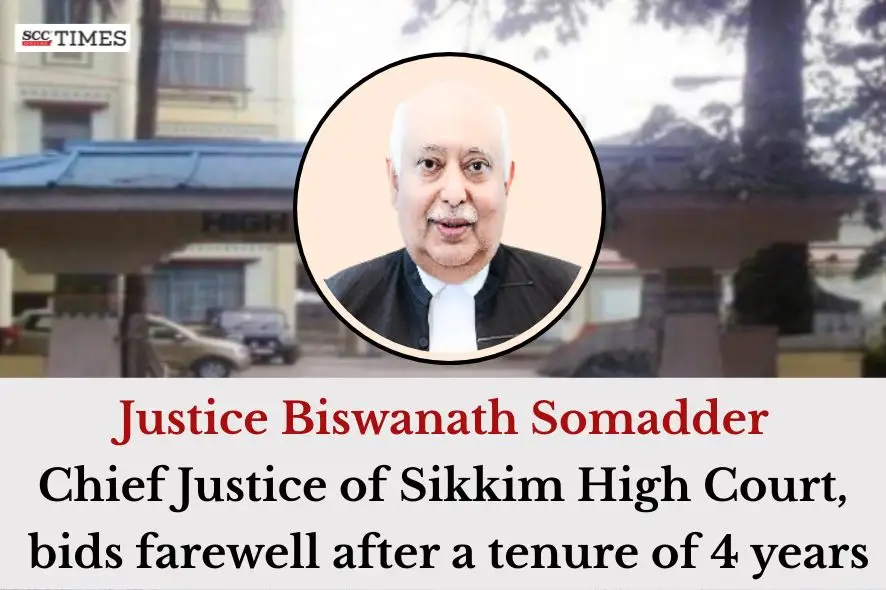
Justice Biswanath Somadder carved an illustrious career in the Indian judicial system, leaving an indelible mark on the legal landscape of the country. His journey from a law student to the Chief Justice of the High Court of Sikkim became a testament to his dedication, expertise, and commitment to upholding the principles of justice. As he retires on 14-12-2025, let us recapitulate Justice Somadder’s career trajectory.
Educational and Professional Background
Justice Somadder, born on 15-12-19631, embarked on his academic journey by obtaining a Bachelor of Arts (B.A.) and a Bachelor of Laws (LL.B.) from the prestigious University of Calcutta.2 His academic pursuits laid a solid foundation for a career that would span various facets of law and justice.
In an era where technological proficiency is a valuable asset, Justice Somadder recognized the importance of staying abreast of advancements. He undertook a Certificate Course on “Office Automation Tools” as part of the Computer Education Programme at the Regional Computer Centre, Calcutta.3 This initiative showcased his adaptability in an ever-evolving legal landscape.
Legal Career
The commencement of his legal career dates back to 21- 7-1989, when he was enrolled as an Advocate. Justice Somadder exhibited versatility by practicing in both the High Court at Calcutta and the Supreme Court of India. His appearances extended beyond these prestigious institutions, encompassing the Central Excise and Service Tax Appellate Tribunal (CESTAT), Eastern Regional Bench.4
His practice covered an extensive range of legal domains, including Constitutional (Customs & Central Excise, FERA, Telecommunication, Education, Service & Income Tax), Arbitration, Company, Revenue, Civil, and Criminal matters. Justice Somadder’s specialization in Revenue, Arbitration, and Constitutional Laws reflected his deep understanding of complex legal issues.5
The pinnacle of his legal practice saw him assume the role of Senior Counsel for the Central Government in Calcutta High Court. Simultaneously, he held the position of Honorary Joint Secretary of the Bar Library Club of Calcutta High Court, showcasing his commitment to both the legal profession and the legal community.6
Judicial Career
Justice Somadder’s judicial journey took a significant turn when he was elevated to the Bench of the Calcutta High Courtas a Permanent Judge on 22-6-2006.7 This marked a milestone in his career, as he transitioned from advocacy to a distinguished role on the bench.
His contributions to the judicial system extended beyond the courtroom. Justice Somadder was appointed as the Executive Chairman of the State Legal Services Authority, West Bengal, by the Governor of West Bengal, on 5-11-2018. Subsequently, he assumed the role of Judge-in-Charge, Administrative Department, High Court at Calcutta, effective from 19-11-2018. The year 2019 witnessed Justice Somadder briefly stepping into the shoes of the Acting Chief Justice from January 1 to April 3.8 His interim leadership demonstrated his ability to navigate the administrative responsibilities of the judiciary.
On 17-10-2019, Justice Somadder took charge as a Judge of the Allahabad High Court, expanding his judicial footprint.9 This was a prelude to his elevation as the Chief Justice of Meghalaya High Court,10 where he took the oath of office on 27-04-2020. In a noteworthy move, Justice Biswanath Somadder was subsequently transferred to the High Court of Sikkim. On 12-10-2021, he took the oath as the Chief Justice,11 continuing his legacy of service and leadership in the Indian judiciary.
Notable Judgements
In Dhan Raj Gurung v. Sikkim University, 2025 SCC OnLine Sikk 105, a public interest litigation (‘PIL’) was filed by a retired Government graduate teacher in the Nepali language (‘petitioner’), for seeking urgent and effective judicial intervention to safeguard the linguistic integrity, constitutional sanctity and academic accuracy of the Nepali language, as it was being taught and propagated within the State of Sikkim by the Sikkim University (“Respondent 1’). The Division Bench of Biswanath Somadder*, CJ., and Meenakshi Madan Rai, J., found the petitioner’s grievance bona fide and held that even if educational institutions made minor distortions while imparting Nepali language, such distortions could compromise with the linguistic integrity and academic accuracy of the language and could also cause a direct impact on the delicate distinction between the Nepali language and other languages where the script was common. Accordingly, the Court disposed of the PIL and formulated directions to preserve and protect the linguistic integrity and sanctity of the Nepali language.
A Division Bench comprising of Biswanath Somadder, CJ., and Bhaskar Raj Pradhan*, J., in UOI v. SICPA India Private Ltd., 2025 SCC OnLine Sikk 42, considered an Appeal filed by the Union of India challenging the Single Judge’s order allowing refund of unutilized Input Tax Credit (‘ITC’) on closure of business under Section 54 of the Central Goods and Services Tax Act, 2017 (‘CGST Act’). The Court noted that Section 54(3) does not envisage refund of unutilized ITC on closure of business and held that the impugned judgment involved judicial rewriting of statutory provisions and was beyond the scope of the Writ jurisdiction. Observing that the respondent had not provided sufficient proof of reversal of accumulated credit under Section 29(5) of the CGST Act, the Court held that no constitutional or statutory rights were violated. Accordingly, the Court allowed the said appeal and set aside the impugned order.
In Discharge of Effluents by Pharma Companies situated at Singtam, In re, 2025 SCC OnLine Sikk 66, a Public Interest Litigation(‘PIL’), initiated in 2017, concerning discharge of effluents by pharma companies situated parts of Sikkim was considered. The Division Bench of Biswanath Somadder*, CJ., and Meenakshi Madan Rai, J., suggested the State Government to conduct periodical inspections of all companies, including existing pharma units, to check for release of effluents into rivers. The Court noted that during the pendency of the PIL, it was observed that pharma companies across the State were also extracting groundwater, despite abundant surface water. After examining the compliance report, which included a draft of the Sikkim Springs and Groundwater (Regulation and Management) Bill, 2025, the Court held that inspections should be carried out to ensure environmental compliance and the PIL was accordingly disposed of.
While considering the Commercial Court’s decision to set aside an arbitral award on the ground that the arbitrator had become functus officio in UOI v. Valecha Shivalaya, 2025 SCC OnLine Sikk 42, the Division Bench of Biswanath Somadder, CJ., and Bhaskar Raj Pradhan*, J., held that the 2019 Amendment to Section 29A(1) of the Arbitration and Conciliation Act 1996 applied to all pending arbitrations as on the date of its enforcement. The Court held that the Commercial Court failed to consider the exclusion of time granted by the Supreme Court during the COVID-19 period for computing timelines under Sections 23(4) and 29A of the Act. It further observed that the Court had travelled beyond the scope of Sections 34(2) and 34(3) by applying the 2015 Amendment instead of the 2019 Amendment, even though the arbitration was pending when the latter came into force.
In an appeal filed by the Commissioner of Central Goods and Services Tax and Central Excise, under Section 35-G of the Central Excise Act, 1944, the final order passed by the Customs, Excise and Service Tax Appellate Tribunal was challenged in Commissioner of Central Goods and Services Tax and Central Excise v. Alkem Laboratories Ltd., 2024 SCC OnLine Sikk 141, a Division Bench of Biswanath Somadder*, CJ., and Meenakshi Madan Rai, J., held that Section 11A91) of the said Act authorises the Central Excise Officer to recover any duty of excise, besides others, which has been erroneously refunded. Further, the Court stated that the statutory appeal at hand was a classic example where precious and valuable time of the Court was lost because of the appellant choosing not to follow the law laid down by the Supreme Court which governs the field.
While dealing with the dispute in relation to ‘Loss of Profits’ awarded by the Arbitral Tribunal but disallowed by the Commercial Court in KMC Brahmaputra Infrastructure Ltd. v. State of Sikkim, 2022 SCC OnLine Sikk 130, the Division Bench of Biswanath Somadder, CJ., and Meenakshi Madan Rai, J., while considering the matter under Section 37 of Arbitration and Conciliation Act, 1996 (Arbitration Act), set aside the order passed by the Commercial Courts and restored the award passed by the Tribunal. The Court held that neither the Court below nor this Court was empowered under the relevant provisions of law to reappreciate the evidence on record nor do the provisions of law envisage that Courts while exercising power under section 34 of the Arbitration Act shall function as a regular first Court of Appeal. The Court, under section 34 of the Arbitration Act cannot replace the views of the Tribunal, if found plausible, by substituting its own views.
In Union of India v. MG Contractors (P) Ltd., 2024 SCC OnLine Sikk 29, a Division Bench of the Sikkim High Court comprising Biswanath Somadder, CJ., and Bhaskar Raj Pradhan*, J., considered the scope of modification of an arbitral award under Section 34 of the Arbitration and Conciliation Act, 1996 and held that the Court cannot modify an arbitral award beyond setting it aside under Section 34, reiterating the Supreme Court’s decision in SV Sundaram v. State of Karnataka, (2024) 3 SCC 623 that any modification would cross the “Lakshman Rekha.” Consequently, the first appeal was dismissed as unmaintainable, but the second appeal was allowed to the extent that the Trial Court had impermissibly modified the Award, and the impugned judgment was partly set aside, restoring the Award in its original form.
A Division Bench comprising of Biswanath Somadder,* CJ., and Meenakshi Madan Rai, J., took up the PIL, Court on Suo Motu v. Ministry of Surface Transport, 2022 SCC OnLine Sikk 39, in order to peruse the status report concerned with the damaged roads and highways in the State. Noting the fact that this year’s monsoons is around the corner and the entire condition of the existing road (NH–10) between Sevoke, West Bengal and Rangpo, Sikkim, will be back to square one if pace of the work would continue be slow, the Court directed the concerned authority of the State of West Bengal to ensure immediate escalation of progress of work of repairing of National Highway-10, especially in those areas where progress has been abysmally slow along with filing a fresh status report on the next date.
In Missing Children, In Re., 2022 SCC OnLine Sikk 27, a PIL concerning missing children in the State, a Division Bench comprising of Biswanath Somadder,* CJ. and Meenakshi Madan Rai, J. issued following directions:
“(i) The concerned authority/authorities of the State shall trace out the thirteen (13) missing children as expeditiously as possible and positively within a reasonable timeframe;
(ii) The concerned authority/authorities of the State shall file quarterly reports with the office of the State Legal Services Authority of Sikkim with regard to the status of investigation regarding the thirteen (13) missing children and the steps being taken in order to trace them out. Apart from this, the quarterly reports shall also give full details of any incident of any child going missing in the days to come for which immediate action shall be initiated by the concerned State authority/authorities in accordance with law. We make it clear that even if the missing children are traced, that should not be the culmination of investigation. The process of finding out as to why they actually went missing shall continue till the concerned authority of the State is clearly able to establish the actual reason thereof.
(iii) At any time, in future, if the learned Amicus Curiae is of the opinion that this Court’s jurisdiction in respect of missing children is required to be invoked again, he is at liberty to do so.”
In Henna Subba v. State of Sikkim, 2022 SCC OnLine Sikk 49, a writ petition, assailing that the “One Family One Job” policy decision of the State Government, which failed to comply with any statutory provision, a Division Bench of Biswanath Somadder, CJ. and Meenakshi Madan Rai, J., refused to interfere with the State Government’s scheme and observed that more than 13,000 citizens residing in the State of Sikkim have got employment in the process, therefore, the beneficial nature of the Scheme cannot be doubted and examined purely on basis of technicalities as provided under the relevant Rules.
In Tilok Dasgupta v. State of Meghalaya12, a Division Bench of Biswanath Somadder, CJ., and H. S. Thangkhiew, J., directed the State of Meghalaya to formulate a policy laying down a roadmap for those people residing in this State, who, till date, do not have any easy access to potable and arsenic-free drinking water.
While deciding a PIL, in Registrar General, High Court of Meghalaya v. State of Meghalaya, 2021 SCC OnLine Megh 277, filed with two primary issues, (i) mandatory vaccination which was dealt by the order dated 23-06-2021 and (ii) method of implementation of the Government Welfare Schemes meant for the marginalized section of the society in the State of Meghalaya, a Division Bench comprising of Biswanath Somadder, CJ. and H.S. Thangkhiew, J., requested the State not to insist on production of AADHAAR Card as the only proof of identity since there were other recognised options available to citizens of India to present their proofs of identity.
In Ibahunlang Nongkynrih v. State of Meghalaya, 2021 SCC OnLine Megh 276, a PIL challenging the constitutional validity of Meghalaya Resident Safety and Security Act (MRSSA), 2016, a Division Bench comprising of Biswanath Somadder, CJ., and H. S. Thangkhiew, J., provided the State with an opportunity to clearly and categorically spell out the purpose of establishing facilitation centres under the provisions of sections 17 and 18 of MRSSA, 2016, and also to let the Court know specifically as to whether the State, as of date, has no other effective mechanism for weeding out “known” anti-social elements from the State without impeding upon the fundamental rights of the residents and it will “only” be possible to do so by creation of the facilitation centres under the relevant provisions of MRSSA, 2016.
In Kaustav Paul v. Union of India, 2021 SCC OnLine Megh 136, a PIL highlighting the issue of cutting/felling of trees (some of which are of considerable heritage) for the purpose of widening of NH-40, which connects Shillong to Dawki (commonly referred to as the Shillong-Dawki road), particularly in the vicinity of the Eastern Air Command, a Division Bench comprising of Biswanath Somadder, CJ. and H.S. Thangkhiew, J., constituted a 5-member High Powered Committee considering that the issue was concerned with the public interest at large. The Court stated that the committee shall look into the specific grievances as sought to be highlighted in the instant PIL and a comprehensive report shall be submitted by the HPC. The Court further added that it shall be open to the HPC to suggest means to resolve the highlighted issue raised in the instant PIL without compromising either with conservation of the trees (some of which are of considerable heritage) and environment on one hand and development/expansion of the road project on the other.
While deciding whether vaccination can at all be made mandatory and whether such mandatory action can adversely affect the right of a citizen to earn his/her livelihood, in Registrar General v. State of Meghalaya, 2021 SCC OnLine Megh 130, the Division Bench comprising of Biswanath Somadder,* CJ. and H.S. Thangkhiew, J., discussed the fundamental rights in question at length and drew an analogy that right to health care, which includes vaccination, is a fundamental right. The Court however believed that vaccination by force or being made mandatory by adopting coercive methods, vitiates the very fundamental purpose of the welfare attached to it. The Court further issued certain directions in the interest of the general public.
While deciding whether production of a subsequent medical examination report by the appellant-writ petitioner will override or set at naught, the medical opinion of the Regional/District Medical Boards, which show that the appellant-writ petitioner was suffering from an ailment in the left ear and accordingly was assessed unfit in Vivek Kumar v. State of U.P.,13 a Division Bench comprising of Biswanath Somadder and Dr Y. K. Srivastava, JJ., held that in cases where a recruitment process has been carried out as per prescribed statutory rules where under a procedure has been prescribed for testing the medical fitness of candidates by a duly constituted Medical Board, the report of the Medical Board is not to be normally interfered with, and that too, solely on the basis of a claim sought to be set up by a candidate on the basis of some subsequent report procured by him from a private practitioner. The Court dismissed the present appeal since the present matter was not a case where the decision of the Medical Board was arbitrary, capricious or in violation of recruitment rules hence the court found no infirmity in the impugned order.
In Praveen Kumar Sharma v. State of U.P.,14 the Division Bench comprising of Biswanath Somadder and Dr Y. K. Srivastava, JJ., directed the existing members of the Juvenile Justice Boards and Child Welfare Committee of the state, whose term expired in December last year, to continue to function and discharge their duties until fresh appointments.
In Panchanan Bera v. State of W.B., 2018 SCC OnLine Cal 3468, an appeal challenging the judgment of the Single Judge dismissing the writ petition on grounds of suppression of facts on the part of the writ petitioner (appellant), the Division Bench comprising of Biswanath Somadder* and Arindam Mukherjee, JJ., held that on a plain reading of the judgment, no such perversity was deductible, rather it was rendered with cogent and justifiable reasons. The Court categorically observed, in an intra-court appeal, no interference is usually warranted unless the impugned judgment suffers from palpable infirmities or perversities.
In Mina Perween v. State of W.B., 2018 SCC OnLine Cal 3962, an appeal against the decision of the Single Judge dismissing the writ petition filed by the appellant challenging the election process for the post of Gram Panchayat member, the Division Bench comprising of Biswanath Somadder* and Arindam Mukherjee, JJ., held that the appellant could take recourse to the available alternative remedy before a competent statutory Authority as provided under the West Bengal Panchayat Elections Act 2003. Therefore, the Court did not find any infirmity with the decision of the Single Judge, and accordingly, the appeal was dismissed.
Conclusion
Justice Somadder’s career trajectory is a saga of dedication, legal acumen, and a commitment to justice. His journey from a young law student to the Chief Justice of the High Court of Sikkim is not just a personal achievement but a symbol of the resilience and excellence that define the Indian judicial system.
* Judge who has penned the judgment.
1. Former Judges, High Court at Calcutta.
2. Supra.
3. Hon’ble Mr. Justice Biswanath Somadder, High Court of Judicature at Allahabad.
4. Judges, High Court of Sikkim.
5. Chief Justice and Judges, Meghalaya High Court.
6. Supra
7. Former Judges, High Court at Calcutta.
8. Supra.
9. Hon’ble Mr. Justice Biswanath Somadder, High Court of Judicature at Allahabad.
10. Justice Biswanath Somadder, Judge of Allahabad HC appointed as the Chief Justice of Meghalaya HC, SCC Blog.
11. Judges, High Court of Sikkim.
12. PIL No.12/2017
13. Special Appeal Defective No. 117 of 2020
14. PIL No. 222 of 2020