
Disclaimer: This has been reported after the availability of the order of the Court and not on media reports so as to give an accurate report to our readers.
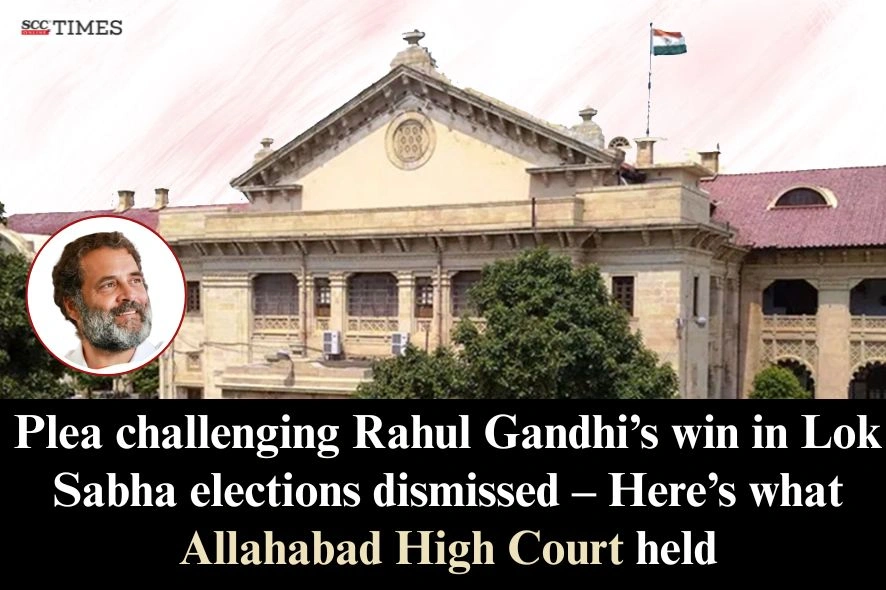
Allahabad High Court: In a petition filed under Article 226 of the Constitution, the petitioner challenged qualification of Rahul Gandhi to be chosen as Member of Parliament (‘MP’) citing his conviction under Section 499 of the Penal Code, 1860 (‘IPC’), the Division Bench of Manjive Shukla and Shekhar B. Saraf, JJ., a person convicted of an offence and sentenced to imprisonment for not less than two years is the bar provided under Section 8(3) of the Representation Act, however, when such a conviction has been stayed by a higher court, the indelible mark of a convict cannot be assigned to such a person till the appeal is decided.
Accordingly, the Court rejected the petition at hand.
Background
Rahul Gandhi was convicted by the Trial Court for an offence punishable under Section 499 of the IPC for which there was simple imprisonment of two years or fine or both. The order was challenged, the Gujarat High Court dismissed the revision petition and accordingly rejected the prayer for stay of conviction. When the matter went up before the Supreme Court, the order was stayed.
The petitioner contended that the stay of order of conviction did not allow Rahul Gandhi to contest in elections because Article 102 of the Constitution read with Section 8(3) of the Representation of Peoples Act, 1951 (‘Representation Act’), created a disqualification for being chosen as or for being an MP. Thus, he was disqualified to be chosen as MP, so his nomination paper was wrongly accepted, and his name was wrongly put for voting amongst the voters of Wayanad and Raebareli Lok Sabha seats.
Analysis and Decision
The Court perused Article 102 of the Constitution and Section 8(3) of the Representation Act and stated that once an order of conviction is stayed, the bar under Section 8(3) of the Representation Act would not apply. The reason for the same is that a person convicted of an offence and sentenced to imprisonment for not less than two years is the bar provided under Section 8(3) of the Representation Act, however, when such a conviction has been stayed by a higher court, the indelible mark of a convict cannot be assigned to such a person till the appeal is decided.
The Court further clarified that in several cases, the higher court does not stay the conviction of a person but merely stay the execution of the sentence and even grants bail to the petitioner, but such a stay of the execution is not synonymous to stay of conviction. In the former case, the bar under Section 8(3) would apply but in the latter case, since the conviction has been stayed, the bar would not apply.
The Court stated that the moment a higher court stays a conviction, the anathema of conviction goes out of the window and the person against whom such conviction is stayed, though not absolved, cannot be stated to be a convicted person. It is only when the appeal is decided that it could be ascertained as to whether he would be a convicted person or an acquitted person.
Hence, the Court held that the present petition was devoid of merit. Further, the Court stated that since no substantial question of law arose, as the matter was categorically settled by the Supreme Court and is no longer res integra, thus, the prayer regarding issuance of certificate for appeal to the Supreme Court under Article 134A of the Constitution is also rejected.
[Ashok Pandey v. Rahul Gandhi, 2025 SCC OnLine All 8032, decided on 4-12-2025]
Advocates who appeared in this case:
For the Respondent: A.S.G.I., Anupriya Srivastava
Buy Constitution of India HERE

Buy Penal Code, 1860 HERE