Disclaimer: This has been reported after the availability of the order of the Court and not on media reports so as to give an accurate report to our readers.
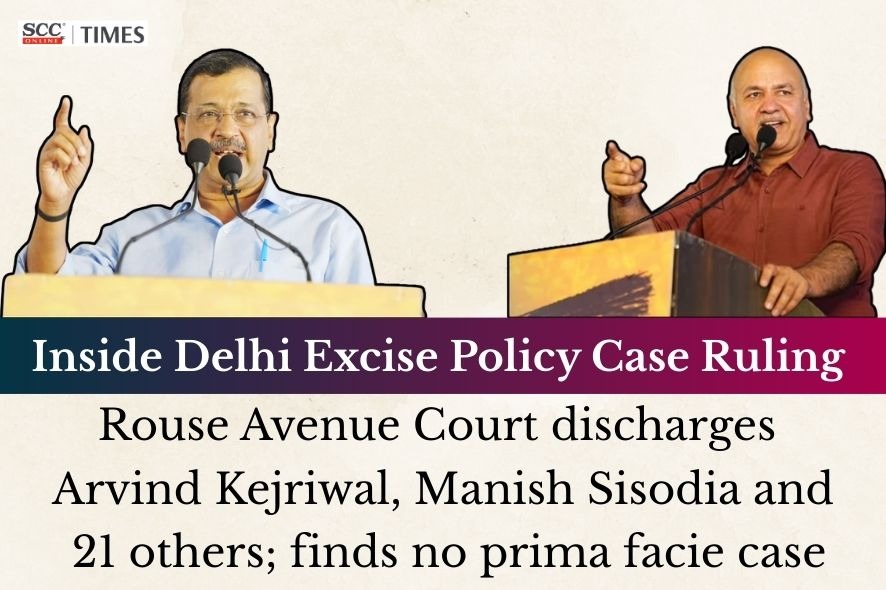
Rouse Avenue Court, New Delhi: The present judgment dealing with alleged irregularities in the Delhi Excise Policy 2021-2022 (Delhi Excise Policy) to extend undue benefit to certain private persons/entities described as the “South Group” and allied intermediaries in consideration of illegal gratification quantified at approximately Rs 90—100 crores. While determining whether charges should be framed against the accused or whether they were entitled to discharge under the provisions of the Criminal Procedure Code, 1973 (CrPC), a Single Judge Bench of Jitendra Singh, J., discharged the accused A-1 to A-23 of all the offences alleged against them and held that material placed on record did not disclose even a prima facie case, much less any grave suspicion, against any of the accused persons.
Factual Matrix
The Delhi Excise Policy was introduced on 5 July 2021 with the stated objective of curbing monopoly and cartel formation in the liquor trade by separating the roles of manufacturers, wholesalers, and retailers. Retail zones were to be allotted through e-tendering, and a Tender Evaluation Committee (TEC) was constituted to scrutinise bids.
The present matter arose out of FIR dated 17 August 2022 registered by the Central Bureau of Investigation (CBI) concerning alleged irregularities in the Delhi Excise Policy. The prosecution alleged that certain public servants of the Excise Department of the Government of National Capital Territory of Delhi, in conspiracy with private liquor businessmen and intermediaries, manipulated the formulation and implementation of the policy to confer undue advantage upon “South Group”.
The CBI filed one principal chargesheet and four supplementary chargesheets, arraigning 23 accused persons (A-1 to A-23), including public servants, businessmen, intermediaries, and political functionaries. The allegations broadly involved criminal conspiracy, corruption, manipulation of policy provisions, payment of illegal gratification, and routing of funds through hawala channels, allegedly amounting to approximately Rs 90—100 crores.
Prosecution (CBI)’s Case
The prosecution alleged that in May—June 2021, at the instance of A-3, meetings were held in Delhi and Hyderabad between A-3, A-4, A-5, approver PW 20 and other individuals connected with the liquor trade, to discuss the upcoming excise policy and it was indicated that 7 to 10 retail zones in Delhi would be secured by the “South Group”. It was further alleged that certain accused persons agreed to pay Rs 20—30 crores as “upfront money” which would later be adjusted through business arrangements.
The CBI contended that entities such as M/s Indospirits (A-7) and M/s Brindco Sales Pvt. Ltd. (A-9) were to receive favourable treatment under the policy, including, allocation of wholesale distribution rights, enhanced profit margins and preferential licensing arrangements The prosecution further alleged that part of the illegal gratification was transferred through hawala channels and routed through intermediaries.
The prosecution claimed that during the policy-formulation stage, the recommendations of an Expert Committee suggesting government control over wholesale distribution were ignored, the wholesale profit margin was increased from 5 per cent to 12 per cent, eligibility criteria for wholesale licenses were modified and restrictions concerning related entities were diluted, thereby benefiting “South Group.”
It was alleged that certain officials of the Excise Department facilitated the conspiracy by processing license applications in undue haste, ignoring complaints regarding cartelisation and cross-funding and granting licences despite deficiencies in documentation. The prosecution also alleged that illegal gratification of Rs 30 lakhs was paid to expedite the issuance of an L-1 licence.
It was claimed that the policy resulted in substantial financial gains to “South Group.” For instance, A-8 reportedly generated a turnover of approximately Rs 1333 crores, net distributable profits of about Rs 47.68 crores were recorded and a large portion of profits was allegedly transferred through complex financial arrangements to intermediaries and associated companies.
Another major allegation was that a portion of the alleged illegal gratification was transferred through hawala or angadiya channels and used for political campaign expenditure during the Goa Assembly Elections of 2022. It was claimed that approximately Rs 44.54 crores was transported from Delhi to Goa and disbursed for campaign-related activities.
The supplementary chargesheets expanded the scope of the investigation and alleged that additional accused persons participated in meetings concerning policy manipulations, acted as conduits for financial transactions and facilitated hawala transfers and cash disbursements. The prosecution sought prosecution of these persons under Sections 120-B, 420 and 201 IPC and Sections 7, 7-A, 8 and 12, Prevention of Corruption Act, 1988 (PC Act).
Role of Accused — ‘A-1 to A-23’
Two excise officials are implicated, A-1 — Deputy Commissioner, Indian-Made Foreign Liquor Department, (IMFL) and A-2 — Assistant Commissioner (IMFL). The prosecution alleges that they processed the L-1 licence of A-7 despite deficiencies and ignored complaints regarding cartelisation and cross-funding.
The prosecution alleged that A-8 (then Deputy Chief Minister) played a central role in influencing the formulation of the Delhi Excise Policy. An Expert Committee had recommended the government control over wholesale, privatisation of retail through lottery and safeguards against cartelisation. It was alleged that the report was not processed normally and was sidelined because A-8 intended to adopt a different model favouring private entities. It was further alleged that fabricated public feedback emails were generated to support policy changes. Regarding missing Missing Cabinet Note and GoM Report, it was claimed that the file was last in the conscious possession of A-8. Subsequently a new note was prepared on 2 February 2021 which allegedly increased the wholesale margin from 5 per cent to 12 per cent and altered eligibility conditions to favour certain businesses.
Regarding alleged role of “South Group” which included A-5, A-4, A-6, their associate and Chartered Accountant A-11, it was alleged that A-3 acted as intermediary between the group and A-8 and illegal gratification of Rs 90—100 crores was negotiated. A-7 was allegedly structured to represent this group and earned profits of Rs 29.29 crores forming part of the alleged bribe proceeds.
The prosecution alleged that A-11 assisted members of the South Group in incorporating favourable clauses into the excise policy. He participated in policy discussions and had access to confidential government documents. Further alleged that A-9 played a role in facilitating interactions between policy actors and private liquor manufacturers.
The prosecution alleged that Rs 44.54 crore from the alleged illegal gratification was utilised for the AAP Goa Assembly Election campaign (2022) allegedly transferred through hawala/angadiya operators from Delhi to Goa. Cash handlers and conduits allegedly included A-12 to A-16, who were involved in receiving and disbursing cash for campaign expenses.
The prosecution alleged that A-17 emerged as a key conspirator in the criminal conspiracy relating to the formulation, manipulation and implementation of the Delhi Excise Policy. A-17 demanded Rs 100 crore as upfront money from liquor businessmen of South India and operated through associates A-4, A-5 and A-11. PW 226 allegedly paid Rs 10 crore in March 2021 and Rs 15 crore in June 2021 as part of the alleged demand. It was further alleged that A-17 held 32.5 per cent stake in A-7 through proxy A-5. It was alleged that to recoup bribe money a sham arrangement was made through a land transaction with Mahira Ventures Pvt. Ltd. controlled by A-23 for Rs 28 crores. Additionally, Rs 80 lakhs corporate social responsibility (CSR) funds were allegedly routed to her NGO Telangana Jagruthi.
The prosecution claimed that PW 225 met A-18 (Chief Minister of Delhi) and was asked to contact A-17 and provide monetary support to the party. Subsequently, Rs 25 crores was allegedly paid through associates in two instalments.
The prosecution further alleged that A-21 acted as a conduit on behalf of A-18 and the Aam Aadmi Party for transferring money to Goa through hawala channels and A-21 and A-22 acted as conduits for transferring Rs 25.50 crores to Goa.
Moot Points
-
Whether the prosecution material disclosed a prima facie case of criminal conspiracy under Section 120-B IPC and raised “grave suspicion” sufficient for framing of charges against the accused?
-
Whether the evidence showed a nexus between alleged illegal gratification and the formulation or implementation of the Delhi Excise Policy?
-
Whether administrative decisions and policy formulation could give rise to criminal liability in the absence of material indicating dishonest intention or quid pro quo?
Court’s Analysis
At the outset, the Court noted that 23 accused persons have been arrayed in the present case. The Court individually examined the material relating to the public servants, namely A-8, A-1, A-2 and A-18, due to the distinct nature of the allegations attributed to them in their official capacity. It then examined the allegation against A-3, A-4, A-5, A-6, A-7, A-9, A-10, A-11, A-17 and A-23 in relation to the formulation, implementation and ancillary transactions connected with the policy. Lastly, examined the allegations against the A-12, A-13, A-14, A-15, A-16, A-21 and A-22, foe alleged movement of the purported upfront money, stated to have been routed to Goa and utilised for election related purposes.
Allegation against A-8 (Manish Sisodia, then Deputy Chief Minister)
The Court noted that the allegation relating to the formulation and implementation of the Delhi Excise Policy was placed at the doorstep of A-8, who at the relevant time was serving as Deputy Chief Minister and was holding the portfolio of the Excise Department. The prosecution projected A-8 as the “principal architect and controlling force behind the alleged conspiracy.”
The Court observed that the prosecution case against A-8 broadly rests on four inter-linked pillars:
-
Manipulation of the policy formulation process, including alleged deviation from the recommendations of the Ravi Dhawan Expert Committee.
-
Role in preparation and approval of the GoM reports and policy documents, allegedly favouring certain private entities.
-
Demand and acceptance of illegal gratification described as “upfront money”.
-
Subsequent implementation of the policy and grant of licences, allegedly structured to benefit members of the so-called “South Group”.
The Court observed that policy formulation in a governmental setting inherently involves deliberation, modification and rejection of earlier proposals. Expert Committee recommendations are advisory in nature, and the executive is not legally bound to adopt them. Therefore, the Court held that the mere fact that the final policy differed from the recommendations of the Expert Committee cannot by itself indicate criminal misconduct.
Another important allegation made by the prosecution was that draft versions of the GoM report were shared with private persons, particularly members of the South Group and relies upon hotel records, photocopy records, and statements of witnesses. The Court observed that the material placed on record does not clearly establish the chain through which such draft documents allegedly reached the private persons. Even assuming that some version of a draft document was available outside official channels, it observed that the prosecution must still demonstrate how such access influenced the policy-making process in a corrupt manner.
The Court further observed that administrative files passed through multiple levels of scrutiny, including various departments and the Cabinet. Such institutional processes weaken the suggestion that the policy was the result of unilateral manipulation.
“A circumstance that merely indicates that 36 pages were photocopied at a hotel has been treated as a conclusive link in the alleged chain of conspiracy. When inferential coincidences are framed as established facts or when an inference unsupported by the primary statements and documents is presented with such finality, it risks distorting the appreciation of evidence at the threshold stage. A fair trial requires a balanced and faithful presentation of material; selective emphasis or overstatement of circumstances undermines that standard and directly affects the right of the accused to an impartial adjudication.”
With respect to the alleged disappearance of the Cabinet Note, the Court found that the prosecution has not produced clear evidence demonstrating deliberate destruction or concealment. Administrative files often undergo revision and movement across departments, and the absence of a particular draft does not automatically establish culpability. In the absence of clear material demonstrating deliberate concealment with dishonest intent, the Court held that the allegation of disappearance of the file cannot be treated as incriminating material.
The prosecution also emphasised that the wholesale margin was increased from 5 per cent to 12 per cent, which allegedly benefited certain private entities. The Court observed that policy decisions relating to commercial margins fall squarely within the domain of economic regulation. Such decisions may be influenced by a variety of considerations, including market viability, incentives for private investment, competitiveness of the liquor trade, and revenue considerations. It was emphasised that the mere fact that a particular margin appears favourable to private entities cannot by itself constitute evidence of corruption. Unless there exists material demonstrating that the margin was fixed in exchange for illegal gratification, the decision remains a policy determination rather than a criminal act. The Court found that the prosecution material does not disclose prima facie evidence linking the increase of margin to payment of bribes or quid pro quo arrangements.
“Significantly, the investigating agency has not undertaken any comparative analysis between the old and the new policy frameworks to contextualise the increase in the wholesale margin. Without examining the qualitative and quantitative differences in obligations, cost structures, and risk allocation between the two regimes, any assertion that the revised margin is excessive remains conclusory.”
Regarding allegations of illegal gratification, the Court observed that the prosecution case relied substantially on the statements of approvers but found that approver’s statements lacked independent corroboration in material particulars. Further, no documentary evidence had been produced demonstrating the alleged payment of Rs 100 crores, or the actual transfer of funds to the accused persons. It was held that in the absence of such corroboration, the allegation of upfront payment remains unsubstantiated.
The Court also examined the financial transactions relied upon by the prosecution and stated that while the records demonstrate business activities and profits earned by certain companies, they do not establish that these profits were proceeds of bribery or illegal payments. Commercial profits arising from a regulatory framework cannot by themselves constitute evidence of criminal conspiracy.
After considering the entire prosecution material, the Court observed that the allegations against A-8 rest largely upon inference and narrative reconstruction rather than concrete evidence. The prosecution attempted to link policy decisions, business outcomes and witness statements into a coherent narrative. However, the Court found that the material does not disclose a clear chain of circumstances establishing a criminal conspiracy or quid pro quo arrangement. In the absence of evidence demonstrating demand, payment and receipt of illegal gratification, the prosecution case against A-8 failed to cross the threshold of grave suspicion required even at the stage of framing of charge.
Allegation against excise officials (A-1 and A-2)
The prosecution alleged that two excise officials, A-1 (Deputy Commissioner, IMFL) and A-2 (Assistant Commissioner, IMFL) processed the L-1 licence of A-7 (M/S Indospirits) despite deficiencies under the Delhi Excise Policy.
The Court observed that the prosecution case was essentially rested upon the manner in which the application of A-7 was processed within the Excise Department. The Court noted that administrative processing of licence applications necessarily involves multiple steps, including scrutiny of documents, issuance of show-cause notices where required, and final decision by the competent authority. It was emphasised that differences in administrative assessment or procedural decisions cannot by themselves be treated as evidence of criminal conspiracy.
The prosecution argued that A-1 had directed that certain allegations relating to cross-funding and cartelisation should not be included in the show-cause notice issued to the applicant. The Court noted that the complaints received by the department were of varying nature and required evaluation by the officials concerned. It observed that decisions regarding the relevance or sufficiency of allegations to be included in a show-cause notice fall within the domain of administrative discretion. Therefore, unless the prosecution is able to demonstrate that such decisions were taken with dishonest intent or in exchange for illegal gratification, the same cannot be treated as criminal misconduct.
With regards to allegation that the licence was processed with unusual haste on 5 November 2021, the Court observed that administrative actions often take place within short time frames once the necessary documents are found to be in order. Further, the prosecution had not demonstrated that any mandatory procedure was bypassed in granting the licence. In the absence of such material, the Court held that the mere fact that the licence was granted on a particular date cannot be treated as incriminating.
With regard to the allegation that A-2 received Rs 30 lakh as illegal gratification, the Court noted that the prosecution relied mainly upon oral statements recorded during investigation. It observed that no recovery of the alleged amount was made, no financial trail demonstrating payment of the amount was produced, and no documentary material was placed on record establishing the transfer of the alleged bribe. The Court emphasised that allegations of bribery must ordinarily be supported by some form of objective evidence, particularly where large sums of money are alleged to have been paid.
The Court reiterated the principle that administrative decisions taken by public officials in the course of their official duties cannot be treated as criminal acts unless accompanied by evidence of dishonest intent or abuse of office.
The Court held that the prosecution failed to demonstrate a meeting of minds between A-1, A-2 and other accused persons, payment or receipt of illegal gratification supported by objective evidence, or deliberate misuse of official position for unlawful gain. In the absence of such material, the Court held that the prosecution case does not disclose the ingredients of the offences alleged against A-1 and A-2 even at the stage of charge.
Accordingly, the Court found that no prima facie case is made out against A-1 and A-2, and the allegations against them do not give rise to grave suspicion warranting their trial.
Allegations against A-7 (Business entity M/s Indospirits.)
It was alleged that certain members of the so “South Group” had entered into a criminal conspiracy to manipulate the Delhi Excise Policy and subsequently recoup the alleged upfront payments through the wholesale business of A-7.
At the outset, the Court noted that A-7 was concededly not a member of the “South Group” and was not present at the meetings, according to the prosecution, were the conspiracy allegedly crystallised and the decision to pay an upfront amount of Rs 20—30 crores to A-3 for “tweaking” the policy was taken.
The Court note that the prosecution’s conspiracy theory presupposed that A-7 would first secure an L-1 licence, and thereafter it would be appointed as distributor by Pernod Ricard India (P) Ltd. (PRI). It found that the conspiracy theory advanced by the prosecution as inherently contingent and speculative as both these events were outside the control of the alleged conspirators.
While examining the actual course of events during the implementation of the Delhi Excise Policy, the Court opined that it did not support the prosecution’s case of a pre-planned and effectively executed conspiracy. It found the difficulties faced by the South Group and by A-7 at every material stage, to be inconsistent with the existence of a centrally controlled conspiratorial design.
Accordingly, the Court held that the allegations against A-7 did not disclose material capable of establishing acts in furtherance of a criminal conspiracy.
Allegations against A-4, A-5 and A-6
According to the prosecution, certain monetary credits were made by A-4 and A-5 to these entities, and the acquisition of the logo/trademark of the “India Ahead” news channel was part of a broader design attributed to them. The Court referred to this set of allegations as the “Media-Transaction Theory.”
The Court noted that the prosecution attempted to construct a theory in which profits from A-7 were allegedly diverted, funds were routed through companies associated with A-6, and investments were made in media entities connected with A-4. However, when the underlying transactions were scrutinised individually, it found that the loan agreement was validly executed and supported by witness testimony, the financial dealings between the parties pre-dated the alleged conspiracy, and the corporate acquisitions were supported by contemporaneous documentation.
Upon a consolidated consideration of the allegations against A-4, A-5 and A-6, the Court held that the prosecution’s Media-Transaction Theory rests largely on conjecture rather than demonstrable evidence. It found the transactions relied upon by the prosecution to be consistent with legitimate commercial dealings in the media sector.
The Court stated that “the narrative now projected is, therefore, not an inference flowing from evidence; it is a post-facto construction which attempts to fit pre-existing commercial activity into a conspiracy framework by reversing the sequence of events” and held that the prosecution had failed to link these transactions with the alleged conspiracy or with the proceeds of crime arising from the excise policy case
Allegation against A-17 (Kalvakuntla Kavitha, former MLC from Nizamabad) and A-18 (Arvind Kejriwal, Chief Minister of Delhi)
The prosecution case is that A-17 was part of the so-called “South Group” and played a significant role in the alleged arrangement whereby “upfront money” was paid in exchange for favourable provisions in the excise policy. It was contended that A-17 acted as a link between the South Group and certain political functionaries, and played a role in coordinating the payment of the alleged upfront money.
The Court noted that the very inclusion of A-17 and A-18 in the present case rests substantially upon the statements of PW 225 and his son PW 226, the latter having been tendered pardon during the investigation. It is essentially through these two witnesses that the prosecution attempts to bring A-17 and A-18 within the alleged conspiracy. It observed that the reliance upon these statements alters the chronology of the alleged conspiracy itself. Initially, the prosecution had projected the conspiracy as having taken shape around April—May, but after reliance upon PW 225 and PW 226, the starting point is pushed back to March. Thus, the timeline of the alleged conspiracy stands shifted primarily on the accomplice’s statements.
The Court further noted that beyond this assertion, no circumstance, meeting, communication or overt act is attributed to them jointly. The prosecution allegations that Rs 10 crores were received from PW 226, but the attempt to corroborate this through PW 227 remained unsatisfactory, as PW 226 does not specify the exact date, place or time of delivery, leaving the link incomplete. The allegation that Rs 10 crores and Rs 15 crores were received at Chennai and thereafter routed to Delhi and then to Goa, lacked substance as it was silent on the basic question of how the amount reached Delhi in the first place.
While acknowledging that the prosecution must be granted reasonable latitude at this stage, the Court emphasised that it cannot dispense with a meaningful application of mind. “Even if the material is taken at face value, a straightforward reading raises doubts as to whether the investigation has traced a coherent chain, or whether isolated events have been placed together to create the appearance of a larger design.”
The Court observed that the case is projected against a background of sensational and striking features, including the allegation that a 36-page printout became the GoM report, the alleged Rs 90—100 crores in illegal gratification, the involvement of high-level public servants, businessmen and media persons, allegations of bribe-taking by government officials, an alleged connection with the Goa elections, and the fact that multiple participants have turned approvers and given successive statements.
The Court asserted that “criminal law does not proceed on impression. It proceeds on admissible material.” Viewed casually, such elements may create the impression of a sweeping and well-organised conspiracy, and the narrative appears structured. However, once the matter is examined in light of the principles governing accomplice statements and the requirement of corroboration, the apparent superstructure begins to lose stability.
“Courts cannot permit the force of a narrative to replace the discipline of evidence. However serious the allegations may appear, they must withstand scrutiny under settled legal principles. When so examined, what is projected as a single, coherent design may, in truth, consist of a chain of assertions resting upon one another, without firm and independent support.”
Invoking the maxim “sublato fundamento cadit opus” i.e., when the foundation is removed, the structure falls, the Court observed that once the primary reliance on mutually supporting accomplice-like statements is tested, the apparent coherence dissolves. Like a pack of cards, once the base is unsettled, the entire arrangement begins to give way, and the larger structure cannot sustain itself.
Allegation against A-12 to A-16, A-21 and A-23 (utilisation “upfront money” in Goa Assembly Election)
The Court further examined the alleged movement of cash forming part of the prosecution narrative relating to hawala/angadiya transfers to Goa. The Court stated that the statements relied upon by prosecution primarily describe the functioning of angadiya networks and courier operations, which by themselves did not establish that the money formed part of an unlawful scheme.
The Court found that the alleged chains of cash movement did not conclusively establish that the money originated from the accused persons or was intended for the purposes alleged by the prosecution. It noted that the witnesses spoke mainly about transporting or facilitating delivery of cash, the evidence largely demonstrated transportation of cash through angadiya channels, but it did not provide a clear and reliable basis for concluding that the transactions were connected with the alleged conspiracy relating to the excise policy.
Collapse of the Prosecution Case
The Court observed that the very foundation of the prosecution case rested on the assertion that the formulation and implementation of the Delhi Excise Policy were deliberately engineered to confer undue pecuniary advantage upon the so-called “South Group.”
The Court recorded that the material on record rendered prosecution’s narrative wholly unsustainable as it was established that A-1 and A-2 granted the L-1 licence to M/s Indospirits strictly in accordance with the notified eligibility criteria, and the contemporaneous record discloses no deviation, indulgence, or extraneous consideration in the grant of such licence. Further, the prosecution had failed to place on record any material whatsoever indicating either demand or receipt of illegal gratification by A-1 or A-2, or by any public servant, in connection with the licensing process.
The Court further found the allegation of manipulation in the framing of the excise policy equally fragile. The documentary trail demonstrates that the policy was formulated through the prescribed institutional route, in consonance with the Transaction of Business Rules of the GNCTD, the Allocation of Business Rules, and the Cabinet Secretariat Manual of Procedure. In the absence of proof of policy manipulation, the very substratum on which the alleged conspiracy was erected stands demolished.
The Court held that once the alleged foundational acts, policy manipulation and grant of licence for illegal consideration, was found to be devoid of evidentiary support, the entire superstructure of conspiracy collapsed. It found the theory of generation of “proceeds of crime” to be entirely unsubstantiated. Where the genesis itself is missing, the question of accrual, layering or utilisation of proceeds of crime does not arise. The chain of circumstances projected by the prosecution as forming an unbroken sequence of conspiracy did not merely suffer from missing links; it disintegrates altogether.
According to the Court, what instead emerged was a troubling picture of an investigation steered by a preconceived outcome rather than by objective evaluation of evidence. “Lawful administrative actions and policy decisions appear to have been selectively extracted, stripped of context, and artificially interlinked to manufacture an appearance of conspiracy. Such an approach reflects a marked departure from the settled principles governing fair investigation and betrays an effort to substitute inference and conjecture for proof.”
Concern regarding manner of conducting investigation
The Court raised serious concern regarding the overall direction adopted by the investigating agency, observing that it raises issues touching upon the fundamentals of the Rule of Law and constitutional governance. It noted that the investigation did not begin with the identification of the essential ingredients of a criminal offence or the collection of legally admissible material demonstrating criminality in the formulation or execution of the Delhi Excise Policy. Instead, the investigation appeared to shift its focus mid-course and expand progressively, moving from a campaign-related company to small vendors and intermediaries, then to angadiyas operating cash-transfer networks, thereafter to house owners, hotel operators, political volunteers, contesting candidates, and eventually to higher levels of political leadership. The Court observed that “this widening arc does not appear to be founded on fresh or independent incriminating material emerging at each stage, but rather on a preconceived assumption of the existence of “proceeds of crime”, coupled with an apparent attempt to demonstrate that no segment has been left untouched in the purported effort to trace such proceeds”.
The Court further observed that the investigation strayed into the constitutionally demarcated domain of election expenditure and by scrutinising campaign logistics, accommodation arrangements, political volunteers and alleged cash payments, the investigating agency in effect undertook an audit of election spending, a field which lies within the exclusive constitutional jurisdiction of the Election Commission of India.
While acknowledging that the criminal process vests wide discretionary powers in the investigating agency, including the power to array persons as accused or to tender pardon and examine an accused as an approver, the Court emphasised that these powers remain subject to the disciplines of fairness, proportionality, reasonableness and constitutional conscience.
“Procedural fairness also demands institutional symmetry: if a person’s statement is sufficient to treat him as an accused, the converse decision to pardon him must be supported by demonstrable reasons grounded in relative culpability and evidentiary necessity.”
Court’s Decision
The Court held that the prosecution case failed to disclose even the threshold of a prima facie suspicion, far less the “grave suspicion” required for proceeding further in a criminal trial. Accordingly, the Court discharged the accused persons, as the prosecution has failed to establish the necessary ingredients of the offences alleged even at the stage of framing of charge.
[CBI v. Kuldeep Singh, 2026 SCC OnLine Dis Crt (Del) 13, decided on 27-2-2026]
Buy Code of Criminal Procedure, 1973 HERE
Buy Penal Code, 1860 HERE
Buy Prevention of Corruption Act, 1988 HERE