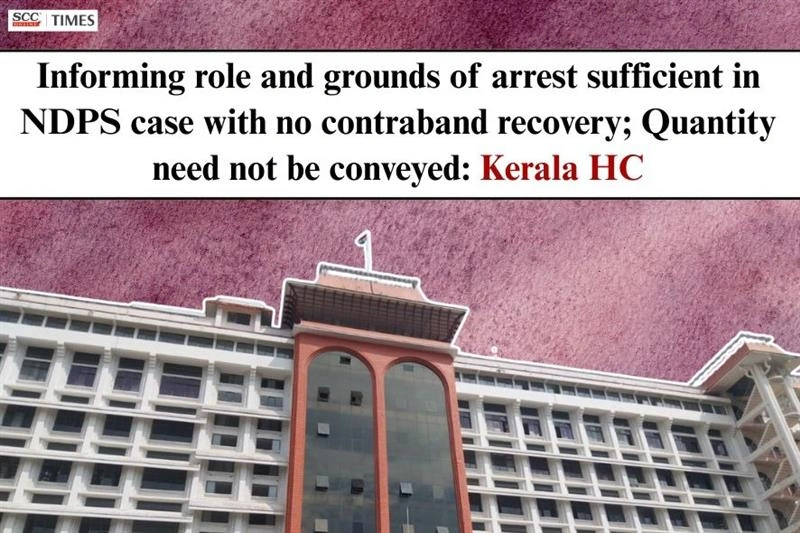
Kerala High Court: In a bail application revolving around the question whether the arrest is vitiated for non-communication of ‘grounds of arrest’ as mandated by Article 22(1) of the Constitution and Section 47 of the Nagarik Suraksha Sanhita, 2023 (‘BNSS’), especially in the context of an offence under Narcotic Drugs and Psychotropic Substances Act, 1985 (‘NDPS Act’), a Single Judge Bench of Dr. Kauser Edappagath, J., held that quantity need not be communicated if no contraband is seized from NDPS accused and that informing role and grounds of arrest sufficient.
Background
On 21-1-2025 at 12.50 p.m., Accused 1 and 2 were found in possession of 221.89 grams of MDMA inside an almirah in a hotel room, for sale. Accused 1 (‘applicant’) was arrested on 20-5-2025, and judicial custody continued thereafter. He was charged with offences punishable under Sections 22(c), 27A and 29 of the NDPS Act.
The applicant’s counsel submitted that the requirement of informing the arrested person of the grounds of arrest is mandatory under Article 22(1) of the Constitution and Section 47 of the BNSS, and since the applicant was not furnished with the grounds of arrest, the arrest was illegal and he must be released on bail. It was contended that the notice informing the written grounds of arrest under Sections 47 and 35(1)(b)(ii) BNSS did not contain the quantity of contraband seized, vitiating the arrest in an NDPS case. On the other hand, the Senior Public Prosecutor submitted that all legal formalities were complied with in accordance with at the time of arrest. It was further submitted that the alleged incident occurred as part of intentional criminal acts and that bail was not warranted at this stage.
Analysis and Decision
The Court noted that Chapter 5 BNSS deals with arrest, that Section 35(1) lists cases when police may arrest without warrant; and that Section 47 clearly states that every police officer arresting any person without a warrant shall forthwith communicate to him full particulars of the offence for which he is arrested or other grounds for such arrest. The Court further noted that Article 22(1) of the Constitution provides that no person who is arrested shall be detained in custody without being informed, as soon as may be, of the grounds for such arrest.
The Court highlighted that the requirement of informing the person arrested of the grounds of arrest is not a formality but a mandatory statutory and constitutional requirement. The Court opined that the non-compliance with Article 22(1) is a violation of a fundamental right and of the right to personal liberty guaranteed by Article 21 of the Constitution.
The Court relied on Pankaj Bansal v. Union of India, (2024) 7 SCC 576, and Prabir Purkayastha v. State (NCT of Delhi), (2024) 8 SCC 254, wherein the Supreme Court held that informing a person of the written grounds of arrest is a mandatory requirement under Article 22(1) of the Constitution and Section 47 BNSS, and its absence renders the arrest illegal.
The Court referred to Vihaan Kumar v. State of Haryana, (2025) 5 SCC 799, it was reiterated that informing the person arrested of the grounds of arrest is mandatory, although there is no need to communicate the grounds in writing. The Court also referred to Mihir Rajesh Shah v. State of Maharashtra, (2026) 1 SCC 500, wherein it was held that the grounds of arrest must be informed to the arrested person in each and every case without exception, and that the mode of communication must be in writing in the language he understands.
Regarding NDPS cases, the Court referred to Yazin S v. State of Kerala, 2025 SCC OnLine Ker 15334 and Rayees. R.M. v. State of Kerala, 2025 SCC OnLine Ker 7502, wherein it was made mandatory to specify the quantity of the contraband seized while communicating the grounds of arrest.
The Court noted that the notice informing the written grounds of arrest in the present case did not mention the quantity. However, the Court opined that no contraband was seized from the applicant’s possession, rather it was seized from the possession of other accused persons. The Court noted that the specific allegation against the applicant was that he supplied the contraband to the co-accused from Bangalore and stayed with them in a lodge at Bangalore, and that this specific role and the detailed grounds for arrest were clearly mentioned in the notice issued under Sections 47 and 35(1)(b)(ii) BNSS.
The Court observed that the requirement of communicating the quantity of the contraband seized cannot be interpreted to apply to all accused regardless of their complicity. The Court highlighted that the specification of quantity needs to be communicated only to those accused from whose possession the contraband was seized. As for other accused from whom no contraband was seized, it was sufficient if their role in the crime and the grounds for arrest were communicated to them.
Consequently, the Court found satisfactory compliance with Section 47 BNSS and Article 22(1) of the Constitution and dismissed the bail application.
[Imran v. State of Kerala, 2026 SCC OnLine Ker 1959, decided on 10-02-2026]
Advocates who appeared in this case:
For the Applicant: P. Mohamed Sabah, Libin Stanley, Saipooja, Sadik Ismayil, R. Gayathri, M. Mahin Hamza, Alwin Joseph, Benson Ambrose, Advocates.
For the Respondents: K.A. Noushad, SR. Public Prosecutor.
Buy Constitution of India HERE