Speculation can’t decide damages: Inside Delhi HC judgement clarifying evidence-based damages in trademark infringement
“It is the evidence which constitutes the bedrock for any award of compensatory or punitive damages.”
Explore latest Cases reported in SCC’s High Court Cases (HCC) shaping Intellectual property Laws which covers trademark infringement, patentability, passing off and Brand name disputes. A holistic view of evolving jurisprudence on intellectual property laws in India.
“The plaintiffs are the prior adopters and long-standing users of the subject mark ‘HIMALAYA’ since 1930 in connection with ayurvedic, wellness, pharmaceutical and personal care products.”
“The power of rectification is exercisable only by the High Court exercising appellate jurisdiction over the appropriate office of the Trade Marks Registry, wherein the entry relating to the impugned mark is made.”
This article explains the concept of personality rights and how a surge in celebrity lawsuits is reshaping the law on identity, privacy, and digital misuse in India.
“WIPRO has been expanding into various sectors since the 1980s and has obtained various registrations for the ‘WIPRO’ mark in various classes with the earliest registration in the year 1991.”
“The Plaintiff’s registered marks are Device Marks and not Word Marks. Hence, no infringement can be brought merely because of the use of the word ‘YATRA’ by the Defendant as ‘YATRA’ is a generic and a descriptive word.”
by Nishant Tripathi* and Akshat Singh**
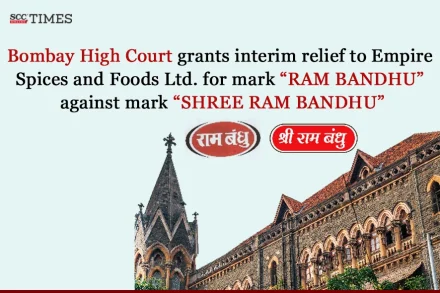
“The combination of the two words “RAM” and “BANDHU” is a coined word and arbitrary adaption being totally unconnected with the goods marketed under the trade mark, gives rise to claim for exclusivity.”
“The defendant’s use of the plaintiff’s trade mark cannot be said to be an honest adoption as though having a registered trade mark, the defendant deviated from the mark and adopted a mark which is deceptively similar to the plaintiff’s registered trade mark.”
Explore latest Cases reported in SCC’s High Court Cases (HCC) shaping Intellectual Property Laws which covers trademark infringement, patentability, passing off, and domain name disputes. A holistic view of evolving jurisprudence on intellectual property laws in India.
The plaintiffs submitted that the RITZ and RITZ-CARLTON marks are widely recognized and known among Indian consumers, especially in the hospitality and travel industry. The plaintiffs have promoted their respective trade marks heavily and have been recognized and given multiple awards and accolades.
“Mere use of a mark, even if continued over a period, is not by itself sufficient to establish enforceable rights under trade mark law. It must be shown that the mark, through its use in trade, has acquired a distinct association in the minds of the relevant consumer base with the claimant’s goods.”
The Court stated that Defendants 1,8, 9 and 10 are engaged in illegal activities, which are potentially criminal in nature, and are aimed at deceiving unwary consumers by making them pay through their website under the false pretence of securing reservations with the plaintiff’s ‘GINGER’ hotels.
Despite Respondent 1’s endeavour to create distinctions, it is crystal clear that the marks are confusingly/deceptively similar to the petitioner’s registered trade mark. Such use of a similar mark would invariably mislead consumers and members into believing that the goods under the impugned mark were sourced from the petitioner.
The long duration and wide geographical area for which the TAJ marks have been in use, their goodwill and reputation due to the extensive promotion and extensive revenue generated by the plaintiff, in India and other countries, the TAJ marks have achieved the status of well-known trade marks.
Defendant 3 has taken unfair advantage of the reputation and goodwill of the plaintiff’s trade marks/artistic works and has also deceived the unwary consumers of their association with the plaintiff by dishonestly adopting the plaintiff’s registered marks/labels without any plausible explanation.
Upon careful comparison of the plaintiff’s trade dress and that of the defendants, it became apparent that the overall colour scheme, get-up and layout of the defendants’ impugned packaging is nearly identical to that of the plaintiff’s trade dress.
Considering the widespread promotional and advertisement activities undertaken by the plaintiff, it is apparent that the trade mark ‘PETER ENGLAND’ has become the single source identifier of the plaintiff and its goods and services.
The plaintiffs submitted that the confusingly similar trade mark in the field of pharmaceuticals, create greater injury as compared to products and services in other fields.