Service Tax not leviable on data hosting services; Amazon Internet Services Pvt. Ltd. not an ‘intermediary’: CESTAT
“The place of supply of service being the location of the service recipient, which is outside India, no service tax is leviable”

Bringing you the Best Analytical Legal News


“The place of supply of service being the location of the service recipient, which is outside India, no service tax is leviable”
“Consideration out of surrender of tenancy right on account of immovable property cannot be considered as service as per definition under Section 65-B(44) of the Finance Act, 1994 and no service tax is payable.”
“SKY Lark Education Welfare Society is imparting education to students of Swami Vivekanand Subharti University, enrolled under the distant learning programme, as per its curriculum and it is duly recognized under the laws of the Uttar Pradesh Government/UGC.”
The Adjudication Authority stated that the appellant’s activity of receiving income from transferring temporarily or permitting the use of the right vested in the film produced by them to their clients fell under the definition of copyright service under Section 65(105)(zzzt) of the Finance Act, 1994.

by Shareen Gupta* and Rajan Mishra**
Summons and letters were issued to the appellant demanding service tax for the period from 01-07-2012 to 16-02-2014. Furthermore, a show cause notice demanding service tax of Rs. 2,07,29,576 along with interest for services during the afore-stated period was also issued.
“At the time of executing the Concession Agreements with developers, DMRC had collected “upfront fee” as a price for obtaining the respective Concession Agreements.”
For getting the films exhibited in their theatre, the owner of the said Multiplexes/theatres enter into agreements with the film distributors/producers. The purpose of the agreement and the intention of the parties is for screening of the film in the theatre, which cannot be treated as “Renting of Immovable Property Service”.
2025 SCC Vol. 5 Part 4: Explore the latest Supreme Court Cases on the Cooperative Societies, Motor Vehicles Act, Service Tax, CrPC, Contract, Constitution, Human and Civil Rights, and Public Premises Act.
A quick legal roundup to cover important stories from all High Courts this week.
Services provided by an advocate or a Partnership firm of advocates providing legal services to any person other than a business entity and a business entity with a turnover up to rupees ten lakhs in the preceding financial year are exempted from the levy of service tax.
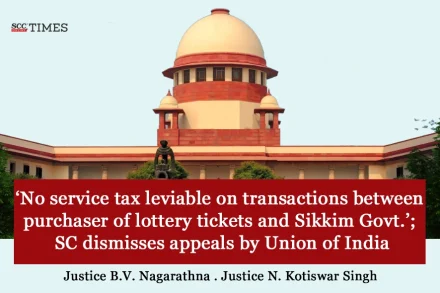
“There being no agency and no service rendered by the respondents-assessees herein as an agent to the Government of Sikkim, service tax is not leviable.”
Advocates Act, 1961 — S. 24(1)(f) — Enrolment Fees: Charging of enrolment fees in excess of statutory stipulation under Advocates Act, 1961
Special leave petition – Exemption from filing the certified copy of the impugned order of the High Court
The assessee-appellant contended that they acted on principal-to-principal with both the customers (shipper) and the shipping line/airline. A freight forwarder may act as principal and raise invoice to the exporter on his own account, providing transportation of goods and is not acting as “intermediary”.
All the activities rendered by the appellant are undertaken during hosting the cricket matches alone and if there were no cricket matches played, then all these services become irrelevant.
The services were not received by the appellant regarding which invoices have been issued to the appellant’s other two addresses, other than the address for which service tax registration has been taken, is contrary to the contention stated by Revenue in the show cause notice. Therefore, the same is not sustainable in law.
The Tribunal noted that Rule 4A (1)(i) of Service Tax Rules, 1994 requires disclosure of service tax payable on the value of service provided, thus, it cannot include exempted services. Moreover, a proviso inserted to the Rule by an amendment cannot enlarge the scope of the provision, at best it is only clarificatory.
The Tribunal stated that for a place to fall within the ambit of a public place, the element of right of access of public was a necessary concomitant.