
TOP LEGAL DEVELOPMENTS THIS WEEK [2nd- 8th Mar, 2026] | Delhi Excise Policy Scam; Sharbat Rooh Afza; India International Disputes Week; and more
A quick roundup to cover all the important legal developments and cases this week.
“From the allegations made in the complaint, the prosecution has not proved that the accused is guilty of an offence under the Scheduled Castes and Scheduled Tribes (Prevention of Atrocities) Act, 1989”
No specific allegation was made that the petitioners, who were not members of a scheduled caste or scheduled tribe, had intentionally undertaken an act to insult, intimidate or humiliate the first informant, who is a member of the scheduled caste.
“The incident is averred to have transpired within close precincts, specifically within the four corners of the walls of the shop premises. This description denotes a spatially confined and enclosed environment, shielded from casual public access and observation.”
In the case at hand, two people met through jeevansathi.com and subsequently physical relations were formed on various occasions on the false pretext of marriage.
The National Commission for Scheduled Tribes issued summons to MD and CEO of Axis Bank Ltd. to appear ‘in person’ in complaint regarding alleged commission of atrocities against Respondent 2.
“In criminal jurisprudence, the right of speedy trial is recognised as a fundamental right and just because the accused had participated in the trial at one stage, at other stage he does not lose a right to ask for bail.”
The victim after her marriage was being taunted for belonging to a particular community (Scheduled Caste).
A quick legal roundup to cover important stories from all High Courts this week.
The prosecution had raised a preliminary objection regarding the maintainability of the petition contending that the Section 14-A(2) of Scheduled Castes and Scheduled Tribes (Prevention of Atrocities) Act, 1989 puts an embargo on the High Court from hearing any anticipatory bail application.
“It is high time to send a strong signal to the society at large to be more vigilant on women and children belonging to weaker sections of the society.”
The Court stated that if the answer to all the steps is in the affirmative, then judicial conscience of the High Court should persuade it to quash such criminal proceedings, in exercise of power vested in it under Section 482 of the CrPC.
“In an acquittal appeal if other view is possible, then also, the appellate court cannot merely substitute its view by reversing the acquittal into conviction, unless the findings of the trial Court are perverse, palpably wrong, manifestly erroneous or demonstrably unsustainable.”
“The law requires that for an allegation of malafide to be sustained, it must be pleaded with specificity and supported by material facts. In the absence of mens rea, or a demonstrable element of ill-intention, such a prayer cannot be entertained.”
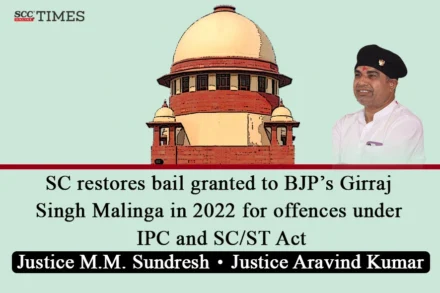
Girraj Singh Malinga was charged for the major offences punishable under Section 307 IPC, amongst others, read with Sections 3(1)(r), 3(1)(s) and 3(2)(va) of the SC/ST Act. He was duly arrested, and bail was granted by the order dated 17-05-2022.
There is sufficient material collected during investigation to indicate that the incident did take place and that slapping ‘G’ is an offence under Section 3(2)(v-a) of the Scheduled Castes and the Scheduled Tribes (Prevention of Atrocities) Act, 1989.
A quick legal roundup to cover important stories from all High Courts this week.
In the present case, the complaint remained pending for several years and no application was filed by Respondent 2. Now, no purpose would be served by ordering the prosecution of the accused persons, after a long delay of 14 years, when Respondent 2 and his co-accused have already been convicted in a criminal trial, relating to the same occurrence.
“One cannot lose sight of the reality that celebrities and public figures invariably tend to speak in a casual tone during interviews, and it is thus essential to consider the broader context rather than isolating specific words.”