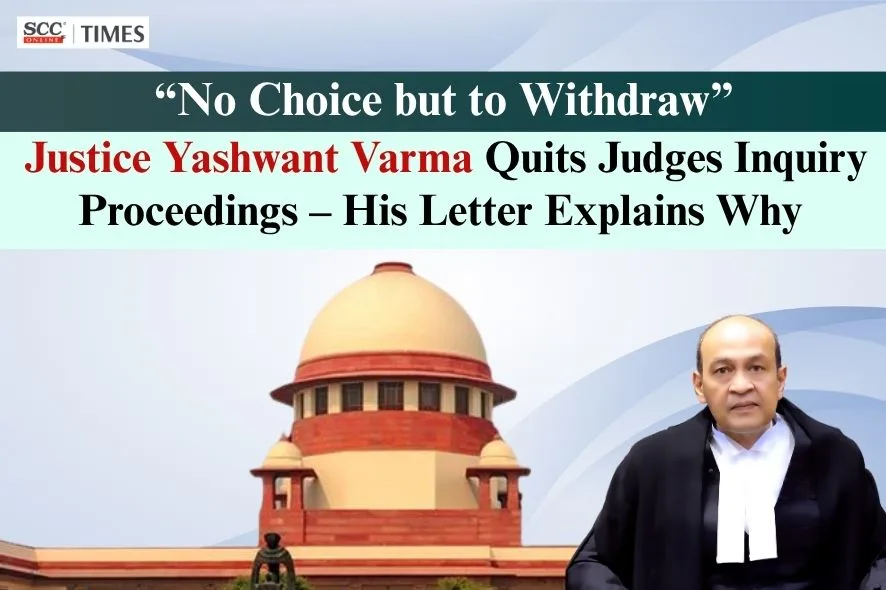
On 9 April 2026, Justice Yashwant Varma of the Allahabad High Court has withdrawn from the ongoing proceedings before the Judges Inquiry Committee, alleging serious violations of due process and denial of a fair hearing in connection with an inquiry linked to the discovery of cash following a fire at his official Delhi residence in March 2025.
He also submitted his resignation to the President of India, with immediate effect.
Fire Incident During Vacation and Discovery of Alleged Cash
In a detailed letter addressed to the Committee, Justice Varma stated that he was on a pre-planned vacation when a fire broke out in a detached storeroom at his government bungalow in New Delhi, during which videos were recorded by emergency responders showing what appeared to be cash. He said he was unaware of the incident at the time and denied any knowledge, ownership, or control over the alleged cash. He maintained that the storeroom was unsecured, regularly accessed by staff and others, and not under his exclusive control.
“I have been subjected to public vilification for over a year based on unfounded insinuations.”
Criticism of Inquiry Process and Evidentiary Standards
Justice Varma strongly criticised the inquiry process, claiming it relied on presumptions rather than evidence, reversed the burden of proof, and selectively excluded witnesses and material favourable to him, including the official fire report. He said several key witnesses were dropped after cross-examination revealed contradictions or weaknesses in the prosecution’s case. According to him, no prima facie case of misconduct was established under any of the three charges framed, and no evidence linked him to the alleged cash.
Key Grounds Cited for Claiming Procedural Unfairness
-
Inquiry proceeded on assumptions and presumptions, not on evidence linking him to the alleged cash
-
No prima facie case of misconduct was established on any of the charges
-
Burden of proof was reversed, forcing him to disprove unproven assumptions
-
Key defence-favourable evidence, including the official fire report, was excluded without explanation
-
Crucial witnesses were dropped after cross-examination exposed weaknesses or contradictions in the case
-
He was denied effective cross-examination, especially during the In-House Committee inquiry
-
Best available evidence, such as CCTV footage and security data, was never produced despite requests
-
Storeroom was detached, unsecured, and accessed by multiple people, yet he was presumed responsible
-
He was not present at the premises when the fire occurred and was informed only after decisions were taken by officials
-
Inquiry continued despite failing the legal threshold required for proceedings against a sitting High Court judge
-
Selective handling of material turned the inquiry into an adversarial exercise, not a truth-seeking process
Decision to Withdraw to Avoid Legitimising the Process
Stating that the proceedings have caused grave damage not only to him, but to the institution of judicial independence, Justice Varma said continuing participation would legitimise a process that compelled him to “answer the unanswerable.” He confirmed that he has also written to the President of India and instructed his lawyers to withdraw from the inquiry with immediate effect. Stating that he had no choice but to withdraw from these proceedings, he said,
“I withdraw with the deepest sadness, conscious of the gravity of my decision, and with the hope that history will one day record the unfairness with which a sitting High Court Judge was treated.”
Click Here to read the full letter