
Disclaimer: This has been reported after the availability of the order of the Court and not on media reports so as to give an accurate report to our readers.
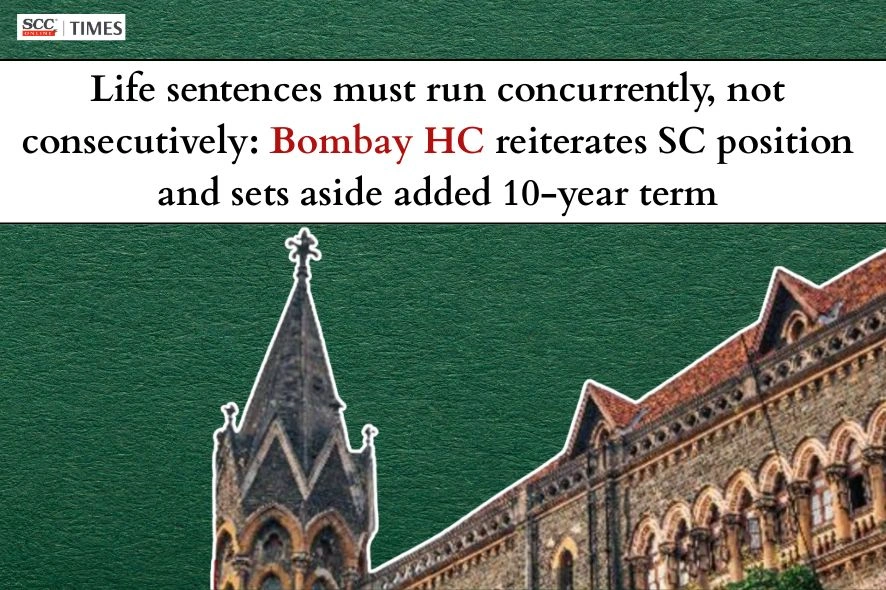
Bombay High Court: In a writ petition filed under Article 226 challenging the legality and the validity of impugned order of the State of Maharashtra, the Division Bench of Madhav J. Jamdar and Pravin S. Patil, JJ., held that the State Government passed the order without considering the binding effect of the Constitution Bench judgment in Muthuramalingam v. State, (2016) 8 SCC 313 and partly allowed the petition by affirming the impugned order to the extent that the petitioner to be released after completion of 30 years of imprisonment including remission and set aside further 10 years imprisonment awarded.
Background
The petitioner with other co-accused committed murder of three persons, robbery and rape for which they were convicted by the District and Sessions Judge at Pune for offences under Section 302 read with Section 34 Penal Code, 1860 (‘IPC’) and were awarded death sentence subject to confirmation by the High Court and for the offence under Section 376(2)(g) IPC, were directed to suffer rigorous imprisonment for 10 years and a fine of Rs 200.
Later Bombay High Court confirmed the conviction and sentences awarded by the trial court except the conviction under Section 201 read with Section 34 IPC to which the Supreme Court also confirmed but further directed that the petitioner shall first undergo imprisonment for life and thereafter undergo the sentence imposed under Section 376(2)(g) IPC. The State Government in view of the direction directed by the impugned order, that the petitioner shall undergo 30 years of imprisonment including remission to serve life imprisonment and thereafter undergo 10 years of imprisonment imposed under Section 376(2)(g) IPC by the learned Trial Court, which has been confirmed up to the Supreme Court.
Analysis and decision
The Court, after discussing the factual aspects, went through the rival contentions where at first the three categories 1(e), 5(a) and 6(a), of the Guidelines dated 11th May 1992 (‘Guidelines’) were examined by the Court and was noted that these categories are prescribed by the State Government under Section 433A Code of Criminal Procedure, 1973(‘CrPC’). The Court further discussed the Section 433A CrPC where a sentence of imprisonment for life is imposed on a convicted person for an offence for which death is one of the punishments provided by law, such person shall not be released from imprisonment unless he has served at least 14 years of actual imprisonment.
The Court noted that the Guidelines classify offences for premature release after 14 years, however, the categories are not exhaustive. Clauses (2) and (3) clarify that these categories are only a broad classification of crime patterns and do not cover all categories of prisoners. The criteria apply to normal cases, i.e., prisoners with ordinary features and good conduct in prison whereas, in present case the petitioner had absconded for a period of 1150 days and that the brutality and seriousness involved in the same was also noted.
The Court for the further direction of State Government of 10 years imprisonment, which was given in view of the Supreme Court direction, noted that this aspect was specifically considered by the Supreme Court in Muthuramalingam v. State, (2016) 8 SCC 313 and Duryodhan Rout v. State of Orissa, (2015) 2 SCC 783, the Court reiterated that imprisonment for life means imprisonment for the entire natural life of the convict and is not limited to 14 years or any fixed term, and that only the appropriate Government has the power to grant remission or commutation, subject to Section 433A CrPC. It was further clarified that although a convict must undergo at least 14 years of actual imprisonment, a life sentence cannot be automatically treated as a term of years in the absence of formal remission. The Court emphasised that while multiple life sentences may be imposed, they cannot run consecutively but operate simultaneously, so that remission in one does not ipso facto apply to others.
The Court found that the Constitution Bench in Muthuramalingam held that to the extent the said judgment in Ronny v. State of Maharashtra, (1998) 3 SCC 625, can be understood to mean that life sentences can run consecutively, it does not lay down the correct law and stands overruled to that extent.
Consequently, the Court held that while the State Government’s direction to release the petitioner after completion of 30 years of imprisonment including remission does not warrant interference, the further direction requiring the petitioner to undergo an additional 10 years under Section 376(2)(g) IPC is unsustainable in law, being founded on an overruled position, and the same was passed by the State Government without considering the binding effect of the Constitution Bench judgment.
The writ petition was thus partly allowed. The direction of release after 30 years was upheld, while the additional 10-year sentence under Section 376(2)(g) IPC was quashed.
[Ronald James Alvares v. State of Maharashtra, CWP 4544 OF 2025, decided on 07-03-2026]
Advocates who appeared in this case:
For the petitioner: Rupesh a. Jaiswal a/w Ramnik Pawar, Advocate
For the respondent: Shrikant Yadav, APP
Buy Code of Criminal Procedure, 1973 HERE
Buy Penal Code, 1860 HERE