
Disclaimer: This has been reported after the availability of the order of the Court and not on media reports so as to give an accurate report to our readers.
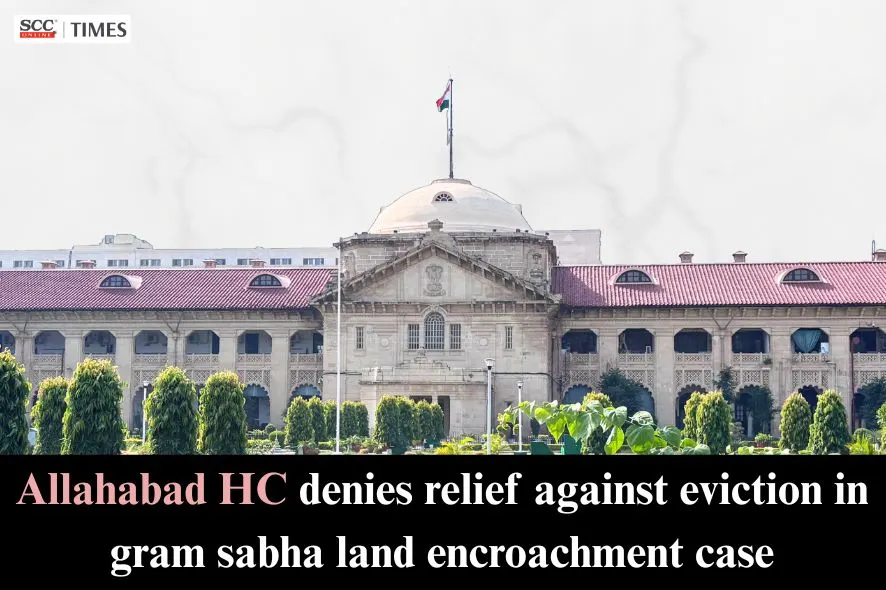
Allahabad High Court: In a writ petition filed by petitioners who were penalised for illegal encroachment of Gram Sabha land by constructing a mosque, the Single Judge Bench of Alok Mathur, J., dismissed the petition, holding that the procedure under Section 67 of the U.P. Revenue Code, 2006 (the Code) was duly followed. However, the Court set aside the penalty order, holding that there was no material to link the petitioners to either the construction or the occupation of the mosque.
Background
The petitioners were served an eviction and penalty order under Section 67 of the Code, for allegedly illegally encroaching and building a mosque on Gram Sabha land, which is recorded as “Khalihan” in the revenue records. In pursuance of this notice, the petitioners appeared before the Tehsildar stating that they had not constructed the mosque, as it was built 60 years ago. They also stated that they were not aware of the facts relating to the construction of the said mosque and denied that they were part of the mosque’s management or the manager/Mutwalee of the mosque; they only visited the mosque for prayers.
The Tehsildar rejected the objection raised by the petitioners, holding that the land on which the mosque existed was recorded as “Khalihan” and therefore, was a land owned by the Gram Sabha. Accordingly, the petitioners did not have any right interest or title in the disputed land. Thus, the Tehsildar passed orders for eviction and imposition of a penalty of Rs 36,000.
Aggrieved, the petitioners filed an appeal before the Additional District Magistrate (ADM) (Judicial), Lucknow. The ADM opined that the petitioner was unable to demonstrate that he had any right, interest, or title in the disputed property, as the same was undisputedly recorded as Gram Sabha land, and accordingly rejected the appeal vide the impugned order.
Hence, the present writ petition.
Analysis
Upon perusal of Section 67 of the Code and Rules 66 and 67 of the U.P. Revenue Code Rules, 2016 (the Rules), the Court noted the procedure as laid down for initiation of the proceedings under Section 67 of the Code:
-
Information is received by the Assistant Collector about encroachment on the Gram Sabha land.
-
Assistant Collector proceeds to conduct an enquiry and obtain further information relating to the particular area of the land on which the encroachment has been made, the plot number, the area boundary of the property, and the market value.
-
After receiving the entire details of the encroachment, a notice is required to be issued in RC Form 20 to the person who is alleged to have encroached upon the Gram Sabha land.
-
The person so put under notice has a right to respond to the notice and file his objections.
-
In case the person does not respond to the notice or his response is found to be insufficient or unsatisfactory, then orders can be passed for eviction from the said land, and also imposition of compensation for the damages for wrongful occupation.
-
Once the entire material as provided for under Section 67 (1) of the Rules has been obtained by the Assistant Collector, he has to issue notice in RC Form 20 to the person who is alleged to have occupied the Gram Sabha land.
-
The said noticee has a right to respond and deny the allegations levelled against him.
-
The Assistant Collector can file all the material on affidavit in support of his contentions. As per the proviso to Section 225-A of the Code, he may be permitted to cross-examine any witness who has filed an affidavit.
-
On consideration of the reply, the Assistant Collector is also mandated to return a finding that his reply is found to be insufficient; only then can he pass orders for eviction and levy damages for wrongful occupation.
The Court added that the opportunity of hearing has to be provided at the stage of consideration of the reply of the concerned person. After hearing and giving full opportunity to rebut the allegations in the notice, a reasoned and speaking order has to be passed by the Assistant Collector, clearly demonstrating whether the concerned person has been able to demonstrate any right, interest, or title in the disputed property, and also whether the disputed land is recorded in the name of the Gram Sabha.
After delving into the procedure, the Court noted that in the instant case, the respondents followed the Rules prescribed under Rules 66 and 67 of the Rules. However, regarding the imposition of a penalty, there was no material to link the petitioners to either the construction or occupation of the Mosque. Thus, the penalty could not be sustained and was set aside.
Regarding the petitioners’ contention that the directions issued by a Co-ordinate Bench in Rishipal Singh v. State of U.P., 2022 SCC OnLine All 829, were violated, the Court examined the directions provided under para 74. The Court stated that while they were clarifications/amplifications of the provisions already contained in Rules 66 and 67 of the Rules, Clause (vi) provided a major departure from the prescribed rules. According to the said clause, it would be mandatory for the authority to examine the person who submitted the report and to permit the said authority to be cross-examined.
The Court demarcated the issue as whether any order issued in violation of Clause (vi) of para 74 of Rishipal (supra) can be set aside without there being an amendment in the appropriate rules by the State Government?
Answering the question, the Court stated that the Legislature had already framed rules, i.e., Rules 66 and 67 of the Rules; it was not a case where there was an absence of any prescription for the procedure in proceedings under Section 67 of the Code enabling the Court to step in to fill the vacuum. The Court opined that since specific, valid, and enforceable rules exist, there was no occasion to exercise the extraordinary powers of formulating enforceable guidelines unless and until the existing rules are declared to be ultra vires.
Regarding Rishipal (supra), the Court noted that the Co-ordinate Bench did not discuss the inadequacy or any infirmity of the existing procedure prescribed in the Code and Rules, but rather suggested a fresh mechanism in itself titled “guidelines” to be adopted as procedure under Sections 67, 67-A, and 26 of the Code. Once the Court itself has issued directions for the “adoption” of the said guidelines/rules by the State of U.P., then such adoption was necessary, and without such adoption, the guidelines framed by this Court could not be implemented.
Apart from the above, the Court found that if the guidelines in Rishipal (Supra) were adopted and implemented, then the procedure, which hitherto was a summary procedure, would be converted into a regular procedure providing for determination only after parties are given due opportunity to adduce evidence. Thus, the Court held that this was why there was no intention to make the guidelines enforceable as such prior to adoption by the State, and necessary amendments in the rules.
Accordingly, the Court held that proceedings under Section 67 of the Code would have to be judged on the anvil of the existing procedure, till the guidelines framed in the case of Rishipal (supra) are adopted by the State by amending the Rules. The court further held that the procedure laid down in the Rules had been followed in the present case, as the guidelines were not mandatory.
[Shahban v. State Of U.P, 2026 SCC OnLine All 1246, decided on 25-03-2026]
Advocates who appeared in this case :
For the petitioners: Abdul Haleem, Ashid Ali, Mohammad Danish, Mohammad Kashif, Mohd. Mansoor, Mohd. Shameem Khan
For the respondent: C.S.C., Dilip Kumar Pandey