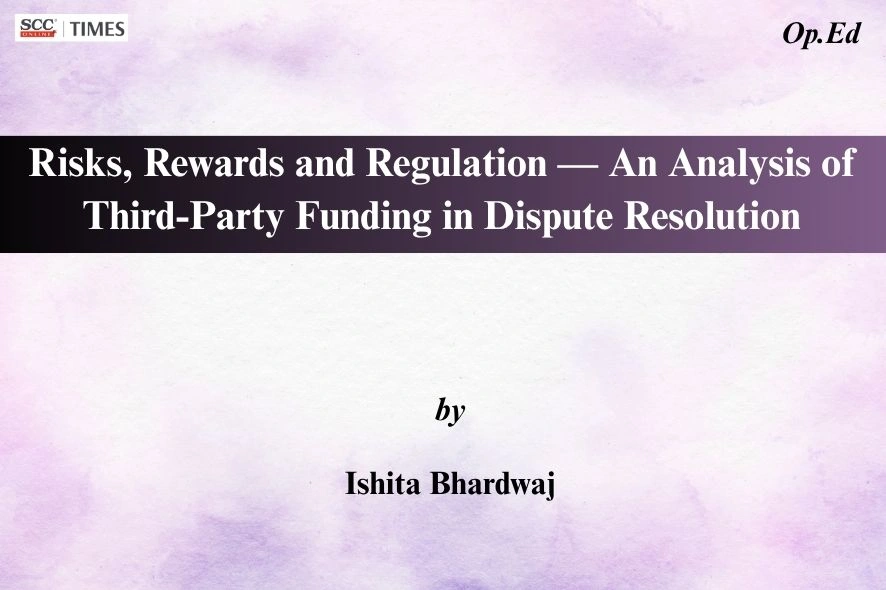
TPF has gained significant traction in jurisdictions like the United States, the United Kingdom, Singapore, and Australia in the recent decades, where well-established litigation finance industries are now supporting parties in commercial disputes, arbitration, and insolvency proceedings.
Introduction
The restriction on third-party funding (hereinafter referred as, “TPF”), an arrangement by which a funder, who is not a party to the lawsuit, agrees to help the litigant fund it, finds its origin in the doctrines of maintenance and champerty.1 These doctrines originated in the ancient Greek and Roman era to prevent wealthy individuals from unfairly taking over other people’s legal disputes,2 and were initially designed to curb frivolous or vexatious litigation resulting from TPF of dispute resolution in exchange for a share of the proceeds. Over time, legal systems have adopted new ways and relaxed these old restrictions — it was realised that when TPF or transaction for proceeds is correctly regulated, it can make access to courts and to legal representation much fairer. While TPF has raised controversy over the ethical issue of funder influence on case strategy, studies have shown that TPF has significantly enabled and facilitated financially poorer parties to make claims that they would otherwise have been unable to assert.
TPF has gained significant traction in jurisdictions like the United States, the United Kingdom, Singapore, and Australia in the recent decades, where well-established litigation finance industries are now supporting parties in commercial disputes, arbitration, and insolvency proceedings. According to industry reports, the US litigation funding market alone surpassed $4.5 billion in value in 2023 with an estimated target of $9.7 billion for 2032,3 with specialised investment firms actively participating in legal financing. Singapore and Hong Kong have introduced legislative frameworks explicitly permitting TPF in international arbitration, ensuring transparency and preventing conflicts of interest. Despite growing acceptance worldwide, India’s legal landscape is still uncertain about with the treatment of TPF. The Supreme Court, in BCI v. A.K. Balaji4, ruled that while advocates are prohibited from funding litigation, no such restriction applies to third-party financiers such as corporations or non-banking financial companies (NBFCs). In certain jurisdictions like Maharashtra and Gujarat, courts are adjusting formal procedures under the Civil Procedure Code, 1908 to allow courts to impose security costs on funders. Still, the lack of an overarching statutory regime leaves a number of key issues uncertain, including requirements of disclosure5, conflicts of interest6, and ethics. Further, the lack of clarity in the aspect of TPF in India has both legal and economic implications. On one hand, proponents argue that TPF can democratise access to justice and provide financially weaker parties the means to pursue legitimate claims, and on the other hand, critics express concerns over funders exerting excessive control over litigation strategies, thereby undermining petitioners’ interests. The Standards of Professional Conduct and Etiquette to be Observed by Advocates issued by the Bar Council of India prohibit lawyers from stipulating their fee as contingent on the results of the litigation or sharing the proceeds of the litigation, arguably in the interests of protecting professional ethics and preventing conflict of interest between the petitioner and their lawyer.7 Advocates are also prohibited from receiving any share or interest in any actionable claim, i.e., even where the advocate is not personally engaged.8
As India aims to become an international arbitration hub, the imposition of a regulated framework for TPF can have substantial benefits. Learning from those jurisdictions that have been able to successfully introduce TPF, India can establish mechanisms that protect the interests of funders, claimants, and the judiciary. Resolution of issues related to disclosure, funder participation, and enforceability of contracts will be critical in making TPF beneficial to India’s dispute resolution system.
Chapter 1: TPF in different jurisdictions
United States
The United States has one of the most developed TPF markets, particularly in commercial arbitration and litigation. The US litigation funding market has been rapidly expanding and investment firms are increasingly engaged in financing lawsuits. The legality of TPF is largely influenced by State legislations, as there is no federal law to address the practice. The US Courts have generally enforced TPF contracts, provided they do not contravene public policy or produce conflict of interests.
A landmark case, Miller UK Ltd. v. Caterpillar Inc9, addressed the disclosure mandate of TPF agreements and highlighted the importance of transparency. Another crucial case, Gbarabe v. Chevron Corpn.10, stressed the importance of judicial review of TPF arrangements so that there is no conflict of interests. TPF has played an important role in class action litigation, enabling consumers to sue deep-pocketed companies, for example, Boling v. Prospect Funding Holdings, LLC11, where the Court considered the enforceability of litigation funding contracts under State usury laws.
United Kingdom
The United Kingdom (UK) has moved away from traditional prohibitions against maintenance and champerty, and permits TPF in a regulated manner. Maintenance and champerty have been abolished as criminal offenses through the Criminal Law Act, 196712 but not the jurisdiction of the courts in finding certain contracts to be unenforceable where they are against public policy. The UK has established a system of self-regulation through the Association of Litigation Funders (ALF),13 imposing ethical duties on funders and enforcing professional standards on them.
The Excalibur Ventures LLC v. Texas Keystone Inc (No 2)14, reaffirmed the necessity of funder responsibility and regulation on the part of the Court, and condemned the reckless financing of poor claims. Yet another high-profile case, R. v. Secretary of State for Transport15 upheld the validity of litigation funding structures, holding that the lack of funding might have resulted in the claimants losing the fruits of their litigation, and litigation funding ensured their access to justice. International litigation funders have even been drawn to the UK’s appropriately regulated market, leading to faster economic development in the legal market with moral safeguards in place. The leading case of Impact Funding Solutions Ltd. v. AIG Europe Ltd.16, proceeded to further elucidate that litigation funders have to promote responsible funding, a balance between protection of claimants and security of investment.
The UK allows TPF in arbitration as well as in litigation, but courts can intervene to rectify agreements if exploitative. The success of the UK model has inspired other common law countries to adopt it, providing a structured approach with market freedom and oversight that is needed to avoid abuse.
Singapore and Hong Kong
Singapore and Hong Kong have introduced TPF in an organised manner, particularly in international arbitration. Singapore legitimised TPF in an official capacity by the Civil Law (Amendment) Act, 2017 so that it could be applied to arbitration and associated proceedings. The legislation requires disclosure of funding arrangements to avoid conflict of interest. The Legal Profession (Professional Conduct) Rules, 2015 were also revised to place ethical requirements on lawyers participating in funded proceedings. Correspondingly, Hong Kong passed the Arbitration and Mediation (Third Party Funding) (Amendment) Ordinance, 2017 permitting TPF under the condition of unambiguous disclosure. In Re Cyberworks Audio Video Technology Ltd., In re17, the courts in Hong Kong acknowledged that TPF in insolvency cases served a valid objective of supporting cash-starved litigants. The embracing of TPF has made Singapore and Hong Kong thriving arbitration centres in Asia, where foreign investment and legal professionals congregate.
Judicial philosophies in these jurisdictions have been positive, supporting the role of TPF in advancing fairness and access to justice. Courts have continued to exercise control to prevent funders taking an undue degree of control of litigation strategy, finding a balance between funding and procedural integrity. Singapore’s regulatory model, that is, the requirement for mandatory disclosures, has acted as a template for other jurisdictions that want to balance investor interests, claimant interests and legal ethics.
Australia
Australia has been at the forefront of adopting TPF, particularly in class actions. The Australian High Court case Campbell’s Cash and Carry Pty Ltd v. Fostif Pty Ltd.18, was instrumental in upholding the validity of TPF, holding that funders could fund litigation without necessarily warping the justice system. The case set precedent to the effect that commercial funders can finance cases against a share in the proceeds if they do not unfairly prejudice the legal process. Australia’s Corporations Amendment Regulation, 2012 brought litigation funding arrangements within the regulatory scope of Australian Securities and Investments Commission (ASIC) in order to provide for financial services legislation compliance. The High Court has ruled in BMW Australia Ltd. v. Brewster19, on the enforcement of common fund orders and reaffirmed the requirement of legislative certainty as it pertains to regulating funder returns.
Financed class actions have enabled claimants to pursue corporate malpractice suits, resulting in large awards and even regulatory changes, however increased institutional investor participation in litigation funding has raised controversy over the sustainability of law for hire business. The element that distinguishes Australia is its progressive regulatory framework, which ensures transparency among funders while preventing litigants and lawyers from being distanced from their independence.
European Union
European Union (EU) lacks a uniform regulatory regime for TPF, with variable approaches among member states. In Germany, TPF is regulated under the Legal Services Act20, which provides for the preservation funder’s reasonable control in litigation through contract. French Courts have largely upheld TPF in arbitration but it is still regulated. In SNCF v. CPAM21 (2013) Cour de Cassation, the French Supreme Court adjudicated that TPF is a valid financial vehicle in arbitration so long as it does not contravene public policy. The Netherlands is now the jurisdiction of choice for collective redress proceedings, and TPF is a fundamental vehicle for funding massive consumer and shareholder litigation. The EU is considering more far-reaching rules to harmonise TPF practice within the EU member states, including proposals to require compulsory disclosure obligations as well as ethical codes. The European Parliament’s 2022 Draft Report on Responsible Private Funding of Litigation is in favour of greater transparency and protection for consumers in litigation funding.22
In conclusion, TPF’s success in these jurisdictions presages certain inherent principles which can be followed by India in establishing a structured and transparent funding system. The establishment of a clearly defined legal framework, imposition of mandatory disclosures, and monitoring by the judiciary could help harmonise the interests of the funders, the claimants, and the justice system. Learning from the best international practices, India can create a regulatory framework that encourages funding of litigation without undermining procedural fairness, and professional and ethical standards. Setting up ethics authorities similar to the UK’s ALF or Singapore’s legal finance legislation will serve as a check on malpractices and inspire investor confidence. As India transitions to becoming an international arbitration hub, the successful models should be replicated with suitable modifications which leverage their strengths and steer clear of their weaknesses.
Chapter 2: India’s approach to TPF
India lacks a comprehensive statutory framework explicitly governing TPF, however, there have been important judicial pronouncements and changes made by certain States in the application of the Civil Procedure Code, 1908 in favour of TPF. The changing statutes are an implicit indication that TPF has acquired some level of recognition. Unlike jurisdictions such as Singapore and Hong Kong, which have enacted clear legislation permitting TPF in arbitration, India’s approach remains disintegrated and mostly dependent on the interpretation of judges. It is worth noting that in Ram Coomar Coondoo v. Chunder Canto Mookerjee23, the Privy Council ruled that while TPF agreements generally are not intrinsically illegal unless they are clearly extortionate and go against public interest considerations, Indian Courts have not yet developed a consistent approach when it comes to TPF. The Court observed:
…a fair agreement to supply funds to carry on a suit in consideration of having a share of the property, if recovered, ought not to be regarded as being, per se, opposed to public policy. Indeed, cases may be easily supposed in which it would be in furtherance of right and justice, and necessary to resist oppression, that a suitor who had a just title to property, and no means except the property itself, should be assisted in this manner.24
The Privy Council position has been reiterated many times like in Kunwar Ram Lal v. Nil Kanth.25
In spite of judicial acceptance, there is regulatory uncertainty about TPF in India which creates substantial challenges. The Bar Council of India Rules, 1975 (BCI Rules), based on the Advocates Act, 1961, particularly Part VI (Standards of Professional Conduct and Etiquette) stipulates that advocates are not allowed to be involved in any matters related to TPF. Rule 9 of Chapter II, Part VI of the BCI Rules states that “an advocate should not act or plead in any matter in which he is himself pecuniarily interested”. Additionally, Rule 20, which reads that “an advocate shall not stipulate for a fee contingent on the results of litigation or agree to share the proceeds thereof”, also clearly prohibits contingency fee arrangements, other restrictions include that an advocate shall not be a party to any encouragement of litigation26 and an advocate shall not indulge in buying or trafficking or arranging to receive any share or interest in any type of actionable claim over the case of client.27 These rules were adopted to preserve professional ethics which might hinder the evolution of a well-defined legal funding system. On the other hand, UK and Australia have allowed regulated partnerships between law firms and litigation funders, thus ensuring access to justice while holding ethical standards.
The difference and conflict in judicial opinion have further exacerbated the ambiguity in India’s approach. The Supreme Court in the case of A.K. Balaji28 clarified that third-party funders such as individuals and NBFCs are permitted to finance litigation, though advocates themselves remain barred from doing so. The Court noted that:
38. In India, funding of litigation by advocates is not explicitly prohibited, but a conjoint reading of Rule 18 (fomenting litigation), Rule 20 (contingency fees), Rule 21 (share or interest in an actionable claim) and Rule 22 (participating in bids in execution, etc.) would strongly suggest that advocates in India cannot fund litigation on behalf of their clients.29
But this ruling left major regulatory questions open-ended and particularly important ones, i.e., how much control the funders will have over the litigation process and as well as the disclosure standards.
Recently, the Delhi High Court, in Tomorrow Sales Agency (P) Ltd. v. SBS Holdings Inc.30, addressed the liability of third-party funders by holding that a third-party funder remains a third party and not a party until and unless it had been compelled to arbitrate or was a party under the agreement. The Court further refused to hold a third-party funder liable for not furnishing security in enforcing the foreign award.31 This is in compliance with the position taken by the UK’s Excalibur Ventures LLC v. Texas Keystone Inc (No 2)32, which reinforces the principle that funders should not bear liability beyond their contractual commitments.
The need for a clear-cut legal framework is also brought out in the case of arbitration. The Arbitration and Conciliation Act, 1996, as amended in 2015, does not have explicit provisions to regulate TPF as such, however Schedule 5, Clause 19, does indirectly refer to its existence by stating that if “an arbitrator or a close family member of the arbitrator has a close relationship with a third party who may be liable for recourse on the part of the unsuccessful party in the dispute”, this would constitute grounds giving justifiable doubts as to independent or impartiality of the arbitrators. The provision displays an implied awareness of litigation finance in the arbitration field, but failed to define its scope and formal recognition. Singapore and Hong Kong, however, have enacted specific legislative provisions governing TPF to arbitration in order to ensure transparency and fairness as explained in the previous sections.
Over the last few years, major centres for international arbitration, such as Singapore International Arbitration Centre and International Chamber of Commerce, have adopted new best practices for disclosure and managing conflicts when it comes to TPF. Meanwhile, India might also look at adopting these best practices. The IBA Guidelines on Conflicts of Interest in International Arbitration, 2014 require parties to disclose any direct economic interest in the outcome of a dispute, which is a safeguard against hidden funder influence.
Furthermore, in Essar Oilfields Services Ltd. v. Norscot Rig Management (P) Ltd.33, the High Court in England in 2016 reinforced that an arbitral award allowing one side (successful party) to recover the costs of litigation is absolutely fine.34 This is according to the applicable rules for arbitration. So that means that litigation funding costs, which are costs related to getting a lender to fund legal actions, get to be considered as costs other than legal fees. This ruling can serve as a counterpoint to arbitration procedures in India by encouraging liberal interpretation of the cost recovery doctrine. In addition to this, Paciocco v. Australia and New Zealand Banking Group Ltd. elaborated on the extent to which litigation funding costs can be transferred to the losing party, thus highlighting the importance of defining recoverability rules in legislation.35
Given the speed of international evolution of TPF, formal recognition and regulation of TPF in India can be advantageous and contains the potential to yield multiple benefits. The UK Supreme Court in Gulf Azov Shipping Co. Ltd. v. Idisi noted that “public policy now recognises that it is desirable, in order to facilitate access to justice, that third parties should provide assistance designed to ensure that those who are involved in litigation have the benefit of legal representation”.36 Studies also indicate that TPF reduces the backlog of trials by promoting early settlement.37 Lawyers who favour TPF tend to prefer settlement over prolonged litigation because they often have strong merits in such cases and therefore secure timely and efficient settlements that are beneficial to both parties. Identification of TPF can also enhance India’s arbitration sector so that it becomes a preferred seat for international dispute settlement, after harmonisation of best global practices. Higher foreign investment in legal finance can also contribute towards India’s economic development by ensuring high-value disputes are efficiently resolved within its jurisdiction and not outsourced to other centres for alternative dispute resolution such as Singapore and London.
Before TPF can take off and become widely adopted in India, significant regulatory roadblocks and challenges will have to be resolved, as absence of statutory regulation is also contributing to judicial uncertainty. Whereas in Hong Kong, Singapore and Australia, institutions are regulated by institutional control that ensures compliance with financial and ethical requirements, India does not yet enjoy such a controlled mechanism. In addition, there are no compulsory disclosure requirements which raise concerns as to possible conflict of interest, because courts and the opposing parties are often unaware of what third-party financial involvement is present in a proceeding. The Singapore approach to mandatory disclosure38 under the Legal Profession (Professional Conduct) Rules, 2015, can serve as a model to India to incorporate transparency in TPF arrangements.
The enforcement of funding agreement remains doubtful under Indian laws. Even though the Supreme Court in Union of India v. Sri Sarada Mills Ltd., held that “…a bare right of action for damages is not assignable because the law will not recognise any transaction which may savour of maintenance of champerty”.39 The courts have not yet finally decided on the enforceability of structured TPF agreements against defaulting claimants. In opposition, Australia’s regulatory model under the ASIC ensures that funding agreements are to be treated as legitimate financial instruments to provide clarity on their enforceability. Also, implementing TPF practices in conjunction with existing provisions of the Insolvency and Bankruptcy Code, 2016 may lead to fine-tuning of funding solutions for distressed assets and resolve corporate conflicts better and faster.
As litigation finance keeps growing all over the world, India is facing a fork in the road when it comes to regulations. Building clear and strong rules that have an official stamp can either be a great story for India and drive novel ideas or it could mean that India falls behind compared to countries that have already figured out how to successfully integrate this concept into their own legal systems. A structured approach which draws on best international practices while taking into account India’s unique legal and cultural realities, would not only foster investor confidence but also enhance access to justice and the efficiency of India’s dispute resolution ecosystem.
*Founding Partner, ZI Law (founded in 2021); previously have been a Principal Associate, Shardul Amarchand Mangaldas & Co., and Equity Partner, KT Advisors LLP. Author can be reached at: ishita@zilaw.in.
1. Max Radin, “Maintenance by Champerty” (1935) 24 Cal. L. Rev. 48, 49, 51.
2. Max Radin, “Maintenance by Champerty” (1935) 24 Cal. L. Rev. 48, 49, 51, 52-54.
3. Custom Market Insights, Rushikesh Dorge, US Litigation Funding Investment Market 2024—2033 (6-2-2026), available at <https://www.custommarketinsights.com/report/us-litigation-funding-investment-market/>.
4. (2018) 5 SCC 379) 30 : (2018) 2 SCC (Cri) 734 : (2018) 2 SCC (L&S) 35 : (2018) 3 SCC (Civ) 30; [Bar Council of India Rules, 1975, Part VI, Ch. II (Standards of Professional Conduct and Etiquette, S. 49(1)(c) and the proviso thereto]. , S. 49(1)(c) and the proviso thereto].
5. UNCITRAL Model Law on International Commercial Arbitration, 1985 UN Doc A/40/17, Annex. I, Art. 18; Arbitration and Conciliation Act, 1996, S. 18.
6. Arbitration and Conciliation Act, 1996, S.12(1)(a).
7. Standards of Professional Conduct and Etiquette to be Observed by Advocates, S. II, R. 20, available at <http://34.93.66.95/sites/default/files/2024-04/courtrulefile_x09d4f6e.pdf>.
8. Standards of Professional Conduct and Etiquette to be Observed by Advocates, S. II, R. 21, available at <http://34.93.66.95/sites/default/files/2024-04/courtrulefile_x09d4f6e.pdf>.
9. 17 F Supp 3d 711 (ND Ill 2014).
10. 167 F Supp 3d 1012 (ND Cal 2016).
11. 771 F App’x 562 (6th Cir 2019).
12. Criminal Law Act, 1967, §§ 13—14 (United Kingdom).
13. Association of Litigation Funders (ALF), The Code of Conduct for Litigation Funders (November 2011), available at <https://associationoflitigationfunders.com/code-of-conduct/> last accessd 4-9-2021.
14. (2017) 1 WLR 2221 : 2016 EWCA Civ 1144.
15. 2003 QB 381 : (2002) 3 WLR 1104 : 2002 EWCA Civ 932.
16. 2017 AC 73 : (2016) 3 WLR 1422 : 2016 UKSC 57, para 43.
17. (2010) 2 HKLRD 1137.
18. 2006 HCA 41 (High Court of Australia).
19. 2019 NSWCA 35.
20. Legal Services Act, 2007 (Germany)
21. 2018 SCC OnLine ECJ 9.
22. European Parliament’s 2022 Draft Report on Responsible Private Funding of Litigation, available at <https://www.europarl.europa.eu/doceo/document/TA-9-2022-0308_EN.html>.
24. Ram Coomar Coondoo v. Chunder Canto Mookerjee, 1876 SCC OnLine PC 19, 47.
25. 1893 SCC OnLine PC 7; Lala Ram Sarup v. Court of Wards, 1939 SCC OnLine PC 55.
26. Bar Council of India Rules, 1975, Part VI, Ch. II, R. 18 (Standards of Professional Conduct and Etiquette).
27. Bar Council of India Rules, 1975, Part VI, Ch. II, R. 21 (Standards of Professional Conduct and Etiquette).
28. BCI v. A.K. Balaji, (2018) 5 SCC 379 : (2018) 2 SCC (Cri) 734 : (2018) 2 SCC (L&S) 35 : (2018) 3 SCC (Civ) 30, 411.
29. BCI v. A.K. Balaji, (2018) 5 SCC 379 : (2018) 2 SCC (Cri) 734 : (2018) 2 SCC (L&S) 35 : (2018) 3 SCC (Civ) 30, 411.
30. 2023 SCC Online del 3191, para 36.
31. Tomorrow Sales Agency (P) Ltd. v. SBS Holdings Inc., 2023 SCC Online Del 3191, para 76
32. (2017) 1 WLR 2221 : 2016 EWCA Civ 1144.
33. 2017 Bus LR 227 : 2016 EWHC 2361 (Comm).
34. Essar Oilfields Services Ltd. v. Norscot Rig Management (P) Ltd., 2017 Bus LR 227 : 2016 EWHC 2361 (Comm), para 86.
35. (2016) 90 ALJR 835, para 284.
36. 2004 EWCA Civ 292, para 54.
37. Daughety, Andrew and Reinganum, Jennifer, “The Effect of Third-Party Funding of Plaintiffs on Settlement” (2014) 104 American Economic Review, available at <10.1257/aer.104.8.2552>.
38. Legal Profession (Professional Conduct) Rules, 2015, R. 49-A.
39. (1972) 2 SCC 877 : (1973) 43 Comp Cas 431.