
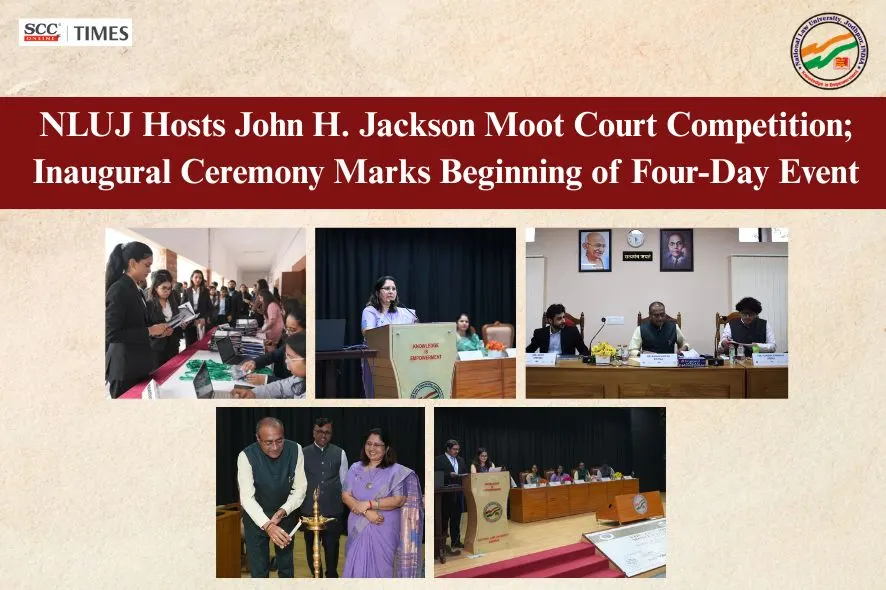
National Law University, Jodhpur (NLUJ) inaugurated the John H. Jackson Moot Court Competition on 17 March 2026, marking the beginning of the four-day event scheduled from 17 to 20 March 2026. Hosting the competition for the second time, NLUJ is organising one of the largest regional rounds of the moot in India, reaffirming its position as a leading centre for international trade law scholarship. The event commenced with a traditional “Khama Ghani,” welcoming participants, dignitaries, and collaborators, followed by the ceremonial lighting of the lamp. The Convenors introduced the structure of the competition and highlighted the role of the European Law Students’ Association (ELSA) in facilitating the global framework of the moot. Addressing the gathering, Dr. Bipin Kumar emphasised NLUJ’s longstanding leadership in international trade law and acknowledged the efforts of the organising committee in successfully hosting the competition.
Addressing the gathering in her inaugural remarks, The Vice Chancellor, Prof. (Dr). Harpreet Kaur, underscored international trade law as a defining feature of NLUJ’s academic identity, supported by a strong emphasis on research, mooting excellence, and academic scholarship. She highlighted RACIEL’s role in fostering research, cross-border regulatory understanding, and scholarly collaboration, particularly focusing on India, South Asia, and the Global South. She also reflected on contemporary developments in global trade governance, including tariff conflicts and the challenges faced by the WTO dispute settlement system, particularly the Appellate Body crisis and the strain on the two-tier mechanism.
Representatives from ELSA, Ms. InÊS and Mr. Rodrigo, joined the ceremony virtually and highlighted the global significance of the competition. Ms. InÊS, Vice President in charge of Competitions, noted India’s growing importance as a hub for international trade discourse and appreciated NLUJ’s efforts in hosting the regional round. She described the moot as a platform that fosters collaboration, negotiation, and intellectual curiosity among participants.
The chief guest, Dr. Rajan Sudesh Ratna, Senior Economic Affairs Officer at United Nations ESCAP South and South-West Asia Office, delivered a keynote address focusing on the evolving challenges confronting the multilateral trading system. Drawing from his experience as part of India’s representation during key WTO negotiations, including the Uruguay Round and subsequent trade discussions, he reflected on the erosion of foundational WTO principles, the absence of an effective appellate mechanism, and the broader implications of unilateral trade measures. He emphasised that the current global trade environment presents significant uncertainty and encouraged participants to develop a nuanced understanding of international economic dynamics to effectively navigate future negotiations.
Following the inaugural session, the competition transitioned into its procedural phase. The Convenors conducted a detailed participants’ briefing outlining rules and expectations, followed by the draw of lots for preliminary round match-ups. A separate judges’ briefing was also held to ensure clarity and consistency in evaluation standards.
The competitive segment commenced thereafter, with the first set of preliminary rounds conducted across courtrooms. Sixteen participating teams presented arguments from both applicant and respondent perspectives before experienced panels of judges. The rounds were marked by well-researched submissions, structured advocacy, and effective rebuttals, reflecting a high level of preparation and engagement.