
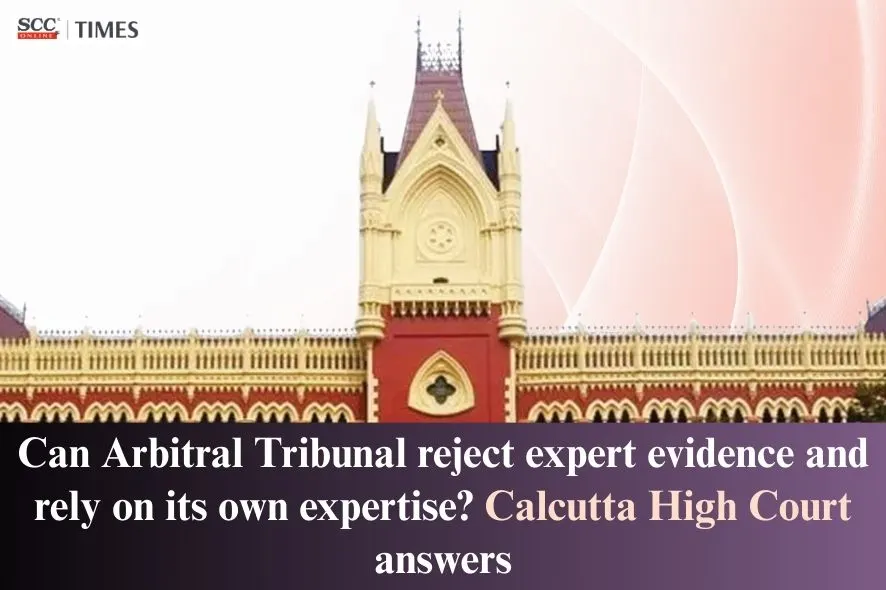
Calcutta High Court: In an appeal filed under Section 37, Arbitration and Conciliation Act, 1996 (the Act), against the Single Judge’s order whereby the arbitral award granted in the 2019 Tunnel Boring Incident was set aside, the Division Bench of Debangsu Basak and Md. Shabbar Rashidi*, JJ., dismissed the appeal, holding that the Arbitral Tribunal not only overlooked the terms of the contract, but also ignored the evidence led by one party without assigning any reason. The Court also held that the Arbitral Tribunal’s findings were not based on any concrete evidence; it was a mere assumption based on personal expertise of arbitrator, and the same was used to discard positive evidence adduced by KMRC.
Background
Kolkata Metro Rail Corporation Ltd. (KMRC) issued a tender for the design and construction of the underground section of Metro Railways from Central Station to Subash Sarobar. ITD-ITD CEM Joint Venture (ITD), an infrastructure development joint venture, participated in the tender and was declared successful. Following this, KMRC and ITD entered into a contract for underground tunnelling. Two tunnel boring machines (TBM) were deployed by ITD to undertake the contracted project.
On 31 August 2019, there was an incident of water ingress in the tunnels where ITD was carrying on the project. Due to such an incident, serious damage to the properties above the tunnels led to the claims being made by the victims of the accident.
Several litigations, including public interest litigations (PILs), were initiated, and various directions were passed in such litigations by the Court. Based on such directions, an expert body was constituted to analyse the causes of such an incident to fix the liability.
Disputes also arose between the parties regarding the liabilities for such an accident, which led to the initiation of an arbitration proceeding against KMRC. A three-Member Arbitral Tribunal was constituted, which passed an award. The award was challenged by KMRC under Section 34 of the Act, which resulted in the impugned judgment and order.
Aggrieved, ITD filed the present appeal challenging the setting aside of the arbitral award.
Analysis
-
Parties treated unequally: Regarding this contention that the parties were treated unequally, affirmed by the Single Judge, the Court noted that the evidence produced by KMRC was discarded by the Arbitral Tribunal merely on the ground that their reports were prepared during the continuance of the arbitral proceedings, i.e., they were prepared for putting up a defence.
-
Personal expertise of the Arbitral Tribunal: Upon perusal of the impugned order, the Court noted that the personal knowledge of the members of the Arbitral Tribunal was imputed to discard evidence adduced on the part of KMRC, i.e., the report submitted by IIT Madras regarding the possible cause of the incident. Professional knowledge of the members of the Arbitral Tribunal made them differ with the report, as Standard Penetration Test (SPT) values could be misleading, and in the case of saturated silty soils, even when the soil is weak, SPT values obtained can be quite high and should not be relied upon in isolation unless corroborated with other tests. It was suggested that internal erosion cannot be ruled out.
-
Overlooking of the contract: The Court noted that the Single Judge referred to Clause 4.23, which dealt with liability in unforeseen physical condition, and stated that no such report regarding this clause was produced by ITD. Furthermore, even if such an unforeseen physical condition had been reported by ITD, it would not have absolved its liability towards third-party risk. Regarding the liability of the contractor to conduct a soil investigation, the Single Judge noted that KMRC successfully conducted the same before entering into the contract.
The Court noted that KMRC came up with a definite case in their report that the TBM was operated unprofessionally and incorrectly by the ITD personnel, such as there was a severe inadequacy of greasing, excessive wear and tear on the tail skin brushes aligning the TBM, and erroneous alignment of rings laid by TBM in its route of boring, which deviated about 88 per cent. Such evidence, according to KMRC, established that the TBM concerned was not being operated with due care.
Furthermore, the Court noted that the Single Judge also held that there was no delay in producing the report as it was prepared immediately after the retrieval of the TBM. If the report submitted by the respondent Metro Railways was liable to be cast off on the ground of delay, then the same logic applied to the report submitted by ITD.
Noting that the reason for discarding the expert report was unreliable photographic evidence, the Single Judge found the reports submitted by IIT Madras and IIEST Shibpur to be prepared based on physical examination of recovered parts of the TBM as well as the soil conditions.
The Court stated that such an opinion of the Arbitral Tribunal was solely based on their alleged personal expertise in the field and was not at all based on any definite scientific reasoning. Moreover, such reasoning ought to have been based on definite imputation saying “should not be relied upon” instead of “must not be relied upon”. Thus, the Court held that findings arrived at by the Single Judge were not perverse or based on implausible reasoning.
“Such findings were not based on any concrete evidence; it was a mere assumption based on the personal knowledge and experience of the Arbitral Tribunal, and the same was used to discard positive evidence adduced by KMRC.”
Thus, the Court upheld the Single Judge’s finding that the reports produced by KMRC were unreasonably discarded.
The Court further noted that, as per the Single Judge, the third-party liability provisions were completely overlooked by the Arbitral Tribunal, which rendered the arbitral award patently perverse without giving due weightage to the terms of the contract and the trade usages prevalent to the nature of the contract.
“The contract between the parties required ITD to report in writing any unforeseen physical condition to KMRC. No evidence of such a report has been brought to record. Moreover, in spite of such a report, according to the contract, ITD accepted the liability of any third-party risk.”
Thus, the Court held that ITD failed to produce any communication made by it in writing regarding unforeseen physical conditions, and the contract specifically affixed any third-party liability on ITD. Nevertheless, the Arbitral Tribunal held KMRC responsible for the third-party risk without assigning any reason.
Accordingly, the Court upheld the Single Judge’s findings on this issue as well.
Decision:
The Court held that the Arbitral Tribunal not only overlooked the terms of the contract but also ignored the evidence led by KMRC, and that too, according to the Single Judge, with a single stroke of pen without assigning any reason, which invited the application of the principle of patent illegality.
In this regard, the Court referred to Ssangyong Engg. & Construction Co. Ltd. v. NHAI, (2019) 15 SCC 131, wherein the Supreme Court noted that a finding based on no evidence at all or an award which ignores vital evidence in arriving at its decision would be perverse and liable to be set aside on the ground of patent illegality.
Regarding the scope of powers of Sections 34 and 37 of the Act, the Court held that it was not the case that the Single Judge altered the view accepted by the Arbitral Tribunal out of two plausible views. Rather, the reasoning provided by the Arbitral Tribunal in arriving at the conclusion was manifestly against the fundamental policy of Indian law as well as principles of natural justice, and was patently perverse. Thus, the Single Judge did not exceed its jurisdiction or fail to exercise its jurisdiction under Section 34 of the Act.
Accordingly, the Court dismissed the appeal, thereby upholding the impugned judgment and order.
[ITD-ITD CEM Joint Venture v. Kolkata Metro Rail Corporation Limited, APOT No. 298 of 2025, decided on 12-3-2026]
*Judgment authored by: Justice Md. Shabbar Rashidi
Advocates who appeared in this case:
For the appellant: Senior Advocate Jishnu Saha, Anal Kumar Ghosh, Hashnuhana Chakraborty, Neelina Chatterjee, Ahana Bhattacharya
For the respondent: Senior Advocate Jishnu Chowdhury, Sreya Basu Mallick, Chayan Gupta, Ankit Dey, Atri Mandal, Subhrojit Mookherjee