
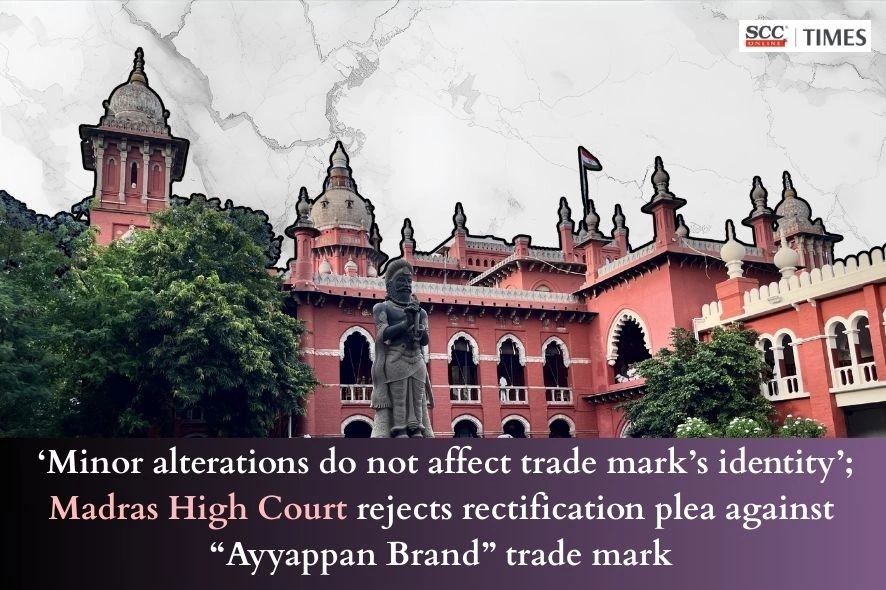
Madras High Court: In a rectification petition filed under Sections 47 and 57, Trade Marks Act, 1999 (Trade Marks Act), seeking removal of the registered trade mark “Ayyappan Brand” on the grounds of misrepresentation of user date and non-use, a Single Judge Bench of Senthilkumar Ramamoorthy, J., while dismissing the petition held that the discrepancy in user date could not conclusively establish fraud and emphasised that invoices from 1993 onwards evidenced bona fide use. The Court further observed that minor alterations do not affect trade mark’s identity’ and, under Section 55, Trade Marks Act such use qualified as valid use. Accordingly, the Court concluded that the petitioner failed to establish grounds for rectification under Section 47 or Section 57, Trade Marks Act.
Background
The case arose when the respondent filed a suit alleging infringement of its registered trade mark by the petitioner’s use of a pictorial representation of Lord Ayyappa in relation to rice and related products. During pendency of that suit, the petitioner filed this rectification petition before the Intellectual Property Appellate Board (IPAB).
It was argued that the user date discrepancy between the application, 14 January 1999, and advertisement, 13 July 1992, was never properly amended, amounting to contravention under Section 57(1), Trade Marks Act. The petitioner contended that the registered mark differed from the mark as used, and no evidence of use of the registered mark was provided, warranting removal under Section 47, Trade Marks Act. It was further argued that the Registrar had earlier concluded misrepresentation under Section 107, Trade Marks Act, showing false claim of use, and that filing of Form TM-16 did not establish valid alteration of user date.
The respondent, however, relied on invoices dating back to 1993 to support its claim of use since 1992, and contended that variations in depiction did not substantially alter identity, with Section 55, Trade Marks Act protecting such use. It was submitted that the use was bona fide and continuous, defeating rectification.
Analysis and Decision
The Court emphasised that the Registrar of Trade Marks had not stated that no amendment application was ever filed by the respondent. Instead, the Registrar’s stand was that the relevant records were unavailable because they had been destroyed. While it is not possible to conclude on the basis of records that an application for amendment was made with regard to the user date and that such application was accepted, the Court noted that it cannot equally be concluded that the respondent indulged in misrepresentation or fraud with regard to the change of the user date. The Court concluded that the alleged contravention in relation to the registration does not constitute a valid reason to direct removal of the mark by exercising power under Section 57, Trade Marks Act.
The Court highlighted that a trade mark can be removed from the register on the ground of non-use if the petitioner establishes that the case falls either within clause (a) or clause (b) of sub-section (1) of Section 47, Trade Marks Act. The Court observed that in order to fall within clause (a) of sub-section (1), Section 47, Trade Marks Act, the trade mark should have been registered without any bona fide intention on the part of the applicant to use it in relation to the relevant goods or services, and such mark should not have been bona fide used in relation to such goods or services up to a date ending three months before the date of application. Further, in order to fall within the scope of clause (b) of sub-section (1), Section 47, Trade Marks Act, there should have been no bona fide use of the mark in respect of the relevant goods or services for a continuous period of five years from the date on which the mark was entered in the Register and ending on a date three months prior to the date of application for rectification.
However, sub-section (1) of Section 47, Trade Marks Act indicates that the use of a trade mark with additions or alterations may be relied upon to prove use of the registered trade mark, provided such additions or alterations do not substantially affect identity. The Court noted that the earlier invoices contain a pictorial depiction of Lord Ayyappa, which does not tally with the pictorial depiction in the registered mark, further, they also contain the trading name of the respondent. The Court observed that such trading name is, however, not written within the ring surrounding the pictorial depiction of Lord Ayyappa, as is the case in the registered trade mark. Nonetheless, the Court highlighted that it cannot be said that the alteration substantially affects the identity.
Therefore, the Court concluded that use of the mark by the respondent, as evidenced by invoices issued from 10 June 1993 to 3 October 2015, qualifies as proof of use in terms of Section 55, Trade Marks Act. The Court also concluded that such use is bona fide and that the period of use extended, as per evidence, at least until 3 October 2015. The Court emphasised that the assertion in the counter statement is that the mark has been used continuously since 1992, however, as a consequence, the petitioner has failed to make out a case for rectification under Section 47, Trade Marks Act.
The Court emphasised that the respondent did not apply for and receive permission from the Registrar under Section 59, Trade Marks Act for alteration of the mark. Therefore, if an action for infringement were to be filed by the respondent, deceptive similarity would be required to be tested by comparing the petitioner’s mark, as used, with the first respondent’s mark as registered but not as used. Further, in the invoices relied upon by the respondent in these proceedings, there is no assertion that the mark is registered. Therefore, the decision of the Registrar of Trade Marks in the complaint under Section 107, Trade Marks Act has no bearing on this petition.
The Court thus dismissed the rectification petition, holding that petitioner failed to establish grounds under Section 47 or Section 57, Trade Marks Act.
[Sree Lakshmi Balaji Industries v. Sri Lakshmi Venkateswara Rice Industries, (T)OP(TM) No. 234 of 2023, decided on 11-3-2026]
Advocates who appeared in this case:
For the Petitioner: R.Sathish Kumar for Ramji.G
For the Respondents: B. Karthick for Rajesh Vivekanandan, Deputy Solicitor General
Buy Trade Marks Act, 1999 HERE