
Disclaimer: This has been reported after the availability of the order of the Court and not on media reports so as to give an accurate report to our readers.
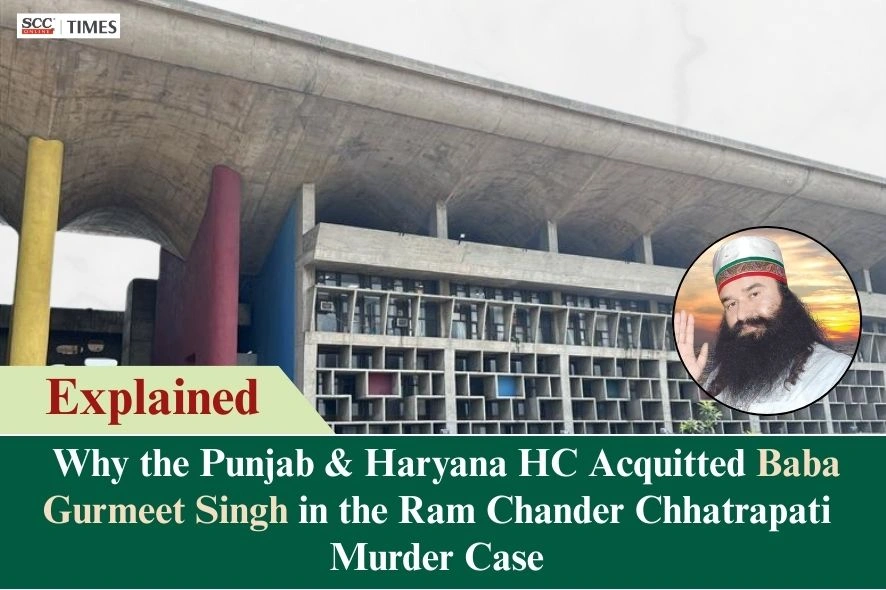
Punjab and Haryana High Court: While considering a bunch of four appeals arising from a common judgment of conviction passed by the Court of Special Judge (CBI), Haryana by which Baba Gurmeet Singh and other appellants was convicted in journalist Ram Chander Chhatrapati’s murder case, the Division Bench of Sheel Nagu, CJ., and Vikram Aggarwal*, J., reiterated that where two possibilities, one of commission of crime and the other of innocence, are reasonably possible, the accused is entitled to the benefit of doubt.
Considering the lack of credibility of eyewitnesses and investigative lapses, the Court acquitted Baba Gurmeet Singh.
Background
On 24 October 2025, Ram Chander Chhatrapati, a journalist and publisher of the Daily Evening Newspaper “Pura Sach”, was shot dead by Appellants 2 and 3 pursuant to a conspiracy led by Baba Gurmeet Singh. Appellant 4, Prabandhak of Dera Sacha Sauda (Dera) which is a socio spiritual organisation having a large following, was alleged to have been part of the conspiracy and had allegedly supplied his licensed 0.32 bore revolver to Appellants 2 and 3 and a walkie-talkie set stated to be belonging to the Dera, apart from other articles.
On the same day at about 7.45 p.m., Ram Chander Chhatrapati was sitting in his house with his children when they heard a voice calling him from the rear side of the house where the wall opened into the lane. When he went outside, two young boys were seen standing there with pistols in their hands. One of them said “Kuldeep goli maar”, upon which Appellant 2 opened fire at Ram Chander Chhatrapati, causing him to fall. When the family members raised alarm shouting “Bachao Bachao”, Appellant 2 told the other person “Nirmal bhag le, kaam ho gaya”, after which both assailants ran towards a scooter parked nearby.
On hearing the commotion, 2-3 policemen who were patrolling in the area came running and apprehended one of the assailants while the other fled on the scooter. Ram Chander Chhatrapati’s son stated that his father had been publishing articles against Baba Gurmeet Singh alleging sexual exploitation of Sadhvis and other misdeeds at the Dera and had been receiving death threats from the Dera people. Subsequently, he filed a complaint based on which FIR was registered under Sections 120-B, 307 and Section 34 IPC and Sections 25 and 27, Arms Act 1959. Ram Chander Chhatrapati later succumbed to his injuries on 21 November 2002 at the Hospital.
The trial court convicted and sentenced the said appellants under Sections 120-B and 302, Penal Code 1860 (IPC). Baba Gurmeet Singh was sentenced to life imprisonment and fine of Rs 50,000 aggrieved by which, he approached the High Court.
Issues, Analysis and Decision
The Court stated that a cumulative examination and analysis of the witnesses’ statements and the documentary evidence produced, conclusively proved that Ram Chander Chhatrapati died due to gunshot injuries.
The Court stated that the issue involved was that who caused the gunshot injuries to Ram Chander Chhatrapati?
Cause of death and credibility of eyewitnesses
The Court emphasised that “the evidence of an eyewitness is kept at a very high pedestal and unless and until, the same is shattered completely in cross-examination, it is not normally discarded.”
The Court held that testimony of both Ram Chander Chhatrapati’s sons could not be shattered in the cross-examination as the version given by them in the Court, was not any different from his previous statement recorded by the Investigating Agency. The Court further stated that minor inconsistencies in the evidence are of no relevance. When one deposes in Court after much time has elapsed from the incident, inconsistencies are bound to be there.
The Court stated that it found no illegality in the findings of the trial court that the statement of both witnesses was consistent and trustworthy. The Court stated that “they cannot be said to be parrot-like statements though, when a truth is stated, it may appear to be a parrot-like statement”.
Evidence and alleged investigative lapses
Regarding the contention that it was the specific case of the alleged eyewitnesses that shots had been fired at Ram Chander Chhatrapati from the front side, the Court stated that the injuries were discovered on both the front and back of his body, demonstrating the falsity of the statement. Further, the Court stated that when shots are fired, there is a natural tendency of a person to either duck or to immediately turn around and when shots are fired continuously, there is a very high likelihood that some shots may hit on the front of the body and the remaining on the back side, when a person ducks or turns around. Therefore, no dent can be caused in the case of prosecution on account of the said fact.
Further, regarding the contention that the genesis of the occurrence was suppressed by the prosecution, the Court stated that there was practically no delay in the registration of the FIR. “When such an incident had taken place, the first concern of the family would be to rush the injured to the hospital. At that time, no one knows and wants to believe that their near and dear one may not survive.” The Court highlighted that under such circumstances, a statement was given to the police and mere delay in sending the special report to the Magistrate would also not cause a dent in the case of the prosecution as the FIR had been registered shortly after the incident indicating no delay in the registration of the FIR.
Considering the argument that no entry was made as regards the alleged detention of Appellant 2, the Court stated that the said issue was a result of defective investigation at best, for which no benefit would go to the accused unless the defect goes to the root of the matter. The Court stated that one has to bear in mind that at the relevant time, the police, the health authorities, the administration, the family of the deceased and others, had gone into a tizzy and minor lapses would, therefore, not cause any dent in the case of the prosecution.
Further, the Court stated that the non-recording of the statement of Ram Chander Chhatrapati in the Hospital also does not cause a dent in the prosecution’s case, as the Medico-Legal Report showed that he was brought conscious but in immense pain at 8.15 p.m. and was referred to another hospital within about an hour and a half. In such a short span, despite a ruqa being sent, his statement could not have been recorded.
The Court stated that under the said circumstances, the non-holding of a test identification parade would not be fatal to the case of the prosecution. The Court further stated that so far as seals of All India Institute of Medical Science (AIIMS) are concerned, it was observed in Court that there were multiple seals on the articles. Thus, the possibility that no seal had been removed, and the cover had been cut from the side and then resealed by different agencies could not be ruled out. The Court stated that it does not find any reason to interfere with, having gone through the trial court’s findings in detail, coupled with the ocular and scientific evidence.
The Court clarified that the revolver was of .32 bore, which means that the bore had a diameter of .32” which comes to 8.1 mm or .81 centimeters. Therefore, it could not be said that the bullets were of a size which could not fit into the barrel. The Court stated that the trial court rightly held that though police officials had informed media people about the recovery of the revolver, mobile phone, etc., the same was not shown to them.
The Court stated that the revolver used in the commission of the offence was found to be Appellant 4’s licenced weapon. Thus, considering the argument that he was never named in the FIR, the Court found the same to be devoid of merit as the allegation was limited to him being a part of the conspiracy, and it was never the case of the prosecution that he was present at the spot.
The Court stated that “It is well known that a criminal conspiracy is always hatched in secrecy and is never an open affair to anyone much less the public at large.”
Conspiracy allegations against Baba Gurmeet Singh
The Court noted that the matter originated in May 2002 when an anonymous letter was addressed to the Prime Minister of India, with a copy to the Chief Justice, alleging sexual harassment of Sadhvis in the Dera by Baba Gurmeet Singh. Similar letters were also received by two members of the Tarksheel Society, a rationalist organization based on logic, facts, and scientific reasoning rather than blind faith. Copies of these letters were later published in newspapers including Amar Ujala and Punjab Kesri. The issue gained further attention when Ram Chander Chhatrapati reported the distribution of the letter in his evening tabloid Pura Sach on 30 May 2002.
Taking suo motu cognizance of the anonymous letter, the High Court initiated proceedings. During this period, concerns were raised regarding the quality of investigation conducted by the Haryana Police. The Division Bench observed that the investigation lacked desirable standards, and that important material evidence had been allowed to vanish, which undermined public faith in the fairness of the investigation. Consequently, investigations in several connected FIRs, including the present case, were transferred to the CBI for a time-bound investigation.
The sons of Ram Chander Chhatrapati consistently maintained that their father had been murdered because he had been publishing reports relating to the Dera and had been receiving continuous death threats. However, in the FIR none of the co-accused mentioned Baba Gurmeet Singh in their disclosure statements. Even after the CBI took over the investigation, Baba Gurmeet Singh’s name did not initially surface.
The situation changed in December 2006 when it was alleged that Baba Gurmeet Singh’s driver gave a statement in connection with the Ranjit Singh murder case. Although he alleged a conspiracy involving Baba Gurmeet Singh in that case, he did not implicate Baba Gurmeet Singh in the present case. In March and April 2007, he filed applications before the Magistrate and other authorities alleging that the CBI was pressuring him to falsely implicate Baba Gurmeet Singh and sought protection from such pressure.
However, nearly five years after the incident, for the first time, it was alleged that on 23 October 2002, he had travelled with Baba Gurmeet Singh to Jalandhar for a Satsang and, upon returning to the Dera, Baba Gurmeet Singh became provoked after seeing the Pura Sach publication and directed Appellants 2, 3 and 4 to eliminate Ram Chander Chhatrapati.
During the trial, a prosecution witness tuned hostile and claimed that the CBI had coerced him to falsely implicate Baba Gurmeet Singh. Though, upon later being recalled, he supported the CBI version. The Court found his testimony unreliable due to his prolonged silence, contradictory statements, and repeated changes in his version.
The Court stated that the trial court did not examine this aspect of the matter from the correct perspective. The Court further stated that Baba Gurmeet Singh is a public figure, and such public figures are known to have admirers and enemies alike. Such public figures are always in the news. At times for good reasons and at times for bad ones. Further, the Court stated that “Lives are given and taken in the name of religion, caste, sects etc. Disputes on Temples, Masjids, Gurudwaras, are not something new for us. Many of the followers of faiths, sects etc., can be termed to be `fanatics’.”
The Court opined that the question which was required to be examined by the trial court was, as to whether there was overwhelming evidence against him and as to whether it could have been a step taken by his staunch followers, however, there was no discussion on this aspect.
Regarding the second question, the Court held that as per the aforementioned discussion, there was a greater possibility of Appellants 2, 3, and 4 acting on their accord.
The Court held that a witness who repeatedly changes his version cannot be considered reliable and that his testimony requires strong corroboration in material particulars. The Court noted that such corroboration was absent in the present case and that key investigative lapses existed, including the failure to examine SI Ram Chander, who had recorded Ram Chander Chhatrapati’s statement in the hospital, and the absence of further attempts to record the victim’s statement despite medical records indicating that he remained conscious and stable for several days.
The Court observed that “It is often said that Courts and Judges should not be swayed by media reports and the public attention which a matter receives. Matters are required to be decided strictly as per law. It has to be borne in mind that the principles of criminal jurisprudence require proving the guilt of an accused beyond reasonable doubt. It is well settled that the moment a doubt arises, its benefit has to go to the accused.”
Thus, the Court held that the prosecution failed to establish the guilt of Baba Gurmeet Singh beyond reasonable doubt. Accordingly, the Court dismissed the appeals of Appellants 2, 3 and 4 and upheld their conviction. However, the Court allowed the appeal of Baba Gurmeet Singh and set aside his conviction acquitting him of the charges.
[Baba Gurmeet Singh @ Maharaj Gurmeet Singh @ Gurmeet Ram Rahim Singh v. CBI, 2026 SCC OnLine P&H 3217, decided on 7-3-2026]
*Judgement authored by Justice Vikram Aggarwal
Advocates who appeared in this case:
For the Appellant: Basant, Senior Advocate, Aman Jha, Advocate, Amar D. Kamra, Advocate, Akshay Sahay, Advocate, and Jitender Khurana, Advocate,
For the Respondent: Ravi Kamal Gupta, Special Public Prosecutor, and Akashdeep Singh, Special Public Prosecutor
For the Complainant: R.S. Bains, Senior Advocate, Sarabjot Singh Cheema, Advocate, Anmoldeep Singh, Advocate and Inderpal Singh Deol, Advocate
Buy Penal Code, 1860 HERE