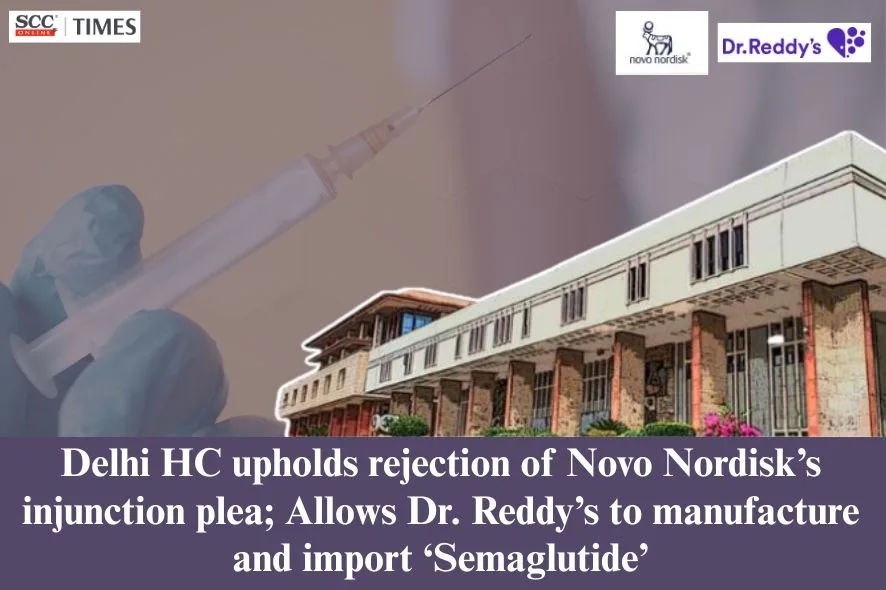
Delhi High Court: While hearing a challenge against the judgment dated 2 December 2025 (impugned judgment), wherein the Single Judge had rejected the application for an interlocutory injunction restraining the respondents Dr. Reddy’s from manufacturing or selling Semaglutide, an anti-diabetic, the Division Bench of *C. Hari Shankar and Om Prakash Shukla, JJ, held that the respondents had raised a credible challenge to the validity of the suit patent under Section 64(1)(e) and (f), Patents Act, 1970 (Patents Act) and hence, allowed Dr. Reddy’s to manufacture and import ‘Semaglutide’.
Accordingly, the Court upheld the impugned judgment and dismissed the present appeal.
Background
The dispute arose out of a patent held by the appellant over Semaglutide, an anti-diabetic medication used in the treatment of diabetes. The appellant had stated that in December 2024 it learned that the respondents had been importing Semaglutide into India. The appellant had alleged that such importation amounted to an infringement of its patent rights.
Accordingly, in 2025, the appellant had instituted a patent infringement suit against the respondents. Along with the suit, the appellant had filed an application seeking an interlocutory injunction to restrain the respondents from manufacturing, importing, marketing, or selling Semaglutide in the Indian market during the pendency of the proceedings.
The respondents did not dispute that they had been importing and exporting Semaglutide, and therefore acknowledged that their actions, in a strict sense, amounted to infringement of the suit patent. However, they relied on Section 107(1), Patents Act, which allowed a defendant in an infringement suit to challenge the validity of the patent as a defence. They contended that the suit patent was liable to be declared invalid under Section 64(1)(a), (e), (f), and (k) of the Act.
The Single Judge had examined the respondents’ plea of prima facie invalidity under Section 64(1)(a), (e), and (f), Patents Act in sequence and, vide judgment dated 2 December 2025, found that the respondents had raised a credible challenge to the validity of the suit patent. Accordingly, the Single Judge had rejected the application for interim injunction. Aggrieved by the refusal to grant interim relief, the appellant preferred the present appeal.
Analysis, Law and Decision
The Court disagreed with the Single Judge’s finding that the respondents had established a credible challenge to the validity of the suit patent under Section 64(1)(a), Patents Act (Anticipation by prior claiming). However, the Court agreed that the respondents had successfully raised a credible challenge under Sections 64(1)(e) (Anticipation by prior publication) and Section 64(1)(f) (Obviousness), Patents Act.
The Court observed that Semaglutide was obvious to a person skilled in the art in light of the complete specifications and teachings contained in Patent IN 275964. While the Single Judge had also reached this conclusion, the Court differed only on the legal classification of the challenge. According to the Court, although a credible challenge to the validity of the suit patent had been established, it properly fell under Section 64(1)(e) and (f), Patents Act rather than Section 64(1)(a), Patents Act.
The Court further held that since a credible challenge under any clause of Section 64(1) was sufficient to constitute a valid defence under Section 107(1), Patents Act in a patent infringement action, the respondents had successfully established such a defence. Consequently, the Court concurred with the ultimate decision of the Single Judge and found that no ground for interference was made out.
The Court held that the Single Judge had slightly erred by conflating the concepts of obviousness under Section 64(1)(f), Patents Act, and anticipation by prior claiming under Section 64(1)(a), Patents Act. According to the Court, the reasoning adopted by the Single Judge to hold that a prima facie case existed under Section 64(1)(a), Patents Act actually supported a credible challenge to the validity of the suit patent under Section 64(1)(f), Patents Act.
The Court examined the relevant portions of the impugned judgment and noted that the defendants had argued that the Semaglutide compound claimed in the suit patent lacked novelty because the same compound had already been disclosed in the genus Patent. They had contended that, based on the principle laid down in Novartis AG v. Union of India, 2023 SCC OnLine Del 106, the plaintiff could not claim the same subject matter again in a subsequent patent. The defendants had also argued that the teachings in the genus Patent sufficiently enabled the Semaglutide compound and relied on the plaintiff’s own statements before foreign patent offices and the Indian Patent Office indicating that Semaglutide was the only commercial product derived from both patents.
The Court observed that the reasoning relied upon by the Single Judge, particularly references to the teachings of the earlier patent and the understanding of a “person skilled in the art”, related more closely to obviousness under Section 64(1)(f), Patents Act rather than anticipation by prior claiming under Section 64(1)(a), Patents Act. The Court emphasised that Section 64(1)(a), Patents Act requires a clear congruence of claims, whereas the perspective of a “person skilled in the art” is primarily relevant for determining obviousness under Section 64(1)(f), Patents Act, and only to a limited extent under Section 64(1)(e), Patents Act.
Nevertheless, the Court noted that the analysis undertaken by the Single Judge effectively demonstrated a prima facie case of obviousness. In particular, the Court observed that some of the features identified by the appellant as novel and inventive in the Semaglutide compound had already been claimed in Claim 21 of the genus patent.
The Court further noted that five inventors were common to both the genus patent and the suit patent. In such circumstances, the Court relied on the test laid down in AstraZeneca AB v. Intas Pharmaceuticals Ltd., 2021 SCC OnLine Del 3746, which held that obviousness should be assessed from the perspective of a “person in the know” rather than merely a “person skilled in the art.”
Applying the “person in the know” standard, the Court held that Semaglutide would prima facie appear obvious from the teachings of the genus patent. Accordingly, the Court concluded that the respondents had established a credible challenge to the validity of the suit patent under Section 64(1)(f), Patents Act.
Since this ground alone was sufficient to uphold the impugned judgment, the Court held that it was unnecessary to examine any other aspects of the case.
Accordingly, the Court upheld the impugned judgment and dismissed the present appeal.
[Novo Nordisk v. Dr Reddys Laboratories Ltd., 2026 SCC OnLine Del 898, decided on 9-3-2026]
*Judgment Authored by: Justice C. Hari Shankar
Advocates who appeared in this case:
For the Petitioner: Hemant Singh, Mamta Jha, Rishabh Paliwal, Shreyansh Gupta, Sanchit Sharma, Advocates
For the Respondent: Gopal Subramanium, J. Sai Deepak, Senior Advocates, Mohit Goel, Sidhant Goel, Aditya Goel, Deepankar Mishra, Kartikeya Tandon, Pavan Bhushan, Avinash Sharma, Raghav Kohli, Adnan Yousuf, Ankit Malhotra, Advocates