
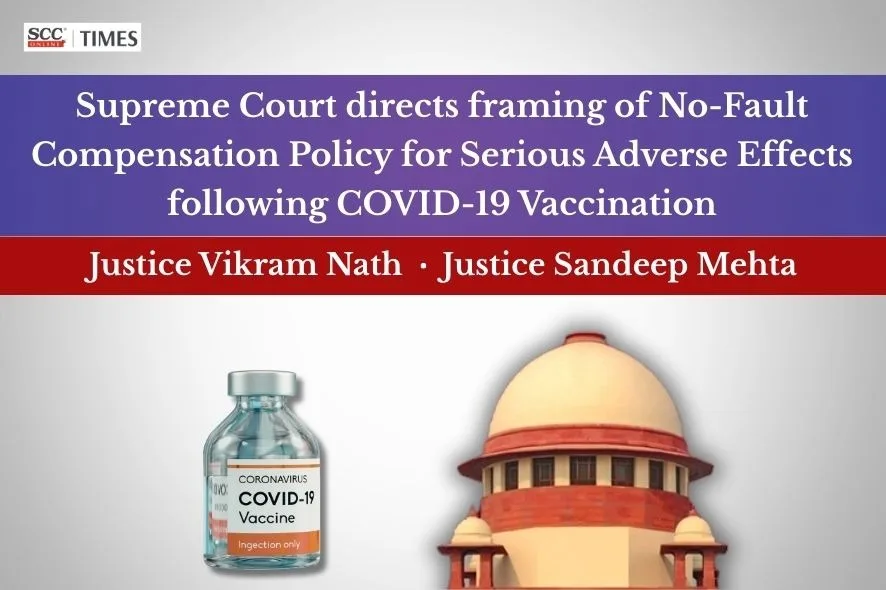
Supreme Court: While considering the petition highlighting issues related to alleged deaths caused after receiving COVID-19 vaccine and whether lack of uniform policy on regarding compensation for covid vaccine deaths violates the Constitution, the Division Bench of Vikram Nath* and Sandeep Mehta, JJ., noted that there is no uniform policy mechanism for redressal of grievance of individuals who suffered adverse effects following vaccination. “This gap cannot be lightly overlooked, particularly when vaccination programmes are undertaken as public health measures under the aegis and authority of the State itself”. Hence, the Court directed the Union of India, to frame a no-fault compensation policy for serious adverse events following COVID-19 vaccination, through the Ministry of Health and Family Welfare (MoHFW).
Background
A bunch of petitions were filed before the Court highlighting concerns and serious consequences in the aftermath of administering COVID-19 vaccine. One of the petitions was filed by parents of a young girl who was diagnosed with Cerebral Venous Sinus Thrombosis (CVST) after receiving the COVID-19 vaccine and subsequently lost her life. This petitioner’s other daughter allegedly developed Multisystem Inflammatory Syndrome (MIS- C/A) and lost her life as well. Another petition highlighted that the petitioner’s husband allegedly died due to Heart Pathology following COVID-19 and he had already taken the first dose of COVID-19 vaccine. Several other petitions highlighted similar adverse consequences. Other petitions stated that their family members developed severe illnesses and became paralytic after taking the vaccine.
Broadly these petitions called upon the Supreme Court to examine the extent to which judicial intervention is warranted in matters touching upon adverse events following immunisation, compensation, and public health policy.
Issues Framed
-
Whether the absence of a uniform policy governing compensation in cases of death or injury following administration of COVID-19 vaccination results in violation of Right to Life protected under the Constitution?
-
If yes, can Supreme Court direct the respondents to frame a policy in that regard?
Court’s Assessment
At the outset, the Court stated that COVID-19 pandemic was an unprecedented period of suffering and disruption, which brought grief and hardship to countless families across the country. The Court assured that the issues raised in the petitions will be approached with empathy for the human loss endured during the pandemic, while remaining mindful that the questions must be examined with care and within the constitutional limits of judicial determination.
The Court pointed out that the present petitions raised a serious question of violation of fundamental rights, more particularly that of right to life.
The Court reiterated that Article 21 of the Constitution is not limited to protection against unlawful deprivation; of life, but also includes within its ambit a wide range of other rights that facilitate the smooth operation of right to life. Right to health and bodily integrity, is one such right. The Court clarified that the present petitions will be approached with limited objective of examining, whether in the exceptional context of a pandemic response, the absence of any structured framework to address serious adverse events raise constitutional concerns warranting an institutional response.
“In doing so, we reiterate that we are neither adjudicating upon the vaccine efficacy nor sitting in scientific review over the regulatory approval process. The question is confined to whether the State’s welfare obligations require the exploration of an equitable mechanism of redressal for harm arisen in the course of a national public health intervention”.
The Court further clarified that it is not proceeding on the premise that the regulatory approval process or the vaccination programme was unlawful or deficient. The measures were undertaken in extraordinary circumstances with the objective of protecting public health. The Court further stated that the Constitution does not view the right to life solely through the lens of fault. Article 21 of the Constitution also embodies a positive obligation of the State to ensure that where grave harm is alleged to have occurred during a State-led public health intervention, affected families are not left without any accessible mechanism of redress. The absence of such an institutional framework raises constitutional concerns which warrant a calibrated response.
The Court further noted that Indian Council of Medical Research (ICMR) and National Centre for Disease Control (NCDC) have affirmed that there is no direct link between the vaccines and sudden deaths caused thereafter. They have concluded that the vaccines are safe with extremely rare instances of side effects. The Court emphasised that it accords due weigh to the scientific findings given by these institutions. It was further noted that “Adverse Event Following Immunisation” (AEFI), as recognised by the World Health Organization (WHO) denotes any untoward medical occurrence after vaccination which does not necessarily have a causal relationship with the vaccine itself. It was stated that it is not feasible or appropriate, in a writ jurisdiction, to embark upon a scientific determination of causality in individual cases. Nevertheless, the Court’s inability to undertake scientific inquiry does not exhaust its constitutional enquiry.
The Court pointed out that the vaccination program undertaken during COVID-19 pandemic was itself an expression of constitutional commitments enshrined in the Directive Principles of State Policy. The State went above and beyond to create a vaccination scheme and the same undoubtedly helped save many lives. However, at the same time, the government data itself suggested that the same vaccines also led to loss of life. In such situation, it is not appropriate that the State shrugs its responsibility in coming to aid to those affected families who have lost their near and dear ones.
Taking note of Union of India’s submission that the aggrieved persons may seek remedies before civil courts or consumer fora on the grounds of negligence-based principles, the Court opined that vaccine injury claims raise questions where scientific attribution is often complex. “To insist upon proof of negligence and fault in each case would impose an onerous burden upon affected families and would not be the best solution to those left affected”. Moreover, multiplicity of individual proceedings will risk inconsistent outcomes and unequal access to relief, thereby undermining the guarantee of equality under Article 14 of the Constitution.
“The relationship between the individual and the State cannot be viewed through the prism of fault-based liability. Where the State undertakes an intervention of this scale in discharging of its duty to protect public health, the right to health under Article 21 of the Constitution would automatically extend to a corresponding obligation of institutional support in cases of grave outcomes, no matter how rare they are”.
Perusing no-fault vaccine injury compensation schemes in Australia, Japan, United Kingdom, etc., the Court noted that India lacks a structured policy mechanism to address adverse effects of vaccines. The Court pointed out that this gap becomes concerning in the context of the COVID-19 pandemic, where immunisation was carried out on an unprecedented scale as a collective societal necessity. “In such a situation, the State cannot be heard to say that those who experience serious adverse consequences must fend for themselves, without any clear or accessible avenue of relief”. The absence of a coherent framework, therefore, requires timely intervention, otherwise the rights of such persons will remain only theoretical and without meaningful enforcement.
Directions Issued
With the aforestated assessment, the Court issued the following directions—
-
The Court reiterated that Union of India shall continue to ensure that surveillance of AEFI is carried out through efficient monitoring mechanisms, and that relevant data is placed in the public domain in a transparent and timely manner.
-
Union of India, through the Ministry of Health and Family Welfare was directed to expeditiously formulate and place in the public domain an appropriate no-fault compensation framework to address serious adverse events following immunisation arising in the context of COVID-19 vaccination.
It was clarified that this judgment shall not preclude any person from pursuing such other remedies as may be available in law. Equally, the formulation of the no-fault framework shall not be construed as an admission of liability or fault on the part of the Union of India or any authority.
[Rachna Gangu v. Union of India, 2026 SCC OnLine SC 345, decided on 10-3-2026]
*Judgment by Justice Vikram Nath
Advocates who appeared in this case :
For Petitioner(s): Mr. Colin Gonsalves, Sr. Adv. Mr. Manik Gupta, Adv. Mr. Satya Mitra, AOR Mr. Amrish Kumar, AOR Mr. Raj Bahadur Yadav, AOR Mr. Sudarshan Lamba, AOR
For respondent(s): Mr. Tushar Mehta, Solicitor General Ms. Aishwarya Bhati, A.S.G. Mr. Rajat Nair, Adv. Mr. Ishaan Sharma, Adv. Mr. Digvijay Dam, Adv. Ms. Tanvi Dubey, Adv. Mr. Arvind Kumar Sharma, AOR Mrs. Aishwarya Bhati, A.S.G. Mr. Raj Bahadur Yadav, AOR Mr. Ishaan Sharma, Adv. Mr. Rajat Nair, Adv. Mr. Padmesh Mishra, Adv. Mr. Vijay Awana, Adv. Dr. Arun Kumar Yadav, Adv. Ms. Aishwarya Bhati, ASG Ms.Riddhi Jad, ADv. Ms. Shivika Ma Ms. Aishwarya Bhati, ASG Mr. Ketan Paul, Adv./AOR Ms. Riddhi Jad, Adv Ms. Shivika Mehra, Adv. Mr. G.S. Makker, AOR Mr. S.P. Chaly, Sr. Adv. Ms. Anu B., AOR Mr. Shivam Sharma, Adv. Mr. Bibhuti Krishna, Adv. Mr. Vaibhav Choudhary, Adv. Mr. Prashant Bhushan, AOR Mr. Shiyas Kr, Adv. Ms. Ria Yadav, Adv. Mr. Prabhu K N, Adv. Mr. Sureshan P., AOR Mr. Nishe Rajen Shonker, AOR Mrs. Anu K Joy, Adv. Mr. Alim Anvar, Adv. Mr. Santhosh K, Adv. Mr. Adolf Mathew, Adv. Ms. Meenu George, Adv. Mr. Shishir Pinaki, AOR Mr. C. Unnikrishnan, Adv. Mr. Pranav Krishna, AOR Mr. Aljo K. Joseph AOR Mr. Rajnish Kumar, Adv. Mr. Rajesh Kumar, Adv. Mr. Mohammed Sadique T.A., AOR Mrs. Devika A.l., Adv. Ms. Monisha Mane Bhangale, Adv. Ms. Bijal Vora, Adv. Mr. Utkarsh Vatsa, Adv. Mr. Udit Bajpai, Adv. Ms. Prachi Dhingra, Adv. Mr. Ayush Raj, Adv. Mr. Pranav Sarthi, AOR Mr. Chandragupta Patil, Adv. Mr. Ramesh Babu M. R., AOR Mr. Vijay Kumar, Adv