
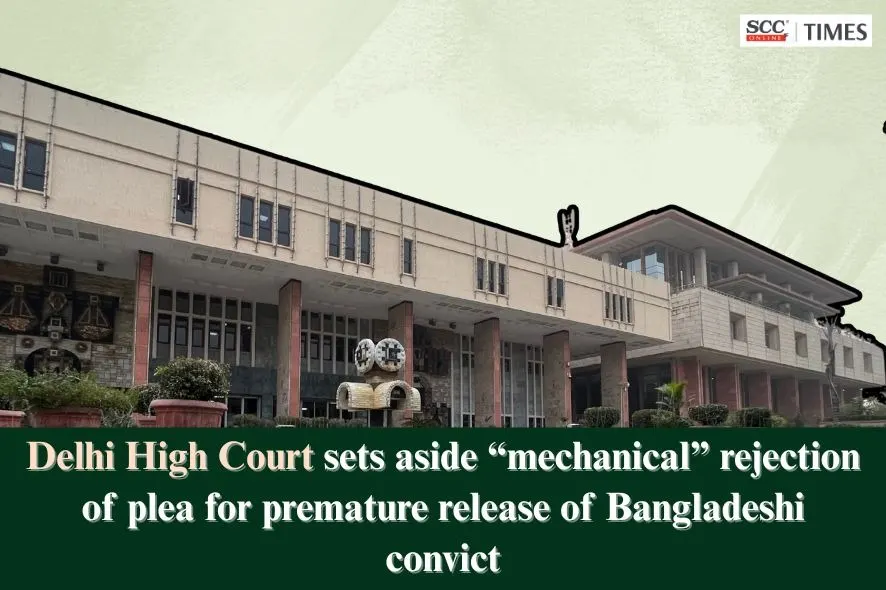
Delhi High Court: While hearing a petition under Article 226 of the Constitution, assailing the decision of the Sentence Review Board (SRB) recorded in the minutes of its meeting dated 30 July 2025 (impugned decision), whereby the SRB had rejected the petitioner’s request for premature leave, the Single Judge Bench of Sanjeev Narula, J., held that a rejection of plea for premature leave primarily on the gravity of offence without considering the petitioner’s custodial records or rehabilitative indicators was unsustainable and liable to be set aside.
Background
The petitioner, a Bangladesh national, by order dated 25 January 2010 had been convicted for offences under Sections 396, 449 and 34, Penal Code, 1860 (IPC). In 2021, the petitioner had been repatriated to Bangladesh to serve the remainder of his sentence.
Vide the impugned decision, the SRB had rejected the petitioner’s application for premature release on two grounds:
-
Firstly, the gravity and perversity of the crime; and
-
Secondly, the apprehension that the propensity to commit a similar crime cannot be ruled out.
The principal question before the Court was whether the Sentence Review Board (SRB), in exercising its discretion under the applicable framework, carried out the evaluative exercise required under the 2004 Policy and the Delhi Prison Rules, 2018 (Prison Rules), or whether the decision amounted to a mechanical rejection based primarily on the gravity of the offence and a speculative assessment of future risk.
Analysis, Law and Decision
At the offset, the Court explained the governing framework stating that the Prison Rules, Chapter XX on premature release, articulate the controlling objective in Rule 1244, namely, reformation and rehabilitation with societal protection, and place conduct and performance during incarceration at the heart of the evaluative exercise. Further, the 2004 policy, requires a comprehensive consideration covering:
-
family and social background,
-
the offence and circumstances of its commission,
-
prison conduct,
-
conduct on parole/furlough if any,
-
health, and
-
a recommendation supported by reasons.
Clause 3.1 of the 2004 Policy structures the eligibility timelines for premature release. In cases falling within the capital category, premature release is considered after completion of the prescribed period of incarceration inclusive of remission, subject to a minimum of 14 years’ actual imprisonment. In the category of heinous offences, including the offence for which the petitioner stood convicted, consideration arises only after completion of 20 years including remission; however, even in such cases, the policy clarifies that “the period of incarceration inclusive of remission should not exceed 25 years”.
The Court observed that the 2004 policy makes two features explicit. First, eligibility after the stipulated period of actual incarceration does not translate into automatic release, and the SRB retains discretion. Second, the discretion must be exercised by weighing the circumstances of the crime together with other relevant factors, including whether the convict has lost the potential for committing crime, the possibility of rehabilitation, and the socio-economic condition of the family. The policy also requires a comprehensive note dealing with the family and social background, the circumstances of the offence, prison conduct, and a reasoned recommendation. Thus, eligibility triggers consideration. It does not guarantee release. At the same time, the policy does not permit the SRB to treat the label of the offence as a veto that makes the rest of the inquiry redundant.
The Court noted that the Prison Rules reinforce the same approach stating that premature release is anchored in reformation, rehabilitation, and reintegration, while ensuring protection of society, and it recognises that conduct and performance in prison bear directly on rehabilitative potential. The Rules also contemplate that the SRB decision should be a speaking one, and caution against treating the police view as determinative in isolation.
The Court observed that such insistence on reasons is not a cosmetic requirement and stated that,
“A conclusion without an intelligible rationale disables scrutiny and breeds arbitrariness. In matters of premature release, the relevant considerations, such as the circumstances of the offence, antecedents, conduct in custody, and the likelihood of reoffending, are not mere formalities to be mechanically recorded. They constitute the foundation of the evaluative exercise.”
The Court held that the decision of the SRB rejecting the petitioner’s request for premature release was arbitrary and unsustainable. The SRB merely referred to the nature of the offence and concluded that release would not be in public interest, without providing a reasoned analysis. It failed to consider the petitioner’s custodial record, rehabilitative indicators, prison authorities’ recommendation in the commutation roll, and the fact of long and satisfactory incarceration.
The Court observed that the SRB’s assertion that the petitioner’s “propensity to commit a similar crime cannot be ruled out” was a bare and speculative statement unsupported by any material. There were no adverse antecedents, prison misconduct, or negative parole/furlough history indicating future risk. The police report relied upon by the SRB merely stated that the petitioner’s Delhi address could not be verified, which was not a valid assessment of future risk, particularly in the case of a repatriated prisoner whose reintegration would occur in the receiving State.
The Court emphasised that while the gravity of the offence is a relevant consideration, it cannot be the sole ground for refusing premature release once the policy eligibility threshold is met. The petitioner had already undergone over 21 years of actual incarceration and more than 27 years including remission, with consistently satisfactory prison conduct and no adverse material. The SRB failed to perform the balancing exercise required under the applicable policy and rules.
Since the matter had already been remanded once and the reconsideration suffered from the same defects, the Court declined to remand the case again. The Court held that conclusions regarding future criminality cannot rest on conjecture and that courts may issue a writ of mandamus where authorities fail to conduct a reasoned evaluation despite judicial directions.
Accordingly, the Court set aside the impugned decision and held the petitioner fit for premature release under the applicable framework. The Government of NCT of Delhi was directed to process the consequential release orders within two weeks and communicate the decision through the Ministries of Home Affairs and External Affairs to the authorities in Bangladesh for implementation under the bilateral repatriation arrangement.
[Asif v. State (NCT of Delhi), 2026 SCC OnLine Del 899, decided on 17-2-2026]
Advocates who appeared in this case :
For the Petitioner: Sarthak Maggon, Advocate
For the Respondent: Amit Tiwari, CGSC, Ayushi Srivastava, Ayush Tanwar, Kushagra Malik, Arpan Narwal, Kamakshi Sehgal, Advocates